
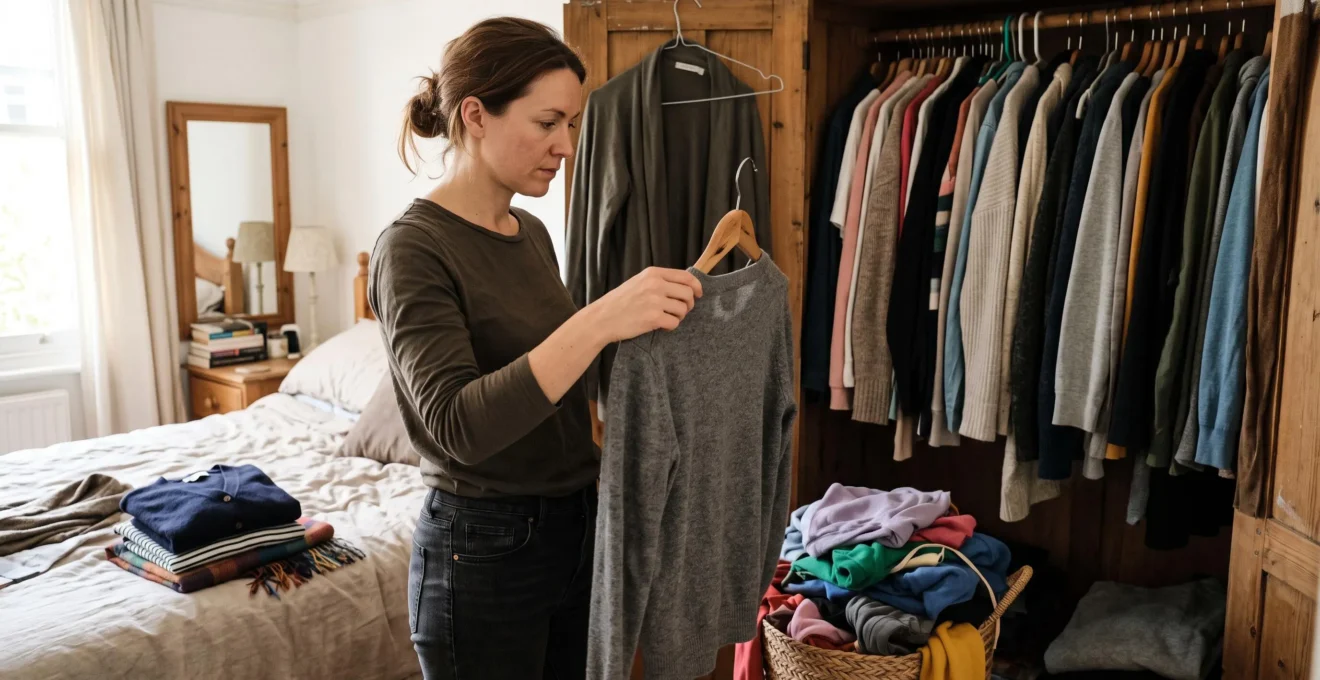
Shopping more thoughtfully doesn’t mean giving up fashion, buying only neutral basics or refusing yourself anything new. It means choosing clothes that genuinely improve your everyday wardrobe instead of repeatedly buying pieces that feel exciting for a moment but rarely get worn.
The difference is less about willpower than having a reliable way to make decisions. A realistic wardrobe audit, a short pause before purchasing and a budget built around your actual needs can help you spend less without making shopping feel like a punishment.
Thoughtful consumption also leaves room for pleasure. A colourful jacket, an unusual print or a beautiful pair of shoes can be a worthwhile purchase when you genuinely enjoy wearing it. The objective isn’t to own the fewest possible clothes. It’s to make the clothes you own more useful, comfortable and satisfying.
Start by understanding why your wardrobe can feel disappointing even when shopping itself feels rewarding.
Thoughtful shopping in three practical principles
- Buy for real outfits: identify where, when and how you’ll wear something before deciding it’s worth purchasing.
- Build in decision time: use a 48-hour pause for non-urgent purchases, then check for duplicates and genuine wardrobe gaps.
- Measure long-term value: consider expected wears, care costs, alterations and your seasonal budget rather than focusing only on the price tag.
- Why Does Shopping Feel Satisfying but Your Wardrobe Still Feels Wrong?
- How to Use a 48-Hour Rule to Stop Impulse Buys Without Missing Good Pieces?
- Tailor, Repair, Resell, or Replace: Which Is the Smart Move for a £120 Item?
- The Thoughtful-Shopping Mistake That Still Leads to Closet Waste
- When Should You Set a Clothing Budget So You Actually Stick to It All Season?
- New, Second-Hand, or Rental: Which Makes Sense for a 3-Time-a-Year Event Outfit?
- The Sale Trap That Quietly Doubles Your Wardrobe Clutter
- How Do You Stop Buying Clothes That Seem Right Online but Fail at Home?
Why Does Shopping Feel Satisfying but Your Wardrobe Still Feels Wrong?
Shopping can feel satisfying because choosing something new offers anticipation, novelty and an immediate sense of reward. But a wardrobe becomes satisfying through repeated use, not repeated purchases. If new clothes don’t suit your routine, fit comfortably or work with what you already own, the excitement of buying them may disappear long before their price feels justified.
Think about the difference between the moment you order a striking jacket and the morning you try to wear it. At checkout, you’re imagining how good it could look. Weeks later, you’re dealing with the weather, your commute, your shoes and the clothes that are actually clean. The purchase may have fulfilled a desire without solving a dressing problem.
A useful first exercise is to count the garments you wore during the last 30 days and compare that number with the clothes available in your wardrobe. Exclude items genuinely reserved for different seasons or specific occasions so the comparison stays meaningful.
Next, examine cost per wear: the amount paid for a garment divided by the number of times you’ve worn it. A hypothetical £90 jumper worn 45 times costs £2 per wear. A £30 top worn twice costs £15 per wear. The cheaper purchase delivered less use for each pound spent.
Try calculating this for your ten most frequently worn pieces and up to fifty of your least frequently worn pieces. For the rarely worn items, note whether the problem is fit, comfort, styling, maintenance or simply a lack of suitable occasions. Don’t treat recently purchased or seasonal items as failures before they’ve had a reasonable opportunity to be worn.
The distinction between wanting and needing is equally revealing:
- Wanting: a piece catches your attention because of a trend, a difficult day, an influencer or the appeal of novelty.
- Needing: a specific wardrobe gap repeatedly prevents you from putting together outfits you already want to wear.
Neither category is automatically wrong. Pleasure is a valid reason to buy clothes. The difference is whether you’re choosing that pleasure deliberately or mistaking the feeling of wanting something for evidence that it belongs in your wardrobe.
Another common pattern is buying near-duplicates. You love one pair of black trousers, so similar pairs keep appearing in your basket. Meanwhile, the practical shoes or layering piece that would complete several outfits remain missing.
Approximately 2.2 years
WRAP’s UK clothing guidance estimates this as the average garment lifetime in the research it references. It is a historical estimate, not a prediction for an individual garment or a verified 2026 average.
WRAP also identifies comfortable fit, repeated wear and appropriate care as factors associated with keeping clothing in use longer. Those priorities are more useful for everyday decision-making than assuming a higher price automatically means a better purchase.
Once you understand which purchases actually support your life, you can introduce a pause that protects your money without eliminating the enjoyment of discovering new clothes.
How to Use a 48-Hour Rule to Stop Impulse Buys Without Missing Good Pieces?
The 48-hour rule works best as a structured buying decision rather than a simple instruction to wait. Save the item, identify exactly where you’ll wear it, check what you already own and review your desire after two days. If the garment still solves a real wardrobe problem or offers pleasure you consciously value, buying it can be a thoughtful choice.
Start by removing the immediate checkout decision. Save the item to a wishlist rather than leaving it in an active shopping basket. Record its price, colour, size and the specific outfit you have in mind.
Instead of writing “nice shirt”, write something concrete: “Blue linen shirt to wear with my cream trousers and brown sandals for work and weekends.” If you cannot imagine a convincing outfit or occasion, that uncertainty is useful information.
A flexible waiting system can accommodate different buying situations:
| Purchase situation | Decision rule | What to verify |
|---|---|---|
| Regular full-price item | Wait 48 hours | Outfit compatibility, budget and existing alternatives |
| Discounted item filling a known gap | Use a 24-hour review window | Whether the item was needed before the discount appeared |
| One-off or limited-size find | Use a pre-written checklist | Fit, intended use, total cost and acceptable return risk |
| Unplanned trend purchase | Wait at least 48 hours | Whether the interest remains without social-media exposure |
These waiting periods are practical personal rules, not scientifically established thresholds. The shorter sale window should be an exception for a previously identified need, not a loophole for everything labelled limited stock.
Before the pause ends, search your wardrobe for alternatives. A visually different piece may already serve the same purpose. For example, two jackets with different cuts might still fill the identical role in your everyday outfits.
Review your wishlist once a week. Remove the items you no longer want, note the pieces that keep returning to mind and look for patterns. If several saved purchases address the same missing outfit component, you may have identified a genuine priority.
The main benefit isn’t proving that every impulse is irrational. It’s learning which desires last after the initial urgency fades.
Once a purchase passes that test, the next question is whether keeping, adapting or replacing an existing garment would deliver better value.
Tailor, Repair, Resell, or Replace: Which Is the Smart Move for a £120 Item?
For a £120 garment, the smartest choice depends on its condition, the cost of making it wearable and how often you’ll realistically use it afterwards. A modest repair or alteration may deliver better value than replacement, while expensive structural changes can be difficult to justify. Reselling makes sense when the garment no longer serves you and the expected proceeds outweigh the selling effort.
Start with the problem, not the original price. A blazer that’s slightly loose at the waist presents a different decision from one with badly proportioned shoulders or extensively damaged fabric.
Ask a tailor for an actual quotation before assuming a garment can be fixed economically. Straightforward work often includes shortening hems, taking in certain seams and adjusting sleeve length. Suitability still depends on construction, lining, seam allowances and fabric.
Shoulder reconstruction, major restyling or fundamentally changing a garment’s proportions can require much more labour. If the item also feels uncomfortable or doesn’t suit your lifestyle, even a successful alteration may not make it worth keeping.
The following comparison uses hypothetical costs and wear estimates, not market quotations.
| Option | Example financial outcome | Practical consideration |
|---|---|---|
| Tailor | £25 alteration for 25 future wears = £1 per additional wear | Worth considering if the adjustment makes the item reliably wearable |
| Repair | £15 repair for 15 future wears = £1 per additional wear | Depends on the garment’s remaining condition |
| Resell | £40 sale price minus £7 in selling costs = £33 recovered | Only attractive if the expected return justifies the effort |
| Replace | £120 replacement worn 40 times = £3 per wear | May be reasonable when the replacement fits substantially better |
For an existing garment, the original £120 is already spent. Compare the additional money required from today onwards with the expected additional use. For a replacement, include its purchase price and any necessary alterations. This avoids allowing a past expense to dictate a future decision.
Resale requires similar realism. A garment’s retail price doesn’t determine its second-hand value. Look at comparable completed sales, then subtract platform charges, shipping contributions and other selling costs that apply to you.
Finally, set a deadline for the familiar “I’ll fix it someday” pile. One season is a reasonable personal limit: arrange the repair, list the item for resale, or donate it if it’s still usable. Recycling or appropriate textile disposal may be needed for garments no longer suitable for use.
The important distinction is between preserving something you will genuinely wear and spending more money to preserve something you no longer want.
The Thoughtful-Shopping Mistake That Still Leads to Closet Waste
One of the easiest mistakes is treating a supposedly better purchase as an automatically useful purchase. Expensive, durable or responsibly produced clothing can still become closet waste if it doesn’t fit your body, routine or personal style. Researching materials and brands matters, but it doesn’t replace the more practical question: will you actually wear this garment?
Imagine buying a beautifully constructed blazer because you want a more polished wardrobe. You investigate its fabric, production standards and stitching. But most of your week involves working from home and wearing relaxed layers, and you already own a blazer for occasional formal meetings.
The missing step wasn’t product research. It was checking whether the new item had a convincing place in your existing life.
Before buying, answer three questions:
- Where could I realistically wear this in the next month?
- Which clothes and shoes I already own would I wear with it?
- Would I still want it if I stopped imagining a different lifestyle?
That final question catches aspirational purchasing. You might buy expensive activewear for a gym habit you haven’t started, formalwear for invitations you haven’t received or impractical shoes for a more glamorous version of your weekends.
There’s nothing wrong with changing your style or trying something new. The problem arises when buying the equipment becomes a substitute for actually developing the habit. If the new activity or lifestyle is uncertain, try it using what you already own, borrow a suitable item or begin with a small, versatile purchase.
A quarterly wardrobe audit can reveal which mistakes repeat. Review everything purchased during the previous season, separating worn from unworn items. For each unworn piece, identify the main reason: incorrect fit, inconvenient care, duplicate function, imagined occasion or changed preference.
This approach avoids treating every unworn garment as a personal failure. A change in circumstances can make an otherwise reasonable purchase less useful. What matters is whether repeated patterns could inform the next decision.
Your five-step quarterly wardrobe audit
- Create a purchase inventory: list the clothes bought during the previous season, with their prices and purchase dates.
- Check actual use: mark each item “worn” or “unworn” and record an approximate wear count where possible.
- Identify the obstacle: give every unworn piece one principal reason it hasn’t been used.
- Choose an action: label each item “wear”, “alter”, “resell” or “donate”, adding a deadline where appropriate.
- Write a buying rule: turn the most frequent purchasing mistake into one specific rule to apply next season.
The audit should produce a shorter list of better decisions, not a demand to replace everything that isn’t perfect.
With those patterns identified, you can build a clothing budget around the items that actually deserve a place in your spending priorities.
When Should You Set a Clothing Budget So You Actually Stick to It All Season?
Set your clothing budget before the season begins, when you can assess upcoming needs without reacting to sales or an empty wardrobe rail. Seasonal planning works well because clothing costs are uneven: replacing a winter coat may cost more than several ordinary months of shopping. A rolling allowance can help you prepare for larger purchases without forcing unnecessary spending in quieter months.
Start with your actual spending over the past two or three comparable seasons, using bank statements, order histories and receipts. Separate purchases you still value from those you regret or hardly wore.
Don’t simply repeat last year’s total. Use it to understand what your wardrobe required, which mistakes consumed money and which future expenses are foreseeable. Then set an affordable amount based on your current circumstances and essential financial commitments.
For example, if your hypothetical seasonal clothing budget is £240, you could allocate it across the season while keeping any unspent amount available for a planned larger purchase. That doesn’t mean you must spend £80 every month.
A rolling allowance lets unused money carry forward. If you spend £35 in the first month against an £80 monthly contribution, the remaining £45 stays available. It can help fund the planned coat, boots or replacement shoes later rather than encouraging a small purchase simply because money is available.
The principle is consistent with MoneyHelper’s advice on irregular expenses and budgeting, which recommends preparing for higher-cost periods and accounting for essential commitments. Its guidance addresses general budgeting, not research proving that seasonal fashion budgets outperform monthly limits.
A fixed spending envelope can also work when income is stable and clothing needs are predictable. The better system is whichever makes future purchases affordable and visible without encouraging debt or competing with necessities.
Decide in advance what happens if you go over budget. A useful breach protocol has three parts: pause discretionary purchases, review why the overspend happened and adjust the next period only if the plan remains financially realistic.
An unexpected essential replacement isn’t the same as repeated impulse shopping. Treat those situations differently rather than abandoning the budget after one difficult month.
Keep a separate shortlist of upcoming wardrobe needs, noting estimated costs and priority. This prevents a spontaneous purchase from quietly using money reserved for something important.
A useful budget should support choices rather than simply restrict them, especially when deciding whether occasional outfits are worth owning at all.
New, Second-Hand, or Rental: Which Makes Sense for a 3-Time-a-Year Event Outfit?
For an outfit worn around three times a year, compare the total cost and inconvenience of buying new, buying second-hand and renting across the number of events you realistically expect to attend. Rental can make sense for occasional statement pieces, second-hand purchases can offer better ownership value, and buying new can be reasonable when consistent fit and repeated use matter.
The crucial variable is expected wears, not the number of occasions for which you imagine the outfit might eventually be useful. Three annual events don’t necessarily justify three different outfits.
Consider this explicitly hypothetical comparison. Assume a new outfit costs £180, a second-hand alternative costs £75 including necessary adjustments, and a rental costs £45 per event including standard delivery and cleaning. Assume no additional charges, resale proceeds or changes in fit.
| Number of wears | Buy new (£180) | Buy second-hand (£75) | Rent (£45 per event) |
|---|---|---|---|
| 1 | £180 total; £180/wear | £75 total; £75/wear | £45 total; £45/wear |
| 3 | £180 total; £60/wear | £75 total; £25/wear | £135 total; £45/wear |
| 6 | £180 total; £30/wear | £75 total; £12.50/wear | £270 total; £45/wear |
Under these assumptions, second-hand ownership becomes cheaper than rental at two wears, while buying new becomes cheaper than repeated rental at four wears. These are mathematical break-even points for the example only, not universal purchasing thresholds.
Real prices and practical constraints can change the outcome considerably. Second-hand shopping requires time to locate the right size, assess condition and arrange any alterations. Private sellers may offer limited or no voluntary returns, so check the actual terms before committing.
Rental has different frictions: sizing uncertainty, delivery timing, cleaning conditions, damage liability and late-return charges. If you’ve never used a rental service, testing its sizing with a lower-stakes event is safer than relying on an unfamiliar fit for an important occasion.
Buying new usually offers a more predictable selection and the possibility of tailoring, but it also commits more money upfront. It makes stronger financial sense when you expect substantial repeated use.
WRAP’s textiles reuse guidance identifies rental as an option for short-term clothing needs and reports particular consumer interest in service-based models for formalwear. That doesn’t establish that renting is always cheaper or environmentally preferable.
A practical hybrid is to own one versatile base outfit while borrowing or renting distinctive additions. A simple dress, suit or pair of shoes might work repeatedly with different jackets, accessories or styling.
That arrangement also reduces pressure to look completely different in every photograph. Wearing a good outfit repeatedly is an ordinary and financially sensible choice.
Once you’ve decided what deserves a place in your wardrobe, discounts are easier to evaluate because a low price alone no longer makes something necessary.
The Sale Trap That Quietly Doubles Your Wardrobe Clutter
Sale shopping becomes a clutter trap when the discount starts to feel more important than the garment itself. A reduced price can make an unnecessary purchase seem sensible, even though it still consumes money and wardrobe space. The simplest defence is to decide what you need before browsing, then use promotions only when they reduce the cost of an already justified purchase.
Imagine finding a £70 jumper reduced to £28. The £42 discount looks appealing. But if you didn’t need or want that jumper before seeing the markdown, you’ve still spent £28 rather than saved £42 against a purchase you were genuinely planning to make.
Ask yourself: Would I buy this at full price? If the answer is no, investigate why. Perhaps it doesn’t fit your style or wardrobe. Alternatively, the item might be genuinely suitable but outside your full-price budget. In that case, the relevant question is whether you would still choose it at the discounted price without feeling rushed.
Discount shopping can also obscure the cumulative cost of small purchases. In a hypothetical example, five £20 sale items cost £100. If you regularly wear only one of them, the remaining £80 has produced little practical wardrobe value.
Calling this a trap doesn’t mean every discounted purchase is wasteful. Sales can be useful for obtaining a specifically planned item at a lower price.
Prepare a list before promotions begin, including:
- Specific missing garments, rather than broad categories such as “nice tops”.
- The size, fit and colour that would work with your existing clothes.
- A maximum total price, including delivery or necessary alterations.
- A realistic use case and expected frequency of wear.
- Minimum acceptable return conditions for uncertain purchases.
The US Federal Trade Commission advises shoppers to check deal terms, refund conditions and return costs, including policies that may differ for discounted merchandise. Its online shopping and returns advice is especially useful for understanding transaction risks, although legal protections vary between countries.
A sale purchase should meet your normal standards for quality, comfort and compatibility. Don’t lower those standards simply because the price has fallen.
If browsing discounts routinely leads to unplanned purchases, try shopping directly from your list and leaving promotional emails unopened until an identified need arises.
Even a carefully chosen bargain can disappoint, however, if it looks right on a product page but proves uncomfortable or impractical when it arrives.
What matters before your next online purchase
- Know the exact wardrobe role of the garment before judging its colour, price or promotional appeal.
- Assess the cost of getting the right fit, not just the amount charged at checkout.
- Protect your ability to return unsuitable items by checking the conditions before ordering.
How Do You Stop Buying Clothes That Seem Right Online but Fail at Home?
To avoid disappointing online clothing purchases, evaluate fit, fabric and styling compatibility before ordering, then test the garment carefully as soon as it arrives. Use your actual body measurements instead of relying on your usual size, inspect product photos for construction details and check the return policy. A short home fitting session can reveal problems that styled photographs hide.
Start with your measurements. Record the body dimensions relevant to the garment, such as chest or bust, waist, hips and inseam. Compare them with the seller’s size chart and, where available, the garment’s actual dimensions. A familiar letter size may represent different measurements across brands and designs.
Read product photographs as practical information. Check where waist seams fall, how trousers sit at the rise, where sleeves finish and whether the fabric hangs loosely or clings. Movement videos can show how material behaves when the model walks or sits.
Model height, garment length and stated sample size are useful reference points, but they cannot guarantee the same fit on your body.
Fabric composition deserves just as much attention as the silhouette. Fibre names offer clues, not guarantees: weave, knit structure, finishing, garment construction and care methods also affect comfort and performance.
- Cotton: can feel breathable and comfortable, but some garments wrinkle or shrink depending on construction and laundering.
- Viscose: often offers a fluid drape, while washing requirements and dimensional stability depend on the fabric and finish.
- Polyester blends: may offer easy care or wrinkle resistance, but comfort and moisture management vary with construction and blend.
- Knitted fabrics: can provide flexibility, although recovery, stretching and shape retention depend on the yarn and knit structure.
These are general textile characteristics, not predictions about every product. Check both the composition and care label instead of assuming a brand or price guarantees particular fabric performance.
Customer reviews can uncover details that polished product descriptions leave unclear. Prioritise reviews with photographs from buyers whose height, proportions or fit preferences resemble yours. Search for terms such as “sizing”, “stretch”, “thin” and “color” or “colour”, then look for recurring observations rather than treating one complaint as definitive.
When the parcel arrives, try the garment on in natural daylight. Photograph the fit from the front, side and back for your own reference. Combine it with three items already in your wardrobe to see whether it actually supports the outfits you imagined.
Spend around 30 minutes testing comfort at home if the garment and seller’s policy permit it. Sit, stand, walk and move your arms. Keep labels attached, avoid outdoor wear and follow the seller’s conditions for trying on and returning goods.
The 30-minute test is a practical suggestion, not a scientifically validated method for catching most clothing defects. It cannot reveal every problem that might appear after laundering or prolonged use.
Check the return deadline immediately, particularly for final-sale merchandise, international orders or products with special conditions. Keep the packaging and order confirmation until you’re confident the garment is suitable.
Finally, resist the temptation to keep something simply because returning it feels inconvenient. An uncomfortable garment doesn’t become better value by remaining in your wardrobe unworn.
For your next clothing purchase, choose one genuine wardrobe gap, identify the outfits it needs to complete and test the item against your budget, measurements and return requirements. Thoughtful shopping starts with a useful decision, not a perfect wardrobe.
Can you enjoy fashion trends while shopping more thoughtfully?
Yes. Thoughtful shopping isn’t about rejecting trends; it’s about choosing which ones genuinely suit you. Try styling an existing garment in a new way before buying something trend-led. If you still want the new piece, can afford it and expect to wear it, enjoying a trend can be a deliberate rather than impulsive decision.
How many clothes should a thoughtful wardrobe contain?
There is no universally correct number. The right wardrobe size depends on your climate, work, lifestyle, laundry routine and personal preferences. Evaluate whether your clothes are comfortable, useful and manageable rather than trying to achieve an arbitrary garment count. A wardrobe with more pieces that are regularly worn may serve you better than a smaller one full of compromises.
What if you genuinely enjoy shopping as a hobby?
You don’t have to abandon the experience. Separate the enjoyment of discovering fashion from the obligation to buy something. Browsing, trying new combinations, visiting second-hand shops or creating a wishlist can remain enjoyable without always ending in a purchase. A defined discretionary clothing allowance also allows room for occasional spontaneous choices.
Is buying second-hand always the most thoughtful choice?
No. Second-hand clothing can extend garment use and reduce demand for new purchases, but buying pre-owned pieces you never wear can still create unnecessary spending and clutter. Compare fit, condition, expected use, alterations and the total cost. Keeping and wearing a suitable garment you already own is often the most practical first option.
How can you restart thoughtful shopping after a spending slip?
Review the purchase without turning it into a judgement about your character. Check whether the item can still be returned, determine what triggered the decision and update your wishlist or budget accordingly. Then resume your usual decision process. One unplanned purchase doesn’t require abandoning an otherwise useful approach to shopping.