
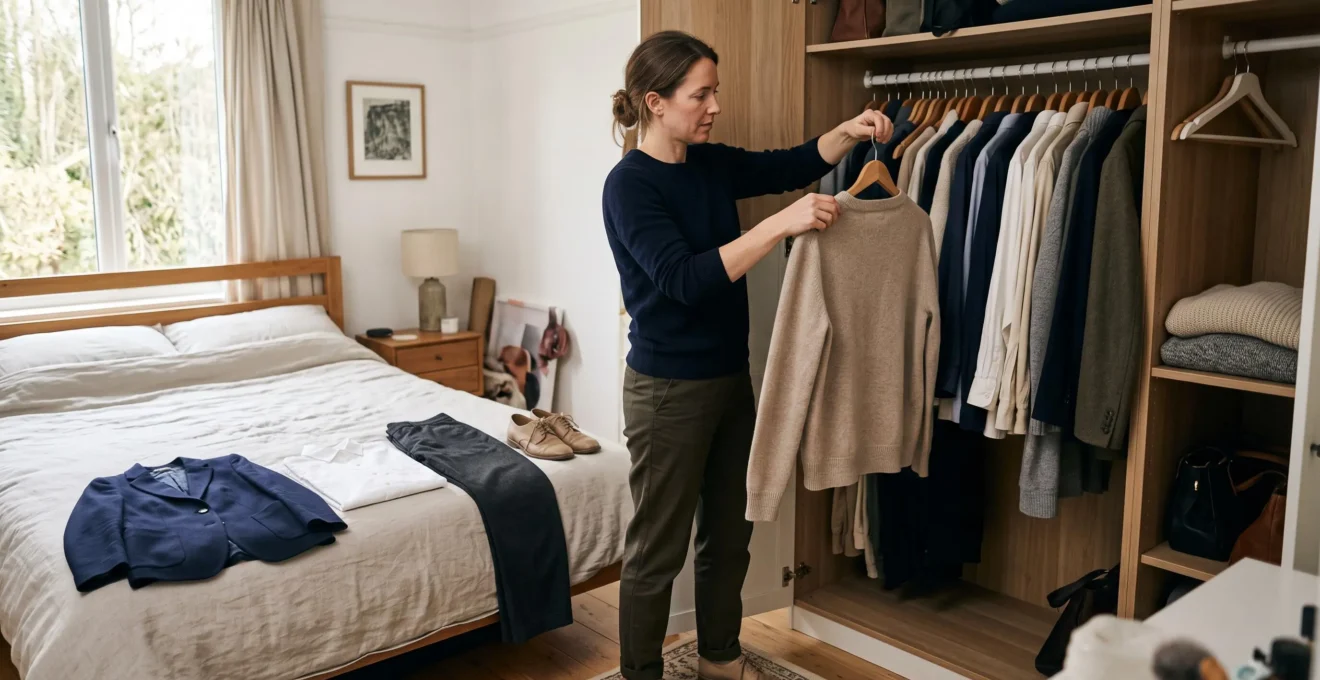
The wardrobe staples that give you the most outfit options for the least money are the pieces that work with several items you already own, suit your actual weekly activities, and withstand frequent wear. For many smart-casual wardrobes, that means well-fitting trousers, dark jeans, a versatile shirt, a plain top, a layering knit, and an adaptable jacket.
But the most economical six-piece wardrobe is not necessarily the cheapest six-piece shopping list. A budget T-shirt that coordinates with five existing outfits may deliver more value than an expensive blazer that only works for occasional meetings. Equally, a reliable pair of trousers worn throughout the week may justify a greater upfront investment.
The practical goal is to increase wearable outfit combinations per purchase, not simply reduce the number of garments hanging in your closet. That requires checking coordination, condition, comfort, and cost per wear before adding anything new. The following approach starts with the shoes and outerwear you already depend on, then builds a flexible wardrobe around real life rather than an idealized capsule.
The essentials for getting more outfits from less clothing
- Buy for compatibility: prioritize pieces that work with at least three other garments you own and your everyday shoes.
- Calculate cost per wear: consider expected use, durability, maintenance, and affordability rather than assuming premium always means better.
- Build around your schedule: use shared staples across work, weekend, and social or active clothing instead of forcing everything into one uniform.
- Why Do Your “Staples” Still Not Match Anything in Your Wardrobe?
- How to Choose 6 Staples That Work With Your Actual Shoes and Coat?
- One Premium Staple or 3 Budget Basics: Which Looks Better After 30 Wears?
- The “Wrong Basic” Mistake That Makes Each Outfit Look Slightly Off
- When Should You Replace Everyday Basics So They Don’t Drag Down Your Whole Look?
- How to Build a Capsule Wardrobe Using 3 Modules Instead of 1 Uniform?
- How to Choose One Pair of Shoes That Works With 80% of Your Wardrobe?
- How Do You Build a Capsule Wardrobe If Your Week Includes Work, Gym, and Social Plans?
Why Do Your “Staples” Still Not Match Anything in Your Wardrobe?
Your wardrobe staples may not match anything because they were purchased as individual essentials rather than as parts of a coordinated wardrobe. Even a well-made white shirt, neutral sweater, or classic pair of trousers can be difficult to style when its color, formality, proportions, or fabric texture conflicts with your existing clothes.
The word “staple” is often used as though it describes a universally useful garment. In practice, versatility is personal. A crisp white button-up may be ideal for someone who regularly wears tailored trousers, but less useful for someone whose week revolves around relaxed denim, soft knits, and casual footwear.
Start by checking three dimensions of compatibility:
- Color: does the garment complement your dominant neutrals and preferred accent colors?
- Formality: can it realistically be worn alongside your most frequently used shoes, trousers, and outerwear?
- Structure: do its proportions balance your usual fitted, straight, relaxed, or oversized silhouettes?
Then run a simple three-outfit test. Select three garments you consider staples and try to combine each with at least three different pieces you already own. Count only combinations you would genuinely wear, not combinations that technically fit together but feel uncomfortable or inappropriate.
The three-item threshold is a practical screening rule, not a scientifically established definition. A winter coat or specialized work garment may be worth keeping even if it passes fewer combinations. The useful question is whether a piece fulfills an important role without requiring unnecessary additional purchases.
Georgia State University‘s capsule wardrobe FAQ recommends starting with versatile garments, developing multiple combinations, and photographing outfits that work. Its guidance emphasizes adapting clothing to everyday needs rather than following a universally correct list of essentials.
A true staple is therefore repeatable, compatible, and appropriate for your lifestyle. A trendy item described as a must-have online may still be an isolated purchase in your own closet.
Once you know what already coordinates, the next step is to build around the garments that are hardest or most expensive to change: your main shoes and outerwear.
How to Choose 6 Staples That Work With Your Actual Shoes and Coat?
Choose six staples by starting with the shoes and coat you already wear most often, then selecting garments that match their color temperature, level of formality, and silhouette. For a smart-casual lifestyle, a useful starting set is a plain top, versatile shirt, fine knit, dark jeans, tailored trousers, and adaptable jacket.
This reverse approach prevents a common budgeting mistake: purchasing attractive basics and later discovering that your existing shoes or coat make the outfits feel inconsistent.
A practical six-staple shortlist might look like this:
| Staple | Wardrobe function | Compatibility check |
|---|---|---|
| Plain T-shirt or fitted top | Base layer for casual and layered outfits | Neckline and color suit your jacket and knit |
| Neutral button-up shirt | Works alone, under layers, or open over a top | Fabric and fit suit your main trousers |
| Lightweight knit | Adds warmth and changes outfit texture | Fits under your existing coat |
| Dark straight-leg jeans | Connects casual and smart-casual clothing | Hem and leg shape suit your shoes |
| Neutral tailored or structured trousers | Provides a more polished alternative | Works with your casual and dressier tops |
| Versatile blazer or casual jacket | Changes the formality of shared basics | Coordinates with your coat, shoes, and preferred layers |
This is a starting framework, not a prescription to purchase six new items. If a category already works, keep it. If blazers do not fit your lifestyle, a structured overshirt or cardigan may be more useful.
Before buying, compare each candidate against your two anchor items. A warm taupe coat may coordinate naturally with cream, olive, and certain browns, while a cool charcoal coat may pair more easily with grey, navy, and crisp white. These are starting combinations, not rigid color rules.
Next, compare formality. Minimal leather trainers can support relaxed tailoring, whereas highly technical running shoes may look out of place with a structured blazer. Finally, check proportions: a bulky knit needs enough room under the coat, and wide-leg trousers need footwear that balances their hem.
Keeping most of the six pieces within one dominant dress register, such as smart-casual, makes combinations easier. Specialized garments can remain outside this core.
Your five-step staple selection audit
- Identify your anchors: photograph your most-worn coat and primary shoes together. Deliverable: one reference photo.
- Choose your dominant dress code: label it casual, smart-casual, or professional based on your usual week. Deliverable: one written style category.
- Audit the six staple roles: identify which you already own and which are genuinely missing. Deliverable: a six-row keep-or-gap list.
- Build three realistic outfits: test your candidate items with your actual shoes and coat. Deliverable: three outfit photos.
- Prioritize only verified gaps: rank missing pieces by expected weekly use and number of compatible outfits. Deliverable: a short shopping list in priority order.
The strongest shortlist is the one that requires the fewest additional purchases. Once those gaps are identified, durability and cost per wear can help determine how much each missing piece deserves.
One Premium Staple or 3 Budget Basics: Which Looks Better After 30 Wears?
One premium staple does not automatically look better than three budget basics after 30 wears. The better option is whichever retains its shape, color, surface finish, and fit while meeting your actual clothing needs. Price alone cannot predict those outcomes, so compare expected frequency of use, construction, care requirements, and cost per wear.
For everyday clothing, cost per wear equals purchase price divided by the number of times the item is worn. It helps distinguish low purchase prices from long-term value, but its usefulness depends on realistic wear estimates.
Consider a hypothetical purchase decision. You have a $90 budget and are choosing between one $90 garment and three $30 basics. The amounts are illustrative, not observed product prices.
| Scenario | One $90 premium garment | Three $30 budget basics |
|---|---|---|
| Initial spending | $90 | $90 total |
| Usage assumption | 30 wears of the garment | 10 wears per garment, 30 total |
| Cost per wear | $3.00 | $3.00 per wear across the set |
| Appearance after use | Depends on fabric, construction, and care | Depends on fabric, construction, and care |
| Main advantage | Potentially useful for one heavily repeated role | More variation and rotation between items |
| Main limitation | Only one garment available | Quality and fit may vary between items |
In this example, both choices produce the same cost per wear over 30 total wears. If the premium item subsequently reaches 90 wears without replacement, its cost falls to $1 per wear. But that outcome must be earned through actual use and durability, not assumed from the price tag.
University of Bath research summary on clothing cost per wear describes six online experiments examining whether presenting cost-per-wear information changes clothing preferences. Participants showed greater preference for higher-quality clothing when that information was available, particularly for everyday items. The research measured preferences and intentions, not garments’ physical performance after 30 wears.
What cost-per-wear research actually shows
Research summarized by the University of Bath compared online purchase preferences under different ways of presenting garment value, including cost per wear.
Displaying cost per wear increased preference for higher-quality clothing despite higher upfront costs. The finding supports evaluating long-term usefulness alongside purchase price, but it does not prove that expensive garments last longer or that consumers ultimately wear them more often.
Physical quality deserves a separate assessment. Florida State University’s Textile Testing Lab identifies colorfastness, dimensional change, pilling, abrasion resistance, and fabric appearance among the properties used to evaluate textile performance.
These are useful inspection categories for shoppers, even though the laboratory information does not rank particular brands or price tiers.
For frequently washed T-shirts and fine knits, pay close attention to collar recovery, surface pilling, shrinkage, and color stability. For structured trousers or jackets, inspect seam quality, shape retention, lining where present, and ease of maintenance. Actual deterioration varies by material, construction, wearing conditions, and laundering.
A reasonable buying rule is to consider paying more when a garment fills a high-frequency role, fits well, and demonstrates convincing quality. If you expect to wear something only occasionally, multiple affordable options may provide more practical variety without requiring a premium purchase.
Weekly frequency is a personal decision aid, not a scientifically established investment threshold. Upfront affordability still matters: a theoretically low future cost per wear does not justify spending beyond your available budget.
Even a durable garment can underperform financially when it looks slightly wrong with the rest of your clothing. The next filter is visual coherence, which matters as much as construction when deciding whether something belongs in your core wardrobe.
The “Wrong Basic” Mistake That Makes Each Outfit Look Slightly Off
The wrong basic is often a garment that is individually attractive but visually inconsistent with the rest of an outfit. A mismatched white, unexpectedly shiny fabric, awkward silhouette, or overly formal detail can disrupt several otherwise coordinated combinations. The practical fix is to test basics within complete outfits before deciding they belong in your wardrobe.
These problems are easy to miss in a fitting room because clothing is usually assessed separately, under unfamiliar lighting, and without the shoes or layers used at home.
Consider three common mismatches:
- White and neutral undertones: a yellow-toned ivory shirt may look noticeably different from the crisp white layers you normally wear. That difference can be intentional, but it should be evaluated together.
- Fabric finish: a highly glossy top can feel disconnected from an outfit built around matte cotton, washed denim, and textured wool.
- Formality and proportions: a sharply tailored shirt may be harder to integrate with relaxed weekend trousers and chunky casual shoes than a softer, less structured version.
Fit introduces another problem. A T-shirt that is too long for your preferred trouser rise can make several outfits look unbalanced. Likewise, a bulky sweater may work alone but create uncomfortable proportions beneath your jacket.
The solution is a two-outfit home test. Try each new basic in one combination appropriate for your most common daily activity and another that represents a different context. Include the actual footwear, outerwear, and accessories you would use.
Photograph both outfits in natural light and evaluate the complete silhouette rather than focusing only on the purchased garment. If the item needs constant adjustment, an additional purchase, or an outfit you would rarely wear, its practical versatility is limited.
One incompatible basic can reduce the usefulness of several planned outfits, especially when it is intended as a shared layer. Still, a mismatch is not always a reason to discard clothing. Alterations, a different styling combination, or using the garment in another context may be more economical.
Remove it from the core rotation when it repeatedly fails the outfit test, but consider keeping, repairing, altering, or responsibly passing it on according to its condition and usefulness.
Once a garment passes the coordination test, maintaining its appearance becomes the next priority. A reliable staple eventually needs inspection, but replacement should depend on observable condition rather than an arbitrary calendar date.
When Should You Replace Everyday Basics So They Don’t Drag Down Your Whole Look?
Replace an everyday basic when visible wear, lost shape, or reduced comfort makes it unsuitable for its main purpose and repair or appropriate care cannot restore it. Common warning signs include stretched collars, distorted seams, persistent discoloration, significant pilling, and fabric thinning. There is no universal replacement schedule because use and care vary.
The age of a garment tells you less than its present condition. A frequently worn shirt may still look appropriate after extensive use, while another may develop noticeable problems sooner because of fabric characteristics, friction, laundering, or fit.
Inspect your most-used pieces for these practical signals:
- Neckline and shoulder distortion: collars that remain stretched or shoulder seams that no longer sit correctly.
- Color deterioration: conspicuous fading, uneven discoloration, or persistent marks that affect the garment’s intended use.
- Surface damage: significant pilling, abrasion, or thinning in high-friction areas.
- Seam and shape problems: twisted side seams, stretched hems, or persistent changes in fit after washing.
- Reduced function: discomfort, damaged closures, or a garment that no longer performs its intended role reliably.
Not every imperfection requires replacement. Some pilling can be carefully removed, minor seams repaired, and fit problems altered. A slightly faded item might also remain perfectly useful for casual activities even when it no longer meets a more formal dress code.
The European Environment Agency briefing on textile durability and circular design identifies longer garment life, durability, repairability, and reuse as important considerations for more circular textile consumption. This supports checking whether a garment can remain useful before automatically buying a replacement.
A manageable routine is to identify the garment you wore most frequently during the previous month and inspect it once per season. Assess its appearance, fit, fabric condition, and remaining usefulness. The goal is a quick review, not a rigid tracking system.
If a basic genuinely needs replacing, consider buying the same model again when its fit, compatibility, and durability have served you well. That reduces the uncertainty of changing silhouettes, colors, or fabric finishes. Check that the current version still matches the garment you liked, as product specifications can change.
For less visible signs of wear, consider reassignment before disposal: a shirt that is no longer polished enough for work may still function as a weekend layer, provided it remains comfortable and fit for use.
Careful replacement protects existing outfit combinations without forcing unnecessary purchases. With that maintenance routine established, the wardrobe can expand into separate activities while continuing to share a compact set of reliable basics.
How to Build a Capsule Wardrobe Using 3 Modules Instead of 1 Uniform?
Build a capsule wardrobe using three overlapping modules: work, weekend, and social or active life. Give each module enough clothing to function independently, then share versatile basics across them. This avoids a rigid uniform while reducing duplication, because the same trousers, shirt, or knit can serve different situations with a change of layers.
A single minimalist capsule often looks efficient on paper but becomes restrictive when one person needs both polished workwear and comfortable casual clothing. The problem is not necessarily the number of items; it is the assumption that one dress code can cover every activity.
Instead, organize your wardrobe by purpose:
| Module | Main clothing needs | Useful shared pieces |
|---|---|---|
| Work | Polished layers, suitable footwear, reliable fit | Button-up shirt, structured trousers, fine knit |
| Weekend | Comfort, practical layering, relaxed styling | Plain top, dark jeans, lightweight knit |
| Social or active | Context-appropriate presentation or movement | Clean denim, adaptable shirt, transitional outer layer |
The active module requires a distinction: everyday garments may bridge errands or casual social plans, but specialized exercise clothing still needs to meet the physical, comfort, hygiene, and safety requirements of the activity.
Next, identify two or three bridge pieces that connect your modules. A neutral button-up shirt can move from work trousers to weekend denim. A fine knit can be layered over a shirt for work or worn with jeans for informal plans. Dark, clean denim may connect casual and social outfits where the dress code permits it.
Each module should also remain usable when its shared pieces are unavailable. If your only suitable shirt is in the wash, the work module needs another workable outfit. If the weekend module depends entirely on trousers reserved for work, its supposed independence may be misleading.
Illustrative three-module wardrobe
Imagine someone who spends three days each week in a smart-casual office, uses weekends for errands and visits, and occasionally meets friends after work. This is a hypothetical planning example, not a documented consumer case.
Structured trousers, a shirt, and a knit form the work foundation. Jeans, a plain top, and the same knit support weekends. The shirt and jeans can then be combined with more polished footwear or an alternative jacket for suitable social occasions. Separate exercise clothing remains available when required.
This arrangement creates variety primarily by changing layers and context, not by purchasing a completely separate wardrobe for each activity.
There is no validated ideal three-module formula or universal number of bridge garments. Adapt the structure to your climate, dress code, laundry routine, and actual activities. Someone working remotely may need a larger casual module, whereas another person may require more specialized professional clothing.
The more modules share footwear, the less storage and spending may be required. However, shoes must satisfy comfort and context, not merely match the largest possible number of outfits.
How to Choose One Pair of Shoes That Works With 80% of Your Wardrobe?
Choose versatile shoes by comparing them with the outfits you actually wear, not just with individual garments. A mid-tone color, moderate level of formality, and silhouette that complements your usual trousers often provide a useful starting point. Treat 80% compatibility as a personal target to test, not a guaranteed result.
Footwear has an outsized influence on outfit coordination because it affects both perceived formality and proportions. Even a neutral pair can look awkward if its shape conflicts with the cut or length of most of your trousers.
Evaluate three characteristics before deciding:
- Color: a mid-tone taupe, grey, brown, or other compatible neutral may bridge lighter and darker outfits, depending on your existing palette. Black or white can also be highly versatile when those colors dominate your wardrobe.
- Formality: choose a style suitable for your most frequent setting. Minimal leather trainers, understated loafers, or simple ankle boots can work across multiple casual and smart-casual outfits, subject to your dress code.
- Silhouette: check how the shoe looks with your most-worn leg shapes. Wide, straight, and slim trousers can create different visual balances with the same footwear.
The most reliable method is a two-week outfit audit. List the complete outfits you actually wore over the previous 14 days, including repeated combinations. Then count how many could realistically be finished with the candidate shoes.
For example, suppose a hypothetical two-week log contains ten outfit occasions and one pair works appropriately with eight of them. That produces an 80% compatibility rate for that log. If it works with only six, the result is 60%. These are illustrative calculations, not performance figures for any shoe type.
Count both appearance and function. Shoes that visually match an outfit but are uncomfortable for the required walking, unsafe for the activity, or unacceptable under a workplace dress code should not qualify.
A neutral pair may cover more combinations, while a distinctive pair may express your preferred style more clearly. Neither objective is inherently better. The important decision is whether maximizing combinations or adding personality matters more for that particular purchase.
One pair also need not serve literally every occasion. Running, physically demanding work, severe weather, and formal events may require specialized footwear. The practical goal is to reduce unnecessary duplication while retaining suitable options.
Once your core shoes and shared clothing are compatible, the remaining challenge is operational: getting dressed efficiently when work, exercise, and social plans compete for time.
What to remember before organizing a busy week
- Plan around transitions: identify when your day changes dress code instead of treating every activity as a separate outfit.
- Keep specialized clothing where necessary: shared staples reduce duplication, but appropriate exercise or protective clothing still matters.
- Prepare the sequence, not just the outfit: laundry availability, packed shoes, spare layers, and timing determine whether a small wardrobe works in practice.
How Do You Build a Capsule Wardrobe If Your Week Includes Work, Gym, and Social Plans?
Build your capsule wardrobe around typical days rather than clothing categories. Map when you move between work, the gym, errands, and social events, then identify garments that can stay on across compatible activities. Keep specialized workout clothing separate where necessary and prepare changes in advance to reduce friction during busy days.
A conventional capsule list might include a certain number of shirts, trousers, and jackets without explaining how they function when an ordinary Tuesday includes an office meeting, exercise, and dinner. A schedule-based approach starts with the day’s transitions instead.
Begin by identifying recurring patterns, such as work followed by exercise, exercise followed by a casual meal, or a weekend errand followed by a social visit. For each pattern, ask which clothing can remain appropriate and which pieces must change.
Some versatile garment categories can simplify these transitions:
- Presentable performance-oriented knits: depending on their fabric and finish, some are suitable for travel, commuting, or casual office settings. They do not automatically replace purpose-built gym clothing.
- Comfortable structured trousers: suitable stretch, appropriate construction, and a versatile cut can allow them to transition between commuting, work, and informal plans.
- Transitional jackets: an adaptable overshirt, cardigan, or lightweight jacket can change an outfit’s presentation without requiring a complete change of clothes.
- Shared underlayers: simple tops can work across several non-exercise settings when clean, comfortable, and appropriate for each context.
For a hypothetical work-gym-dinner day, start with structured trousers, a simple top, a polished layer, and suitable work shoes. Pack exercise clothing and athletic footwear separately. After the gym, change into clean appropriate clothing, then adapt the original outfit for dinner if circumstances allow.
The advantage is not wearing one outfit throughout every activity. It is limiting unnecessary changes while maintaining hygiene, comfort, and suitability.
A reliable system also requires some logistical redundancy. If every module depends on a single shirt or pair of trousers, one laundry delay can disrupt several days. Maintaining a small number of proven alternatives may be more economical than repeatedly buying emergency replacements.
Try preparing clothing in daily blocks the evening before. Check the weather, intended activities, dress requirements, and laundry status. Lay out the first outfit, pack any mandatory change of clothes, and confirm that the footwear needed for each activity is available.
Over time, photograph successful combinations and note which garments repeatedly remain unused. Those records reveal whether a proposed staple is actually supporting your week or merely occupying space.
The most useful capsule wardrobe is not necessarily the smallest. It is the smallest practical collection that supports your recurring activities, coordinates consistently, and remains manageable between laundry cycles.
For your next step, photograph the coat, shoes, and six garments you wear most often. Assemble three outfits for the coming week using only those pieces, then identify the single compatibility problem that prevents another useful combination. Solve that gap before adding anything else to your shopping list.
How many wardrobe staples should a beginner own?
There is no universal ideal number. Six core staples provide a manageable starting exercise, but the appropriate total depends on climate, dress code, laundry frequency, and lifestyle. Georgia State University’s capsule wardrobe guidance mentions approximately 35 pieces as an illustrative capsule size while acknowledging that individual needs vary. Start by identifying what you already use before setting a numerical target.
Are neutral clothes always more versatile than colorful clothes?
No. Neutral colors can simplify coordination, but a consistent palette containing favorite colors can also produce many wearable combinations. Versatility depends on whether garments work together and suit your personal style. A colorful shirt that complements most of your existing trousers may be more useful than a neutral one that does not.
Should you count jackets, coats, and shoes in a capsule wardrobe?
You can include them when assessing the overall wardrobe, but counting conventions vary. For practical shopping decisions, it is more useful to evaluate shoes and coats as essential outfit components, even when you keep them in separate categories. They influence which other purchases will coordinate successfully.
Does buying secondhand clothing make a capsule wardrobe cheaper?
Secondhand clothing can reduce upfront spending when a suitable garment is available at a lower price, but the value depends on condition, fit, remaining useful life, and any alteration or cleaning costs. Use the same compatibility and durability checks you would apply to a new item rather than purchasing something simply because it is discounted.
How do you avoid getting bored when wearing the same staples repeatedly?
Keep the foundations consistent while varying layers, accessories, textures, and proportions. A shirt can look different under a knit, open over a plain top, or paired with another trouser silhouette. Record combinations you enjoy and allow room for a small number of distinctive pieces. A practical capsule should support your preferred style rather than eliminate variety.