
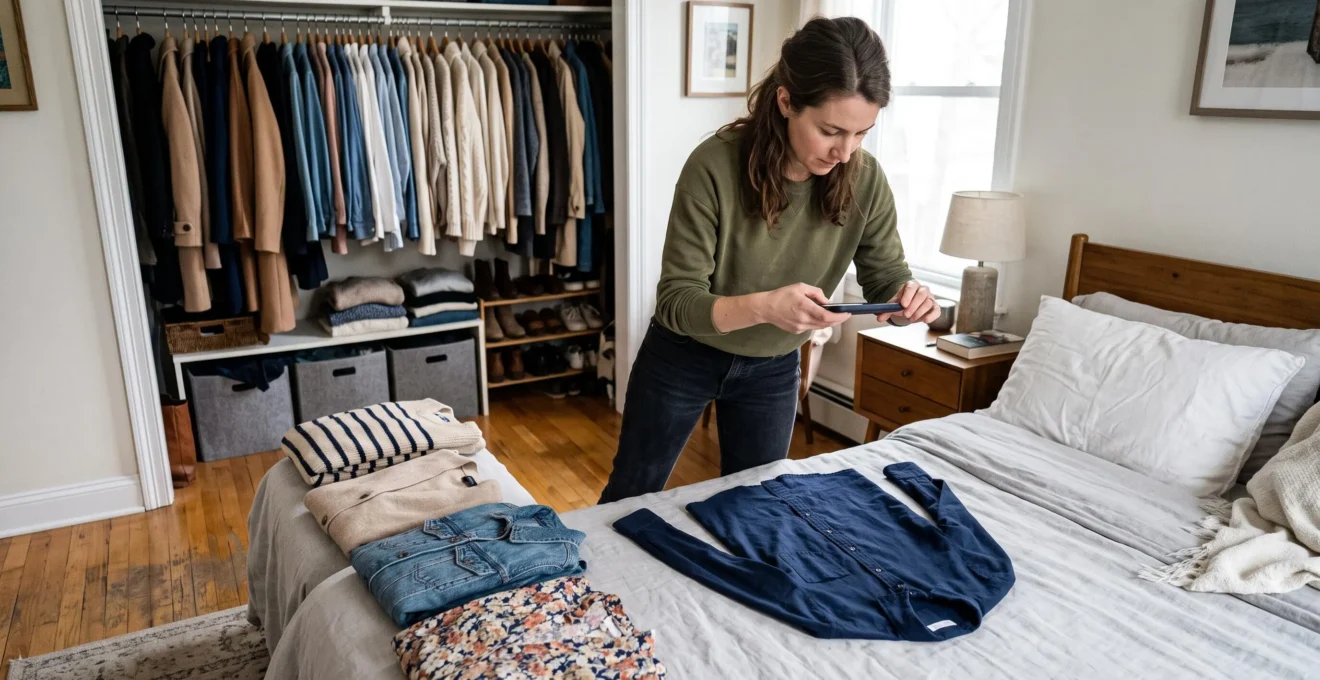
Creating 20 new outfit combinations without buying anything starts with changing how you see your wardrobe. Instead of treating familiar outfits as fixed sets, separate your clothes into interchangeable pieces, photograph them, and test new pairings using a few consistent styling rules.
A wardrobe containing five tops, four bottoms, two layers and three pairs of shoes offers 120 theoretical combinations when selecting one item from each category. Not all will suit your body, the weather or the occasion, but even a fraction of those possibilities can produce noticeably more variety than the handful of looks you repeat automatically.
The goal is not to force every garment to work with everything. It is to discover combinations that already make sense, identify why others fail, and save the successful looks so they become easy choices. A phone camera, a short planning session and a 30-second outfit check are enough to build a repeatable system.
How to unlock 20 outfits from your existing wardrobe
- Photograph your clothes by category and use a simple compatibility filter to identify at least 20 combinations worth trying.
- Alternate between shoes and outerwear as starting points, then balance silhouette, formality, colour and texture.
- Save successful outfits, plan around your actual schedule and make one adjustment rather than rebuilding a look from scratch.
- Why Do You Wear Only 20% of Your Possible Outfits?
- How to Build an Outfit Combination Matrix in 15 Minutes With Your Phone Camera?
- Start With Shoes or Outerwear: Which Creates Better Outfit Combinations?
- The Combination Mistake That Makes an Outfit Look “Off” Even When Colours Match
- When Should You Plan Outfits for the Week to Save 30 Minutes of Morning Stress?
- How to Turn Your Weekly Schedule Into a Shopping Checklist in 20 Minutes?
- How to Check Visual Coherence in 30 Seconds Before You Leave the House?
- How Do You Make an Outfit Look Coherent When You Mix Smart and Casual Pieces?
Why Do You Wear Only 20% of Your Possible Outfits?
You may wear only a small fraction of your possible outfits because your brain remembers familiar combinations rather than every garment’s potential. Clothes hidden from view, assigned to one occasion or repeatedly paired with the same pieces stop entering your daily decisions. The 20% figure is a useful personal question, not a universal statistic.
The difference between wardrobe size and outfit variety is mathematical. Every additional compatible category increases the number of potential combinations multiplicatively. Yet people often think in complete looks: the jeans-and-jumper outfit, the office trousers-and-shirt outfit, or the dress reserved for an evening event.
Once a pairing works, it becomes a convenient default. That helps when you are rushing, but it can also prevent experimentation. The solution is to give individual garments a second chance to participate in different looks.
Visibility matters too. A jacket kept in a storage bag or a blouse mentally labelled “special occasions only” may be perfectly wearable yet effectively absent from your everyday choices.
Approximately 30%
Historical UK findings reported by WRAP indicated that approximately 30% of clothing in wardrobes had not been worn for at least a year. This refers to garments, not to the proportion of possible outfit combinations used, and is not a current universal estimate.
WRAP’s Love Your Clothes initiative, an archived clothing-use campaign.
Find your own utilization rate by counting wearable garments you own, then counting how many you actually wore during the past month. Divide the second number by the first and multiply by 100. monthly garment-use rate reached 40% in the example of wearing 30 of 75 wearable items. This does not measure your outfit-combination rate, which requires tracking distinct looks separately.
Next, write down ten outfits you already wear. Identify which pieces appear repeatedly and which scarcely appear at all. That simple comparison reveals the starting point for building more variety.
A low utilization rate does not automatically mean you need fewer clothes. It may mean that you need a better way to see and recombine what is already there.
How to Build an Outfit Combination Matrix in 15 Minutes With Your Phone Camera?
Build a basic outfit combination matrix by photographing your clothes individually, sorting the images into tops, bottoms, layers and shoes, and comparing them across categories. In 15 minutes, you can make a useful starter version using your most frequently worn pieces. The aim is not to catalogue everything immediately, but to make new pairings easy to identify.
Start with a plain background, such as a neutral bedsheet or uncluttered floor. Photograph each garment flat, from the same approximate distance and in consistent lighting. Avoid elaborate styling: you need to recognise the garment, its shape and its colour.
Create four phone albums named Tops, Bottoms, Layers and Shoes. Dresses can form a fifth album if they are an important part of your wardrobe. Each album becomes one row of a visual combination matrix.
Suppose you photograph five tops, four bottoms and two pairs of shoes. These categories yield 40 theoretical three-piece combinations. Rather than examining every possibility equally, start by removing pairings that obviously fail.
Use three filters in sequence:
- Silhouette: Can the garments balance each other’s volume, length and shape?
- Formality: Do the fabrics, construction and details communicate a compatible level of dressiness?
- Colour temperature: Do the warmer and cooler shades create an intentional relationship rather than an accidental clash?
These are practical styling filters, not universal scientific rules. A combination that initially looks unusual may still work when worn.
Your five-step wardrobe matrix checklist
- Photograph five tops individually and save five recognisable garment images.
- Photograph four bottoms and two pairs of shoes, creating six additional images.
- Sort all 11 photographs into category albums, producing three browsable groups.
- Test combinations against silhouette, formality and colour, then record 20 candidate outfits in a note or photo album.
- Wear-test the candidates and save successful full-length outfit photographs in a dedicated album named Proven Outfits.
Keep the matrix alive. Remove photos when garments leave your wardrobe, and mark three successful combinations each week so the album gradually reflects what you enjoy wearing.
If even a starter catalogue feels excessive, photograph only five or six anchor pieces, such as favourite shoes, coats and versatile bottoms. Build outward from those rather than recording every garment.
The matrix is valuable only when it leads to actual outfits. The next step is choosing which garment should lead each combination.
Start With Shoes or Outerwear: Which Creates Better Outfit Combinations?
Start with shoes when your main constraint is the occasion or when unused bottoms and dresses need new pairings. Start with outerwear when weather, layering or unused tops dominate your wardrobe decisions. Neither approach is universally better: shoes influence proportion and practicality, while outerwear establishes volume and much of the outfit’s visible colour story.
Shoes can determine whether cropped trousers, wide-leg jeans or a particular dress feels balanced. They also establish practical limits: footwear suitable for a long commute may differ from what you choose for a formal appointment.
Outerwear changes the outfit’s overall shape. A long coat, cropped jacket and relaxed overshirt create different proportions even when everything underneath stays the same. Outerwear also needs to accommodate the weather and the thickness of other layers.
Use your existing wardrobe imbalance as a guide. If several bottoms rarely get worn, test them with different shoes. If you have neglected knitwear, shirts or mid-layers, try pairing them with contrasting coats and jackets.
The most versatile anchor is not always the most useful. Starting every outfit with the same plain sneakers or neutral coat can produce numerous technically different combinations that still look almost identical.
Choose anchors that create contrast. For example, rotate between structured boots, minimal trainers and dressier shoes rather than building every look around one safe option. With coats, alternate between longer and shorter shapes where weather permits.
| Decision factor | Start with shoes | Start with outerwear |
|---|---|---|
| Main constraint | Occasion, walking needs and trouser proportions | Weather, layering and overall volume |
| Useful for recombining | Bottoms and dresses | Tops and mid-layers |
| Variety strategy | Alternate footwear shapes and formality | Alternate jacket lengths and structure |
| Potential limitation | Can exclude outfits that require different footwear | Can overwhelm garments with incompatible volume |
Make the anchor decision the previous evening whenever possible. Otherwise, reaching automatically for the nearest shoes or coat can narrow your options before you have considered them.
Once an anchor is selected, the remaining pieces still need to work together visually. That is where a few diagnostic rules become useful.
The Combination Mistake That Makes an Outfit Look “Off” Even When Colours Match
An outfit can look wrong despite matching colours because its pieces communicate conflicting levels of formality, proportions or textures. A highly polished tailored item alongside an extremely casual garment may feel unbalanced without a connecting element. Check fabric sheen, structure, detail density and silhouette before assuming the problem is colour.
Consider a sharply pressed pair of suit trousers worn with a faded graphic sweatshirt, heavily detailed trainers and an embellished bag. The colours might coordinate, yet several competing signals can make the outfit difficult to read.
Instead of declaring the pieces incompatible, identify which visual qualities are in conflict:
- Fabric sheen: Polished wool, satin and glossy leather can feel more formal than heavily washed cotton or distressed denim.
- Structure: Tailored shoulders and crisp pleats communicate something different from slouchy, oversized pieces.
- Detail density: Large logos, visible zips, decorative hardware and embellishments can create several competing focal points.
Proportion creates another potential problem. Two extremely loose pieces may obscure shape, while several rigid pieces can make an outfit appear stiff. Neither pairing is automatically wrong, but introducing a counterpoint can make the result more intentional.
Try a soft knit with tailored trousers, or add a structured bag to an otherwise relaxed look. These changes create contrast without demanding a completely new outfit.
Colour research offers another reason not to pursue perfect matching. The PLOS ONE study on outfit color coordination, published in 2014, reported that moderately coordinated colours received more favourable fashionability judgements than combinations that were either extremely matched or strongly mismatched in the conditions studied. This does not establish a universal styling formula.
Apply a three-point diagnostic to your outfit photograph:
- Does one garment or visual element clearly lead the look?
- Is there useful contrast in texture, softness or structure?
- Is there one dominant focal detail rather than several competing ones?
Treat these as practical questions, not rigid requirements. Minimalist and maximalist outfits can succeed through different visual strategies.
Finally, remember that flat-lay combinations cannot reveal how clothes drape, overlap or move. A pairing that looks excellent in your phone album may need adjustment when worn.
Saving the combinations that pass this test makes future outfit planning much easier, especially on mornings when time is limited.
When Should You Plan Outfits for the Week to Save 30 Minutes of Morning Stress?
Plan your most demanding outfits during one weekly preparation session, then confirm weather-sensitive details the evening before wearing them. Planning the entire week rigidly can fail when conditions change, while choosing everything each morning recreates the original problem. A flexible two-block plan helps reduce decisions without locking you into unsuitable outfits.
First, identify two or three days that impose the most constraints. These might involve an important meeting, extensive walking, a social event or a long commute. Choose a complete combination for each of those days from your saved outfit matrix.
For less demanding days, select only the main anchor and keep two compatible tops or accessories available. You maintain variety without treating every day as a styling project.
Weather is an important reason to leave part of the plan open. According to the Met Office‘s explanation of 10-day weather forecasts, short-range forecasts cover approximately one to three days, while longer-range predictions involve increasing uncertainty. Reviewing outerwear and footwear closer to the day is therefore sensible.
A practical routine might look like this:
- Choose a weekly planning moment connected to an existing habit, such as checking your calendar.
- Mark the two or three days requiring specific clothes.
- Select proven outfits from your phone album for those days.
- Choose likely shoes and outerwear for the remaining days, keeping alternatives available.
- Review the next day’s weather and make any final adjustments the previous evening.
The 30-minute saving is a target, not a documented guarantee. Record how long you normally spend choosing clothes, then compare it with your planned-outfit routine over several mornings. Your actual saving may be smaller or larger depending on your habits.
Research summarized by the American Psychological Association has examined how making multiple decisions can affect performance on subsequent demanding tasks. The findings do not directly demonstrate benefits from outfit planning, but they offer a reason to experiment with making routine choices in advance.
Crucially, your weekly plan should draw from combinations you already generated and tested. Otherwise, you may simply move the same lengthy decision-making session from morning to evening.
Once your schedule exposes recurring clothing difficulties, you can distinguish a genuine wardrobe gap from a combination you simply have not tried.
How to Turn Your Weekly Schedule Into a Shopping Checklist in 20 Minutes?
Turn your weekly schedule into a shopping checklist by identifying occasions your current outfit combinations cannot cover, then defining the missing clothing function rather than immediately choosing a product. Spend 20 minutes reviewing your calendar, testing existing alternatives and ranking unresolved gaps. Because the goal is to avoid buying anything, treat this as a diagnostic list, not a purchase instruction.
Begin with your upcoming commitments. Mark any day when none of the combinations in your phone album appears suitable. Before assuming something is missing, examine why existing outfits do not work.
For example, an outfit might be too casual for a meeting, uncomfortable for extensive walking or insufficiently adaptable to changing temperatures. Each problem suggests a specific function rather than a particular garment.
Next, identify isolated pieces: clothes that currently appear in very few workable combinations. A formal skirt worn only with one blouse or a jacket reserved for one occasion could indicate a missing connector. Equally, the missing connection might already exist among clothes you rarely use.
Organise the exercise into four five-minute stages:
- Review the coming week’s occasions and note any clothing constraints.
- Check saved outfits against those constraints and identify uncovered situations.
- Search your existing wardrobe for garments that could connect otherwise isolated pieces.
- Write any unresolved gaps as functional roles and rank them by how many existing combinations they could unlock.
Imagine a hypothetical wardrobe where a fine-gauge knit could connect tailored trousers, jeans and a structured jacket. The useful checklist entry is “a layer that bridges formal and casual outfits.” Before considering shopping, check whether an existing jumper, cardigan or shirt can perform that role.
Prioritise combination value over novelty. A potential addition should solve several genuine problems rather than merely look appealing in isolation. If a role remains unfilled, leave it on the list for a few days and repeat the wardrobe check before taking any purchasing action.
This cooling period makes the checklist a safeguard against impulse buying. Some apparent gaps disappear once you start experimenting with pieces you previously considered incompatible.
The strongest outcome is a checklist with nothing to buy and several new outfit ideas ready to wear-test.
How to Check Visual Coherence in 30 Seconds Before You Leave the House?
Check visual coherence in 30 seconds by following the same sequence every time: silhouette, colour relationships, texture and focal point. Use a full-length mirror or quick photograph to see the outfit as a whole. If something appears wrong, change only one element and reassess rather than starting the entire outfit again.
Begin with silhouette. Check where your top ends, how your trousers or skirt fall, and whether your shoes visually support the proportions. This is often more useful than scrutinising individual garments.
Next, look at colour. Ask whether the shades create an intentional relationship, not whether everything matches exactly. A restrained outfit may benefit from one contrasting shade, while a colourful outfit may need a quieter supporting piece.
Then consider texture. Smooth leather against knitwear, crisp cotton against denim or a soft layer over tailored trousers can create visual interest. Finally, identify the main focal point and decide whether other details support it.
A full-length phone photo can make these relationships easier to judge. Stand far enough from the mirror to see your complete silhouette. Look at the overall image rather than zooming in on individual features.
If your jacket overwhelms the outfit, try removing it or replacing it with a shorter layer. If your shoes interrupt the proportions, test another pair. Make one adjustment at a time so you can identify which change actually improves the look.
Do not confuse unfamiliarity with incoherence. An outfit created through your new matrix may feel unusual simply because you have not worn that particular combination before. If it suits the occasion, fits comfortably and passes your diagnostic, give it a genuine trial.
With that routine in place, even combinations involving very different clothing styles become easier to evaluate.
Key takeaways before mixing smart and casual clothes
- Choose which style should dominate before adding contrasting pieces, so the outfit has a clear direction.
- Look for connecting garments already in your wardrobe instead of assuming formal and casual pieces cannot work together.
- Judge the complete outfit on your body; photographs of individual garments are starting points, not final proof of compatibility.
How Do You Make an Outfit Look Coherent When You Mix Smart and Casual Pieces?
Make smart-casual combinations coherent by choosing a dominant dress code and introducing a smaller number of contrasting pieces that connect naturally. For example, pair tailored trousers with a relaxed knit and clean trainers, or wear a casual hoodie beneath a structured coat. Balance comes from intentional relationships, not from splitting the outfit into equal formal and casual halves.
A useful starting heuristic is roughly two-thirds of one style and one-third of the other. This is a styling exercise rather than a scientifically established proportion, and the balance does not need to be calculated precisely.
If you want the outfit to feel primarily smart, lead with tailored trousers and a structured layer. Introduce one relaxed garment, such as a fine knit or minimal trainers. If you want a primarily casual outfit, begin with denim and relaxed separates, then add a blazer or polished leather accessory.
Some garments naturally bridge both registers:
- Unstructured blazers add tailoring without the rigidity of a complete suit.
- Clean, minimal trainers can accompany casual denim or more polished trousers.
- Fine-gauge knits provide a soft transition between structured and relaxed garments.
- Simple leather bags, belts and shoes can visually connect different levels of formality.
The most common difficulty arises when every element sends a different message. Combining strongly casual trousers, formal shoes, a sporty jacket, an embellished bag and a business shirt can produce unnecessary competition.
Instead, mix styles mainly through the core garments while keeping shoes, bag and outerwear broadly aligned with the dominant register. This creates a clearer hierarchy without eliminating personality.
Your combination matrix makes these experiments especially valuable. Pieces you once assigned to completely separate occasions may create your freshest outfits when paired together.
Try the same tailored trousers with a formal shirt, a relaxed knit and a simple T-shirt. Change the shoes or outerwear for each version, then photograph the results. Repeat this process with other garments that currently have only one familiar pairing.
Do not keep a combination merely because it looks inventive. Comfort, movement, dress-code requirements and personal preference still matter. Save only the outfits that work in real life.
Choose five garments you have not worn together before, generate several pairings from their existing companions, and wear-test the strongest options this week. Keep saving successful looks until your Proven Outfits album contains 20 combinations you would genuinely wear again, without purchasing a single new item.
How many clothes do you need to create 20 different outfits?
There is no fixed minimum that guarantees 20 wearable outfits. As a hypothetical example, five tops, four bottoms and two pairs of shoes yield 40 theoretical combinations. You need at least half of those pairings to work for your preferences and practical requirements to reach 20 wearable looks. Additional layers and accessories can create further variety.
Can accessories make an outfit count as a genuinely different combination?
Yes, when the change meaningfully affects how the outfit looks or functions. Replacing a casual bag with a structured one, adding a prominent belt or changing footwear may alter the overall effect. For a useful wardrobe catalogue, distinguish major garment combinations from minor accessory variations rather than counting every tiny change as a new outfit.
What should you do with clothes that never work in your combinations?
First check whether the problem is fit, comfort, condition, occasion or a missing connection with other pieces. Try the garment with different shoes, proportions or layers and assess it on your body. If it remains unsuitable, consider alteration, repair, storage for a genuinely different season or responsible redistribution rather than forcing it into an outfit.
Do you need a digital wardrobe app to create more outfit combinations?
No. Standard phone photo albums are sufficient for a basic garment catalogue. You can use folders, favourites and a simple note to record successful combinations. A dedicated app may offer additional organisation, but it is not necessary to build or maintain the system.
How can you stop repeating the same 20 outfits once you find them?
Keep the 20 proven combinations as a reliable starting collection rather than a fixed limit. Each week, choose one familiar outfit and replace either its shoes, outerwear or one central garment. Photograph successful variations and rotate them into your saved album, so the collection continues evolving without additional purchases.