
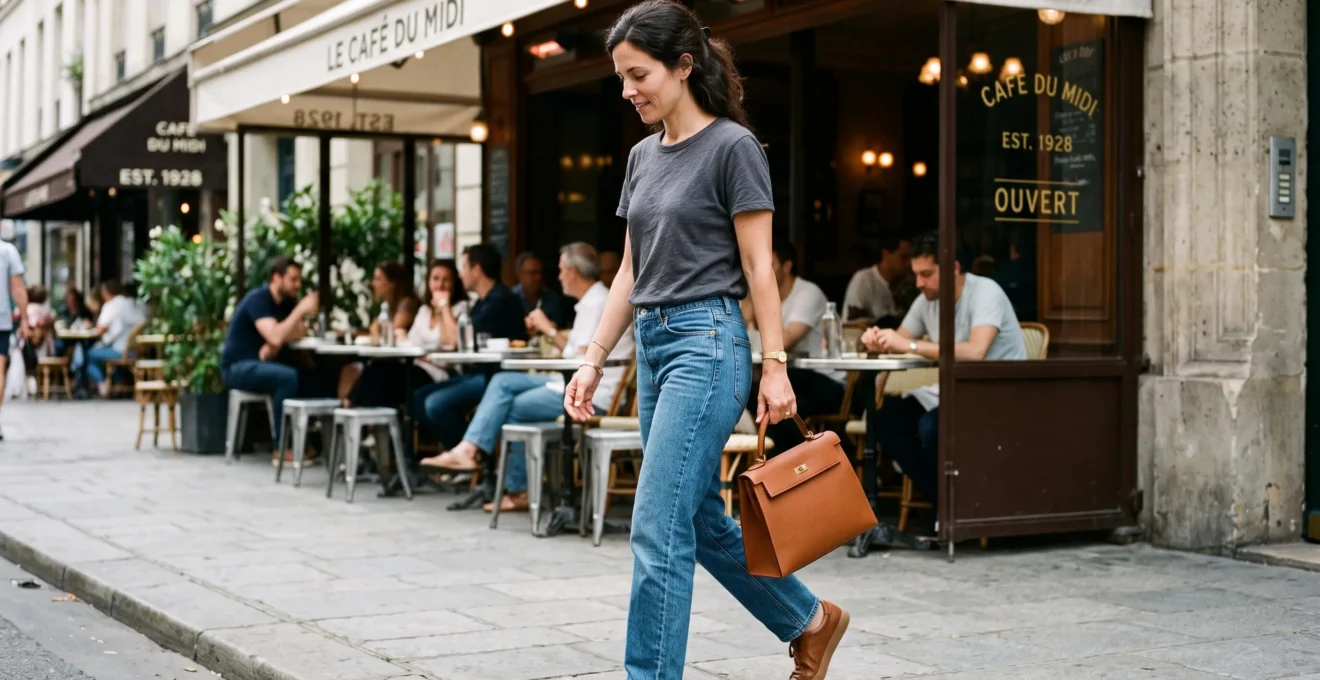
A medium-sized structured handbag in cognac, dark brown, black or taupe is one of the simplest ways to make casual clothing look more considered. The secret is not a prominent logo or expensive-looking hardware. It is a defined silhouette, a stable base, balanced proportions and finishes that remain tidy with regular use.
Imagine straight-leg jeans, a plain white T-shirt and comfortable trainers. A floppy, overfilled shoulder bag reinforces the relaxed feel. Replace it with a clean-lined leather top-handle bag or structured crossbody, and the outfit gains a sharper visual outline without becoming formal.
The best choice still depends on what you carry. A small architectural bag may look beautiful but fail on commuting days, while a large laptop tote can overwhelm a simple weekend outfit. Materials, weight, fastening design and colour matter as much as appearance.
For one reliable everyday bag, aim for a shape that holds its form, accommodates your actual essentials and works with the clothes you wear most often.
The structured handbag essentials
- Best all-round silhouette: A medium-sized, gently rectangular bag with a firm base, minimal branding and restrained hardware.
- Best practical choice: A structured tote for laptop-heavy days or a compact crossbody for lighter, hands-free commuting.
- Best long-term value: Check the actual material, stitching, handles, edge finishing and internal capacity before focusing on labels or trends.
- Why Does a Structured Bag Make Even Jeans and a Tee Look More Polished?
- How to Choose a Structured Handbag That Fits Your Laptop Without Looking Bulky?
- Structured Tote or Structured Crossbody: Which Works Better for a 30-Minute Commute?
- The Handbag Quality Red Flag That Starts Peeling Within 4 Months
- When Should You Choose a Dark Structured Bag Over a Light One for Daily Wear?
- Statement Piece or Clean Minimal Fit: Which Gets More Compliments at a Work Event?
- How to Choose One Structured Bag That Works With 80% of Your Wardrobe?
- Which Structured Handbag Gives You the Biggest Style Upgrade for Under £150?
Why Does a Structured Bag Make Even Jeans and a Tee Look More Polished?
A structured handbag makes jeans and a T-shirt look more polished because its defined edges contrast with the softer lines of casual clothing. A firm base, controlled proportions and tidy handles introduce visual order without requiring a tailored outfit. A medium-sized design usually creates the most natural balance between relaxed and refined.
Casual outfits often contain soft, flexible shapes. Denim creases around the knees, cotton drapes across the torso and relaxed jackets follow the body’s movement. A structured bag adds a stable geometric element that makes those softer pieces appear deliberately combined rather than casually assembled.
That is why shape often matters more than branding. A logo-free rectangular handbag can look more sophisticated than a conspicuously branded bag with sagging corners and oversized decorative details.
However, not every bag marketed as structured has meaningful internal support. Some designs rely primarily on thick outer material. They may appear firm when new but lose definition as the panels soften or the contents pull against them.
Try a simple assessment before buying:
- Empty-bag test: Place the bag on a flat table. It should stand upright without collapsing dramatically.
- Base test: Check whether its bottom remains reasonably flat and supported.
- Panel test: Gently press the sides and observe whether the intended shape returns.
- Finish test: Inspect stitching, edge coating, lining and hardware for uneven or visibly unfinished areas.
These checks are useful indicators of construction, not guarantees of durability. Some intentionally soft-sided bags retain an elegant silhouette without standing independently.
Scale matters too. A tiny, rigid top-handle bag can make an ordinary jeans-and-tee outfit feel unexpectedly dressy. An oversized square tote can have the opposite problem, introducing too much visual weight.
For most everyday outfits, a medium silhouette that sits comfortably against the body creates a more versatile result. Look for slightly softened corners, simple handles and hardware that does not dominate the design.
Once the silhouette works with casual clothes, the next challenge is finding enough usable space without making the bag look like office luggage.
How to Choose a Structured Handbag That Fits Your Laptop Without Looking Bulky?
Choose a structured handbag for your laptop by measuring the computer’s actual width, height and thickness, then checking the bag’s usable interior and opening. Allow approximately 2–3 cm of practical clearance where possible. A slim rectangular tote or portfolio-style bag generally looks neater than a deep, boxy design.
Laptop screen sizes can be misleading because a 13-inch or 14-inch measurement normally refers to the display diagonal, not the device’s exterior dimensions. Bezels and chassis designs differ, so two laptops advertised with the same screen size may not fit the same bag.
Measure the laptop itself, including any protective sleeve you intend to use. Compare those measurements with the internal dimensions provided by the retailer. A bag’s external dimensions can overstate its usable space because rigid walls, internal pockets, seams and closures occupy room.
The opening is particularly important. A laptop might fit comfortably once inside but be difficult to pass through a narrow zipper or stiff upper rim.
Depth is another factor that changes the overall appearance. A very deep bag can resemble a traditional school or document bag, especially when filled with chargers, water bottles and notebooks. A slimmer horizontal profile often keeps the visual emphasis on clean lines.
A narrow vertical tote may also work, provided the laptop fits without pressing against its edges and the handles make it comfortable to carry.
Three formats deserve consideration:
- Wide-opening structured tote: Good for a laptop, documents and daily essentials, particularly with a secure top closure.
- Portfolio-style handbag: Appropriate for a slimmer work kit and a more restrained professional look.
- Rigid zip-top work bag: Useful when secure closure matters, provided the zipper opening is wide enough for the computer.
Mini handbags and narrow flap bags are less suitable for carrying a laptop, even when their published exterior dimensions appear generous.
Do not force the computer against the lining or side panels. Repeated pressure can stress seams, distort the bag and make its opening harder to use. A correctly sized padded compartment or separate laptop sleeve provides a sensible protective layer.
When shopping online, ask for internal measurements and a photograph showing the bag open. If the retailer cannot confirm that your device fits, treat the purchase as uncertain.
A bag that accommodates your work essentials still needs to be comfortable in motion. That makes your commute the next deciding factor.
Structured Tote or Structured Crossbody: Which Works Better for a 30-Minute Commute?
A structured crossbody is often more convenient for a 30-minute commute involving walking, crowded transport and frequent access to small essentials. A structured tote generally works better when carrying a laptop, documents or larger items, particularly by car. The better choice depends on load, transport and how often you open the bag.
Consider your actual journey rather than the bag’s appearance alone. Someone travelling by train may need a free hand for tickets, escalators and handrails. Someone driving to work may value a spacious bag that can be placed beside them and carried a short distance.
For a useful comparison, assess three everyday variables: the weight of your belongings, the transport you use and the number of times you need to access the bag.
| Daily consideration | Structured tote | Structured crossbody |
|---|---|---|
| Laptop and documents | Usually easier to accommodate | Often limited by size and carrying comfort |
| Crowded public transport | May need to be held close to the body | Can be kept in front with hands relatively free |
| Frequent small-item access | Convenient with an accessible opening | Convenient when positioned at the front |
| Walking | Can place sustained load on one shoulder | Hands-free, but may still create uneven pressure |
| Car commuting | Practical for a larger work kit | Useful mainly for lighter essentials |
| Professional appearance | Typically more spacious and work-oriented | Typically compact and adaptable |
Comfort deserves more attention than it usually receives in handbag shopping. The American Academy of Orthopaedic Surgeons‘ carrying advice recommends avoiding prolonged one-sided shoulder-bag carrying and changing sides frequently.
This is general carrying guidance, not a clinical comparison proving that crossbody handbags are always more comfortable than totes. A heavy crossbody can still concentrate pressure, especially with a narrow strap.
A convertible structured handbag offers a useful compromise: carry it by the top handle for a smarter appearance and attach a longer strap when walking. But check its attachment points, strap width and how the bag hangs when loaded.
Some convertible designs tilt forward or collapse at the top because the strap pulls unevenly on the body. Load the bag with your typical belongings and test both carrying positions before committing.
For crowded journeys, secure zippers and compartments may be more valuable than decorative clasps. For driving, a broad-opening tote with a stable base often wins on convenience.
Whichever format suits the journey, its material must withstand repeated handling. That is where some otherwise attractive handbags disappoint.
The Handbag Quality Red Flag That Starts Peeling Within 4 Months
The warning sign is a poorly specified coated material or deteriorating edge finish, particularly around corners, handles and zippers. Some polyurethane-coated handbags develop cracking, flaking or peeling with wear, but four months is not a dependable failure timeline. Durability depends on material formulation, manufacturing quality, exposure and handling.
The distinction between leather and synthetic coated material matters because their surfaces age differently. Many natural leathers can develop a patina, creasing and changes in colour. Coated synthetic materials may instead show separation between the surface coating and the underlying substrate.
The Association for Contract Textiles‘ explanation of polyurethane hydrolysis describes how deterioration in polyurethane-coated fabrics can lead to cracking, flaking and delamination. Heat, humidity and the material’s chemical formulation influence its resistance.
That guidance principally concerns coated textiles used in upholstery. It explains a relevant failure mechanism but does not establish that handbags made from polyurethane routinely peel after four months.
Before purchase, examine areas that regularly bend, rub or carry weight. These include handle attachments, the upper opening, lower corners and seams close to hardware. Look for lifting coatings, uneven edge paint, weak stitching or visible separation between bonded layers.
Be cautious about using smell or unusually uniform grain as proof of poor quality. Such characteristics can raise questions, but they cannot reliably establish a material’s composition or future durability.
Product terminology also deserves scrutiny. The Leather Working Group‘s material and leather-care FAQs explain that “vegan leather” is a broad description that can refer to different non-animal materials. The label alone does not tell you whether a bag is polyurethane, vinyl, a plant-based composite or another construction.
Look for explicit material composition instead of relying on words such as “premium”, “luxury feel” or “designer-inspired”. Ask the retailer for close-up images of handle joins, the inside surface and edge finishing when the product listing is incomplete.
Customer reviews are more useful when they describe extended use. Search for terms such as “peeling”, “flaking”, “cracking” and “handle wear”. Early reviews may reveal delivery and appearance issues but cannot establish how a handbag ages over time.
Price should be considered through cost per use rather than the purchase amount alone. As a hypothetical comparison, a £60 bag replaced annually costs £180 across three purchases, while a £140 bag used throughout that same period costs £140 before maintenance. This arithmetic does not predict how either product will actually perform.
Natural leather is not automatically superior in every situation. Leather quality, coatings, finishing and care vary widely, and some engineered alternatives are designed for demanding use.
Construction affects longevity, but visible maintenance also depends on colour. A handbag that survives daily handling may still look tired if its surface shows every mark.
When Should You Choose a Dark Structured Bag Over a Light One for Daily Wear?
Choose a dark structured handbag when you wear denim frequently, travel daily or want less visible maintenance. Black and dark brown are practical choices for busy routines. Light beige, cream and white can brighten casual outfits beautifully, but their appearance may require more attention, particularly around dye transfer and staining.
The first issue is not colour coordination but how the bag interacts with your clothing and surroundings. Dark bags often conceal minor marks more easily, although scratches, dust and wear can still be noticeable on particular finishes.
Light bags create contrast against dark jeans, navy coats and charcoal knitwear. That contrast can make a simple outfit look noticeably fresher, but it also exposes discolouration more clearly.
One practical concern is denim dye transfer. Levi’s Australia explains in its product FAQ that dark-wash and raw denim can transfer excess dye through contact and friction, particularly when the garments are new. Light-coloured bags are among the accessories potentially affected.
For light bags, reduce prolonged contact with new dark denim and consider washing jeans according to their care instructions before wearing them against pale accessories. Follow the handbag manufacturer’s instructions before applying any protective treatment; waterproofing products are not universally suitable and should not be assumed to prevent dye transfer.
Texture can influence how noticeable scratches and everyday marks appear. Grained and embossed finishes may visually disguise some imperfections, but they should not be treated as guaranteed protection against staining.
To choose a colour intelligently, compare its practical strengths with your wardrobe.
| Colour | Where it works particularly well | Potential drawback |
|---|---|---|
| Black | Monochrome outfits, office clothes, everyday commuting | Can look visually heavy against delicate summer outfits |
| Dark brown | Denim, cream, olive, camel and warmer neutrals | May contrast less naturally with some cool-toned palettes |
| Cognac | Blue jeans, white shirts, navy and earth tones | Some surface marks remain relatively visible |
| Dark burgundy | Grey, black, navy and restrained neutral outfits | Less straightforward with certain bright colours |
| Taupe or beige | Soft neutrals, light tailoring and relaxed summer looks | Marks and denim transfer may be conspicuous |
| White or cream | Minimal outfits and high-contrast styling | Requires more attention to contact marks |
Seasonal rules are less useful than your actual wardrobe. A black structured bag can look excellent with white linen if the rest of the outfit has enough contrast. Likewise, a cream handbag can work in winter against a dark wool coat.
If this is your only everyday handbag, dark brown, black, cognac or muted burgundy offers an approachable starting point. Select the shade that complements your most frequently worn clothes rather than the one that looks most appealing in isolation.
Colour also changes how noticeable a bag becomes in professional settings, where being memorable and looking polished are not always the same objective.
Statement Piece or Clean Minimal Fit: Which Gets More Compliments at a Work Event?
A statement handbag is more likely to attract direct comments at a work event because its colour, texture or silhouette gives people something distinctive to notice. A clean, minimal structured bag offers a quieter form of polish. Neither guarantees more compliments; the best choice depends on the event and the impression you want to create.
A minimal black or cognac handbag reinforces a tidy professional outfit without demanding attention. It can work particularly well when the rest of the clothing already includes strong design elements, such as an interesting blazer, striking shoes or a tailored coat.
A statement structured handbag serves a different purpose. A deep burgundy finish, unusual architectural shape or restrained metallic clasp can create a conversational detail while preserving the seriousness of the overall look.
The useful distinction is between intentional character and visual competition. One distinctive accessory can add personality; several competing accessories may weaken the cohesion of an outfit.
Consider these combinations:
- Minimal outfit, distinctive bag: A navy suit, simple shoes and structured burgundy handbag create a controlled focal point.
- Relaxed smart-casual outfit: Dark jeans, a white shirt, tailored blazer and cognac top-handle bag produce a balanced look without obvious branding.
- Statement clothing, quiet bag: A patterned dress or textured suit pairs naturally with a smooth black structured handbag and discreet hardware.
The one-statement-piece rule is a helpful styling principle rather than an absolute restriction. Creative workplaces may support more expressive combinations, while formal client-facing occasions may reward restraint.
Think beyond the event itself. A brightly coloured croc-embossed handbag may be memorable on one evening but difficult to integrate into ordinary work clothes throughout the year. Highly seasonal textures and colours can also feel dated sooner than restrained alternatives.
For a long-term purchase, let shape, proportion or a rich classic colour create the interest. Distinctive does not have to mean extravagant.
A smooth dark brown handbag with an elegant rectangular profile might receive fewer direct comments than a vivid statement piece, yet still contribute significantly to how composed the overall outfit appears.
For someone buying just one handbag, versatility should generally carry more weight than how memorable it looks at a single event.
How to Choose One Structured Bag That Works With 80% of Your Wardrobe?
To choose one structured handbag that works with roughly 80% of your wardrobe, review the outfits you actually wear rather than every item you own. Select a medium-sized silhouette and a colour that complements most of your recurring combinations. Treat 80% as a personal compatibility target, not a guaranteed styling statistic.
Start with your ten most frequently worn outfits. Include ordinary workdays, weekends, travel and occasions when you dress slightly smarter. Note their dominant colours, proportions and level of formality.
For example, someone who regularly wears blue denim, white shirts, navy knitwear, camel coats and cream trousers may find cognac or dark brown especially adaptable. Someone with predominantly black, grey and cool-toned clothing may prefer black, charcoal or burgundy.
Size often becomes the limiting factor before colour. A mini structured bag may complement evening outfits but feel awkward with a large winter coat or fail to hold everyday essentials. An oversized work tote may suit office days while overwhelming summer dresses and relaxed weekend clothing.
A medium-sized bag with understated proportions usually offers the most flexible starting point. A removable shoulder strap can expand its styling options, provided the attachments and balance are well designed.
Do not confuse versatility with invisibility. A completely neutral bag is easy to coordinate, but it may contribute little visual character. A subtle warm neutral such as cognac, taupe or deep burgundy can provide enough contrast to sharpen an outfit without competing with it.
Your five-step one-bag buying checklist
- Audit ten real outfits: Write down your ten most frequently worn combinations and identify their dominant colours.
- Set your coverage target: Mark which outfits suit each shortlisted handbag and aim for at least eight successful combinations out of ten.
- Check three dress levels: Record how the bag works with your most casual, most formal and most typical outfit.
- Verify daily capacity: Make a list of essentials, measure any laptop and compare everything against the bag’s usable interior dimensions.
- Inspect construction: Complete a short buying checklist covering the base, panels, stitching, closures, handles and stated material composition.
The three-outfit test is especially valuable. Imagine the same handbag with relaxed jeans and trainers, a tailored work outfit and something halfway between them. If it looks awkward with one, decide whether that compromise is acceptable before purchasing.
Also consider your actual carrying needs. A bag that visually works with eight outfits but cannot accommodate the essentials required for those occasions does not truly meet the target.
Online shopping makes this exercise more important. Product photographs typically show ideal styling, not the full variety of clothes in your own wardrobe. Comparing the bag against photographs of your existing outfits is a practical alternative.
Once its wardrobe compatibility is established, the final question is how much quality and visual refinement you can realistically obtain within your budget.
What matters before setting your budget
- Prioritise stable shape, neat construction and usable interior space over prominent logos or decorative details.
- Choose a colour and size that work with your most frequent outfits, not just your favourite styled product photograph.
- Judge value by likely frequency of use, repairability and care requirements rather than purchase price alone.
Which Structured Handbag Gives You the Biggest Style Upgrade for Under £150?
For under £150, a medium-sized, logo-free structured handbag with clean lines, a stable base, secure closure and well-finished handles is a strong style choice. Prioritise construction over branding, then compare genuine leather and clearly specified alternatives. There is no universally best material at this price: inspection and realistic expectations matter more.
The most convincing affordable handbags tend to avoid unnecessary visual noise. Straight seams, restrained hardware, balanced handles and a simple silhouette can create a refined appearance without expensive decorative features.
At this budget, evaluate what the purchase actually includes rather than assuming that a fashionable label guarantees durability.
Do not compromise on basic construction. The bag should close reliably, hold its intended shape and have handles that are securely attached. Inspect the inside for unfinished seams, loose lining and hardware that feels poorly secured.
On the other hand, you can often simplify secondary features without sacrificing the overall effect. A discreet closure may be more useful than an elaborate clasp. A practical single-compartment interior can be preferable to numerous decorative pockets.
Material descriptions require particular attention. Full-grain leather, corrected-grain leather, coated split leather and synthetic alternatives are not interchangeable, and broad marketing labels do not establish their quality.
At under £150, genuine leather construction may be available in some designs, including discounted or pre-owned options, but it should not be assumed for every product in this category. Verify the description carefully and assess the actual condition and workmanship.
For a straightforward purchasing comparison, use this decision framework:
| Feature | Worth prioritising | Where to simplify |
|---|---|---|
| Silhouette | Stable base and balanced panels | Avoid unnecessary decorative shapes |
| Material | Clear composition and appropriate care guidance | Do not pay extra for vague luxury terminology |
| Handles | Secure stitching and comfortable proportions | Choose simpler handle designs |
| Closure | Reliable zipper or fastening | Skip complicated ornamental hardware |
| Interior | Sound lining and sufficient usable space | Choose fewer compartments when practical |
| Branding | Clean, discreet presentation | Avoid paying primarily for prominent logos |
Watch for the common traps in the “looks expensive” category. Descriptions such as “premium vegan leather” do not identify an exact composition. Highly polished plated hardware can look appealing initially but may wear or tarnish depending on its finish and use. A design inspired by current luxury trends is not necessarily well constructed.
A structured bag’s appearance also depends on care after purchase. Follow the maker’s cleaning recommendations, avoid forcing oversized objects inside and store the bag so its panels are not compressed. Leather products may need conditioning appropriate to their specific finish, but there is no universal maintenance schedule suitable for all bags.
Pre-owned bags can offer an additional route to quality within a fixed budget. Inspect their corners, lining, handles and closure carefully, and factor any necessary repairs into the total cost.
Consider a hypothetical comparison between a £75 handbag that works with only two outfits and a £135 handbag that comfortably suits most of your wardrobe. Even though the second option costs more initially, it may provide better practical value if it is used regularly and remains serviceable.
The strongest upgrade is therefore not necessarily the most expensive handbag you can afford. It is the one whose visual refinement, functionality and construction make you want to carry it repeatedly.
Choose two or three understated handbags within your budget, compare their construction and fit using your everyday essentials, and buy the one that passes both the wardrobe test and the practical carrying test. That is a more dependable way to achieve a polished look than choosing by logo, trend or product photograph alone.
Can a structured handbag look too formal with trainers and casual clothes?
Yes. A very small, rigid bag with elaborate hardware can look disproportionately formal beside relaxed clothing. A medium-sized design with softened corners, simple handles and minimal decoration generally creates a more natural contrast with jeans and trainers.
Does a structured handbag need to be made from genuine leather?
No. Both leather and non-leather materials can be used to make structured handbags. Durability depends on the specific material, coating, construction and intended use. Check the exact composition and finish rather than assuming that either category is automatically superior.
How can you tell whether a structured handbag is too heavy before buying?
Check its empty weight where available, then consider the items you intend to carry. If shopping in person, try it with a realistic load and walk with it on your shoulder or across your body. Pay attention to strap pressure, balance and whether the bag remains comfortable in motion.
Is a zip-top structured handbag better than an open-top bag?
A zip-top design is often more practical for commuting, travel and carrying smaller valuables because it helps keep contents enclosed. An open-top design offers faster access and may suit shorter, less crowded journeys. The best option depends on your routine, and a zipper should still open wide enough for your belongings.
How should you store a structured handbag to help it retain its shape?
Empty unnecessary contents, gently support the interior with suitable clean stuffing if recommended by the manufacturer, and store the bag upright without compressing its panels. Avoid hanging a heavily loaded bag by its handles for prolonged periods. Follow the material-specific storage and cleaning instructions supplied with the product.