
Few items in a wardrobe work as hard as your shoes. They carry you through commutes, workouts, celebrations, and long days on your feet, all while shaping the entire impression of your outfit. Yet shoes are also one of the most misunderstood categories in fashion: people often prioritize looks over fit, or buy for a single occasion without thinking about long-term wear. This page brings together the essential knowledge every shopper should have before adding another pair to the closet.
Whether you are building a capsule footwear collection, trying to understand why your sneakers fall apart after a few months, or simply wondering what to wear with that new dress, the sections below explain the fundamentals in plain, practical terms.
Footwear is the only clothing item that affects your body mechanics. A poorly fitted pair does not just look off — it can cause blisters, bunions, back pain, and fatigue. Podiatrists consistently point out that many common foot problems trace back to shoes that are too narrow, too flat, or worn out past their supportive lifespan.
There is also a style dimension. In menswear and womenswear alike, shoes are often described as the foundation of an outfit. Think of an analogy: a beautiful cake on a cracked plate still reads as careless. The same outfit paired with clean, well-maintained, occasion-appropriate footwear instantly appears more deliberate.
Understanding the major categories helps you shop with intention instead of impulse. Most shoes fall into one of the following families:
A versatile collection does not need dozens of pairs. Most people cover the vast majority of their lives with a well-chosen rotation of five to eight pairs spanning these categories.
If you take one lesson from this page, let it be this: fit trumps everything. A gorgeous shoe in the wrong size is a bad shoe. Here is how to get fit right.
Feet change over time due to weight fluctuations, pregnancy, aging, and activity levels. Many people walk around in a size they last measured years ago. Measure both feet in the late afternoon, when they are naturally slightly swollen, and fit to the larger foot. It is completely normal for your two feet to differ by half a size or more.
One fictional example makes the stakes clear: Sarah bought beautiful leather pumps a half size too small because her size was out of stock. After three wears, she developed a bunion and could no longer wear any pointed-toe styles comfortably. The cost of waiting for the right size is almost always lower than the cost of forcing a bad fit.
The material determines a shoe’s comfort, durability, breathability, and care requirements.
Genuine leather is durable, molds to your foot over time, and breathes well. Full-grain leather is the highest quality and develops a patina with age. Suede, a napped finish of leather, looks luxurious but requires a protective spray and a dedicated brush. Leather is generally the best investment for dress shoes and boots you plan to keep for years.
Casual sneakers and espadrilles often use canvas, which is lightweight, breathable, and machine washable in many cases. The trade-off is less structure and faster wear.
Modern performance shoes use engineered mesh and foam composites that are light and supportive. Synthetic leather (vegan leather) has improved considerably and is a common choice for ethical shoppers, though it typically breathes less and does not mold to the foot the way real leather does.
Do not overlook what is underneath. Rubber soles offer grip and shock absorption; leather soles look elegant on dress shoes and can be resoled repeatedly; EVA foam is light but compresses over time. A resoleable shoe can last a decade, while a glued, non-repairable one usually has a shelf life of one to three seasons of heavy use.
The most common styling question is simple: what shoes go with this? A few reliable principles solve most situations.
Consider a typical week: leather sneakers for errands and casual Fridays, loafers or boots for the office, running shoes for workouts, and one dressier pair for evenings. That rotation covers nearly everything without requiring a walk-in closet.
Marketing language around shoes can be confusing. Here are the terms worth knowing:
A useful rule of thumb: comfort technologies matter most in shoes you wear for hours at a time, while style-focused pairs worn for a few hours in the evening can prioritize aesthetics.
Maintenance extends the life of every pair and protects your investment. The core routine is simple:
Footwear is a resource-intensive industry, and shoppers are increasingly asking questions about how their shoes are made. A few practical ways to shop more responsibly:
Sustainability in footwear is ultimately less about labels and more about buying fewer, better pairs and maintaining them well.
There is no universal number, but a practical everyday rotation for most people includes a casual sneaker, a smart everyday shoe (loafer, boot, or flat), an athletic shoe, and one dressier option. Weather where you live may add sandals or winter boots.
Increasingly, yes — but choose minimal, clean, leather or leather-look sneakers without logos or athletic features. Chunky running shoes with a suit reads as athletic; sleek white leather sneakers with tailoring reads as intentional.
Look at the soles first. If the tread is worn smooth, the heel is unevenly worn, or the midsole is visibly compressed and no longer bounces back, the shoe has lost its support — even if the upper still looks fine.
Shoes reward a little education more than almost any other purchase. When you understand fit zones, material behavior, and the role each category plays in a wardrobe, you stop buying shoes you regret and start buying pairs you reach for constantly. Browse the articles in this category for deeper looks at specific styles, fit techniques for problem feet, and care routines tailored to different materials — and step forward with confidence.
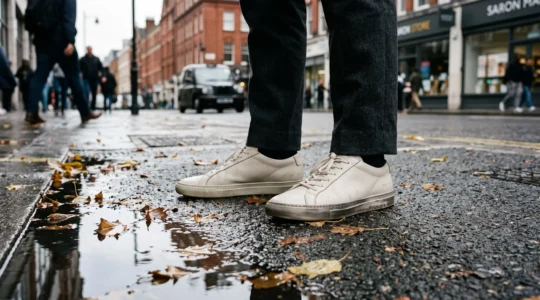
The minimalist sneakers most likely to look sharp after a rainy commute are low-profile leather pairs with a smooth, wipeable upper, restrained stitching, a stable rubber sole and a colour that disguises minor marks. Off-white, stone and light grey are…
Read more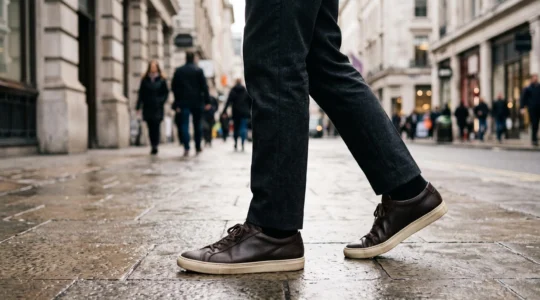
For most relaxed smart-casual wardrobes, a pair of low-profile leather sneakers in dark brown, black or another versatile neutral offers one of the strongest style upgrades under £150. If your working week involves tailored trousers, formal meetings or a stricter…
Read more