
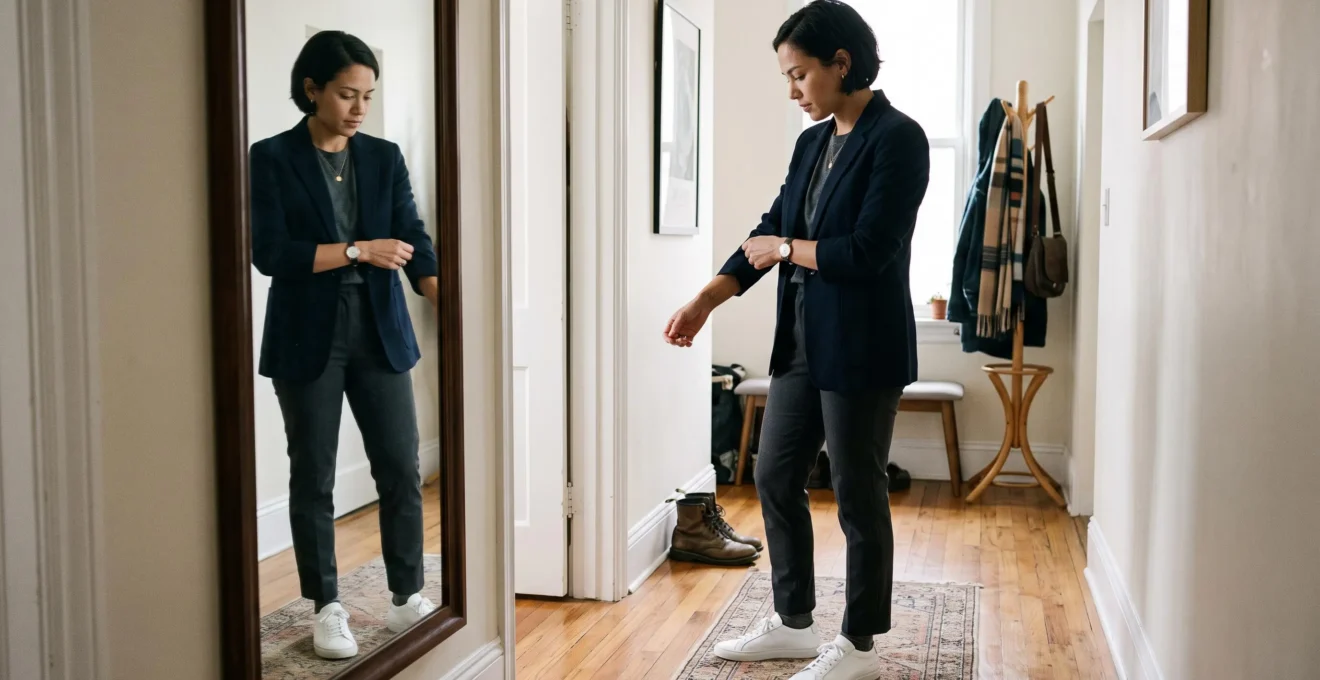
A tailored blazer, comfortable jeans and leather shoes can all be excellent wardrobe choices. Yet put them together without considering their relationship, and the result may look as though you dressed for three different occasions.
The difference between a successful smart-casual outfit and an awkward combination rarely comes down to buying better clothes. It comes down to visual coherence: making separate garments communicate the same overall intention.
To achieve that, assess how closely your pieces match in formality, whether their fabrics and silhouettes feel compatible, and how colours or details connect different parts of the outfit. Shoes, accessories and outer layers deserve particular attention because they can change the impression created by otherwise well-balanced clothing.
A simple process makes these decisions easier: choose a starting piece, keep the formality differences manageable, repeat a discreet visual detail and examine the finished silhouette from a distance. These principles work across different wardrobes, body shapes and personal styles without requiring everything to match perfectly.
Smart-casual outfit coherence: the essentials
- Align formality before matching colours. Make sure your shoes, trousers, top and outer layer belong to a compatible range of dressiness.
- Create a visual connection. Repeat a subtle colour, texture, material or detail across two or three parts of your outfit.
- Check the complete silhouette. Look for competing focal points, conflicting fabric weights and one piece that seems noticeably out of place.
- Why Do Mixed Smart-Casual Outfits Sometimes Look Wrong Even When Each Item Is Nice?
- How to Check Visual Coherence in 30 Seconds Before You Leave the House?
- Colour Anchor or Formality Anchor: Which Creates More Coherence in Daily Outfits?
- The Coherence Mistake That Makes You Look “Busy” Even in Neutral Colours
- In What Order Should You Build an Outfit So Coherence Happens Automatically?
- How to Make an Outfit Look Intentional by Repeating 1 Detail 3 Times?
- How to Build an Outfit Combination Matrix in 15 Minutes With Your Phone Camera?
- How Can You Create 20 New Outfit Combinations Without Buying Anything?
Why Do Mixed Smart-Casual Outfits Sometimes Look Wrong Even When Each Item Is Nice?
Mixed smart-casual outfits can look wrong because individual garment quality does not guarantee visual compatibility. A well-made blazer, attractive jeans and expensive shoes may still clash in formality, texture, proportion or overall mood. The solution is to judge how the pieces work together rather than evaluating each garment separately.
Every garment suggests a degree of formality. A sharply tailored jacket generally communicates something different from a washed cotton hoodie, while polished leather oxfords suggest a different setting from distressed denim.
The difference between these signals can be described as formality distance. When neighbouring pieces sit too far apart on the smart-to-casual spectrum, the contrast may look accidental unless another element deliberately connects them.
Consider a structured blazer worn with a crisp dress shirt, relaxed faded jeans and formal black oxfords. The blazer, shirt and shoes suggest business dressing, while the jeans introduce a distinctly casual message. Nothing is necessarily wrong with the individual garments, but their combined intention is unclear.
Replace the dress shirt with a plain, substantial cotton T-shirt and the oxfords with understated leather sneakers. The same blazer now participates in a recognisable relaxed-tailoring look. The casual pieces make the combination feel deliberately dressed down rather than incompletely dressed up.
Texture and proportion matter too. A smooth fine-gauge knit, lightly structured trousers and suede loafers can feel harmonious even when their colours differ. Conversely, a fragile silk top, heavy distressed jeans and rugged work boots create several competing material and style signals.
This does not mean contrasting styles are prohibited. Intentional contrasts can be expressive. They simply need an understandable relationship: similar proportions, compatible materials, a shared silhouette or a repeated detail.
The broader principle appears in Utah State University Extension‘s clothing design principles, which discuss balance, proportion, emphasis and rhythm in clothing. These principles concern relationships within an ensemble, while acknowledging that perceptions of harmony remain subjective.
The most useful question is therefore not “Do I like every piece?” but “Do these pieces seem to belong to the same intended look?” Once that distinction becomes familiar, identifying mismatches becomes considerably easier.
How to Check Visual Coherence in 30 Seconds Before You Leave the House?
To check outfit coherence in 30 seconds, step back from a full-length mirror and examine three zones: upper body, lower body and feet. Compare their formality, silhouette and fabric weight. If one piece feels noticeably disconnected, adjust that item instead of rebuilding the entire outfit. This is a practical styling routine, not a scientifically validated timing standard.
The key is to evaluate the complete outfit at once. Close-up inspection makes it easy to admire a jacket’s fabric or a shoe’s construction while missing how strangely they relate to the rest of the clothing.
Try dividing the inspection into three short stages.
- Upper body: Examine the relationship between your top and outer layer. Does a relaxed T-shirt sit naturally beneath the jacket, or does a very formal shirt make the combination appear overly businesslike?
- Lower body: Check the cut, finish and visual weight of your trousers against the upper half. Are they structured enough to balance the jacket, or so distressed that they change the outfit’s character entirely?
- Feet: Assess whether the shoes reinforce the intended level of polish. Consider their shape, finish, bulk and compatibility with the trouser hem.
Next, inspect the materials. A lightweight linen jacket over heavy winter knitwear may look seasonally disconnected. Delicate accessories beside oversized rugged footwear can introduce a similar mismatch, even when the colours are coordinated.
If the check reveals a mismatch, identify the most formal garment. Suppose your polished leather shoes look disconnected from your faded jeans and casual sweatshirt. You could replace the jeans with cleaner trousers, add a structured overshirt, or choose less formal footwear.
Use the smallest change that resolves the contradiction. A single substitution often makes more sense than changing several garments that already work well together.
When the outfit looks balanced in silhouette, material and polish, stop adjusting. The final check should support confident dressing, not turn every minor stylistic difference into a problem.
Colour Anchor or Formality Anchor: Which Creates More Coherence in Daily Outfits?
A formality anchor usually provides the better starting point for everyday smart-casual dressing because it establishes a consistent level of polish. A colour anchor then helps connect the outfit visually by repeating a hue across selected pieces. Neither approach is universally superior: choose the one that corrects your outfit’s most noticeable weakness.
A formality anchor is a garment that establishes the intended dressiness of the look. Tailored trousers, leather loafers or an unstructured blazer can serve this purpose. The remaining pieces should relate to that level, even if some are deliberately more casual.
A colour anchor works differently. Repeating brown in shoes and a belt, or navy in a jacket and knitwear, gives the eye a recurring visual reference across the silhouette.
The practical differences are easier to understand side by side.
| Decision point | Colour anchor | Formality anchor |
|---|---|---|
| What it connects | Hues across separate garments and accessories | The perceived dressiness of different pieces |
| Best used when | The outfit feels visually disconnected because colours vary | The outfit feels mismatched despite compatible colours |
| Practical example | Brown loafers, brown belt and a subtle brown watch strap | Tailored trousers, fine knitwear and understated loafers |
| What it cannot fix alone | Extreme differences in formality or seasonal fabric weight | Competing colours, patterns or attention-grabbing details |
Imagine a beige silk blouse, cream trousers and heavy grey work boots. The palette is restrained, but the boots may still look disconnected because their rugged construction contrasts sharply with the delicate upper half.
Changing the boots to streamlined leather ankle boots addresses the formality and material problem without changing the colour story.
Now imagine a dark blazer, olive trousers and brown loafers that already share a comfortable smart-casual level. Repeating the brown in a belt or watch strap may help create a more unified visual impression.
The repeated element should appear in two or three visible places when appropriate, but this is a styling heuristic rather than a strict numerical requirement. Some outfits work perfectly well with only one colour connection.
For reliable everyday styling, establish a workable level of formality first, then use colour to reinforce the result. Once both relationships are controlled, visual clutter becomes the next issue to examine.
The Coherence Mistake That Makes You Look “Busy” Even in Neutral Colours
Neutral outfits can look busy when several pieces compete for attention through shape, texture, shine or decorative details. A statement coat, heavily detailed shoes and prominent accessories may create visual noise even in beige, grey and black. To restore coherence, choose one main focal point and make the surrounding pieces quieter.
Colour is only one source of visual attention. Large lapels, prominent zips, shiny hardware, contrasting fabric textures and exaggerated proportions can each make a garment stand out.
A neutral palette sometimes disguises the problem during assembly. Because the colours appear harmonious, the wearer assumes that every additional detail will also work together.
Consider a hypothetical outfit featuring an oversized camel coat with dramatic lapels, grey pinstriped trousers, chunky black shoes with metal hardware and a heavily embellished taupe bag.
The colours are compatible, but four elements compete to become the focal point. The viewer has little visual space to appreciate any one of them.
Instead of removing the personality from the outfit, apply a one-primary-statement approach. Keep the camel coat as the dominant element. Replace the pinstriped trousers with a plainer pair, choose simpler footwear, and use a less embellished bag.
The goal is not absolute minimalism. It is visual hierarchy: one element attracts initial attention while the others support its shape, texture or mood.
To diagnose competing details, examine:
- Pattern scale: Are several visible patterns demanding attention at once?
- Surface finish: Do glossy leather, metallic accents and textured fabrics all compete?
- Structure: Are exaggerated collars, oversized pockets or heavy shoe soles dominating different parts of the silhouette?
- Accessories: Do the bag, jewellery, belt and shoes each seem designed to be the statement piece?
A useful correction is to demote rather than remove. Replace the loudest secondary item with a quieter equivalent that retains a similar formality level. This preserves the intended smart-casual balance while reducing unnecessary detail.
Editorial guidance in The Concept Wardrobe also recommends balancing elaborate footwear with simpler garments and avoiding unnecessary competition between shoes and the rest of an outfit.
A coherent outfit can be expressive, understated or somewhere between the two. What matters is that its elements have distinct roles rather than all competing for equal attention.
In What Order Should You Build an Outfit So Coherence Happens Automatically?
Build a smart-casual outfit by choosing a formality anchor first, then selecting the remaining garments in relation to it. Shoes or a tailored piece make useful starting points because their level of polish is easy to recognise. Add one deliberate contrast, balance the fabrics and finish with accessories that support the overall look.
The advantage of this sequence is that each decision has a reference point. Instead of assembling unrelated favourite pieces and hoping they work together, you establish the intended look before adding complexity.
Shoes are an especially useful starting point when the outfit needs to suit a particular occasion. Their construction and finish can significantly influence whether the overall combination looks relaxed, polished or formal.
For example, dark leather loafers suggest a different styling direction from worn canvas trainers or highly polished dress oxfords.
As The Concept Wardrobe‘s advice on selecting shoes explains, footwear should be considered alongside the occasion, surrounding garments, colour palette and season. The guidance also emphasises selecting shoes that complement rather than compete with the outfit.
For a practical starting sequence, follow these five decisions:
- Choose the intended level of dressiness for the occasion.
- Select a defining piece, such as loafers, tailored trousers or a blazer.
- Add compatible garments from a nearby formality level.
- Introduce one deliberate casual or smart adjustment.
- Finish with a restrained colour connection and full-length mirror check.
Suppose you begin with an unstructured navy blazer. Dark straight-leg jeans and a plain knitted polo can soften its formality, while leather loafers restore some polish. The result has a clear relaxed-tailoring direction.
If you start with clean white leather sneakers instead, structured trousers and a fine-gauge knit can elevate the outfit without making the shoes appear inappropriate.
The reverse approach is not inherently wrong. Starting with a favourite top or a statement accessory can also work, provided that subsequent choices respond to its formality and visual character. The difficulty arises when shoes and outerwear are treated as unrelated afterthoughts.
A five-action smart-casual outfit checklist
- Define your destination: Write or mentally select one dress-code description, such as “relaxed but polished”.
- Choose your anchor: Identify the specific shoes or structured garment that will guide the outfit.
- Check compatibility: Confirm one top, one bottom and one outer layer with manageable formality differences.
- Connect the details: Identify at least two visible elements that share a colour, finish or structural feature.
- Validate the silhouette: Take one full-length mirror photograph and note any single item that needs changing.
Once the overall structure is established, small repeated details can make the combination appear even more deliberate without requiring additional clothing.
How to Make an Outfit Look Intentional by Repeating 1 Detail 3 Times?
To make an outfit look intentional, choose one subtle detail and echo it across two or three visible areas. The repeated element might be a colour, metal finish, fabric texture or structural line. Distributed repetition gives separate pieces a shared visual identity without requiring exact matching or identical garments.
This technique draws on the design principle of visual rhythm: recurring elements help connect different parts of a composition. Repetition can make shoes, accessories and layers feel related even when they come from different styles.
Three occurrences offer a convenient styling target, not an experimentally established rule. Two well-placed references may be sufficient, and more repetitions are not automatically better.
Practical examples include:
- Leather tone: Chestnut loafers, a similarly toned belt and a brown leather watch strap.
- Metal finish: Gold-toned watch details, understated earrings and small gold buttons.
- Colour: Navy trousers, a navy accent in a scarf and a subtle navy detail on a bag.
- Texture: A ribbed jumper, a similarly textured scarf and a restrained knitted accessory.
- Structural line: Clean straight-leg trousers, a streamlined bag and simple geometric jewellery.
Repetition works best when the echoes are distributed rather than concentrated. A colour that appears near the feet, waist and upper body can visually connect the entire silhouette.
The connections do not need to be perfectly identical. Slight variations within the same colour family or material finish can look natural, particularly when the garments differ in texture.
However, repeating three striking patterns or oversized metallic accessories may reproduce the competing-focal-point problem. A repeated detail should normally function as a quiet link, not as three separate statements.
To verify the result, mentally count the visible occurrences of your chosen detail. If it appears only once, decide whether another subtle reference would improve the outfit. If it appears repeatedly and dominates the look, reduce its prominence.
These deliberate connections become easier to recognise when you can compare several outfit combinations together. Photographing your existing clothes provides a simple way to build that reference.
How to Build an Outfit Combination Matrix in 15 Minutes With Your Phone Camera?
Build an outfit combination matrix by photographing your clothes individually, grouping them into casual, smart-casual and formal categories, then comparing compatible pieces in a phone album or visual grid. A focused 15-minute session can produce a useful starter matrix, although photographing an entire wardrobe may take longer.
The advantage is that outfit decisions happen before the morning rush. Instead of discovering mismatches while dressing, you can compare garments calmly and document combinations you already know work.
Start with a manageable selection rather than your entire wardrobe: frequently worn trousers, tops, shoes and outer layers. Photograph each piece against a plain background in consistent lighting so its colour, shape and fabric are easy to assess.
Next, arrange the photographs into three approximate formality bands:
- Casual: Relaxed denim, everyday trainers, hoodies and informal cotton tops.
- Smart-casual: Dark clean denim, chinos, fine knitwear, understated leather sneakers and unstructured jackets.
- Formal: Structured tailoring, dress shirts, polished dress shoes and occasion-specific garments.
These are flexible styling categories, not universal dress-code classifications. Some garments shift bands depending on their condition, fit, construction and accompanying pieces.
Use your phone’s gallery albums or a simple photo-grid application to organise the images. Place frequently worn bottoms alongside potential tops, footwear and layers. Prioritise combinations from the same or adjacent formality bands before experimenting with more dramatic contrasts.
A practical matrix might contain the following starting relationships:
| Starting piece | Compatible pairing | Detail to verify |
|---|---|---|
| Dark straight-leg jeans | Fine-gauge knit and loafers | Denim finish and trouser length |
| Unstructured blazer | Plain T-shirt and chinos | Jacket structure versus T-shirt fabric weight |
| Leather sneakers | Tailored trousers and simple knitwear | Shoe bulk and trouser silhouette |
| Structured overshirt | Clean denim and understated boots | Harmony between fabric textures |
Mark combinations that work in real life by saving a full-outfit photograph. The Concept Wardrobe’s outfit-organisation tutorial similarly recommends documenting successful looks through photographs, written notes or an outfit planner.
Each time you revisit your matrix, test one crossover pairing: a garment combined with an adjacent formality band rather than its usual companions. Photograph the completed outfit only if the real-life silhouette passes your coherence check.
Once the matrix contains several reliable starting points, you can generate additional outfits systematically without adding anything to your wardrobe.
Key takeaways before remixing your wardrobe
- Begin with combinations that already share a compatible formality level, then experiment with one controlled contrast at a time.
- Change the role of existing garments through layering, footwear or outerwear rather than changing everything simultaneously.
- Save successful full-outfit photographs and reject combinations that only look good in a flat image grid.
How Can You Create 20 New Outfit Combinations Without Buying Anything?
To create 20 new outfit combinations without shopping, systematically recombine your existing tops, bottoms, footwear and layers. Use your wardrobe matrix to identify compatible pairings, then vary one element at a time. Recheck formality, fabric weight and silhouette before counting a combination as genuinely wearable rather than merely possible on paper.
The process works best when you treat your wardrobe as a collection of interchangeable components instead of fixed outfits.
Start with the pieces you wear most often. Cross suitable garments within the same formality band, then consider combinations with the neighbouring band. A casual cotton top, for instance, may work with both dark denim and tailored trousers when the surrounding footwear and outerwear support the intended look.
For a purely hypothetical example, suppose your wardrobe contains four compatible tops, three compatible bottoms and two suitable footwear options.
That creates 4 × 3 × 2 = 24 possible three-piece combinations before considering jackets or accessories. This is a mathematical possibility count, not a promise that all 24 combinations will look coherent or be suitable for every occasion.
Apply the following remixing methods to discover useful variations:
- Change the shoes: Replace minimalist sneakers with loafers to adjust the formality of an otherwise unchanged outfit.
- Change the outer layer: Wear a structured overshirt instead of a blazer to create a more relaxed impression.
- Re-layer existing garments: Add a shirt beneath knitwear, or drape a jumper over the shoulders when the weather and proportions allow.
- Change a garment’s role: Wear a blazer as the outer layer in mild weather or beneath a compatible coat in cooler conditions.
- Adjust accessories: Use a different belt, bag or scarf to introduce a coherent colour connection without changing the main garments.
Do not assume that combinations which look attractive in your phone gallery will automatically work when worn. Real fabrics have weight, movement and volume, and those qualities can expose conflicts that a photograph of separate garments does not reveal.
Test one or two unfamiliar combinations each week. Check them in a full-length mirror, consider the weather and intended activity, and save photographs of the successful results.
If a pairing repeatedly feels uncomfortable or visually inconsistent, remove it from your saved combination bank. A smaller collection of genuinely wearable outfits is more useful than a large gallery of untested possibilities.
The repeatable method is simple: choose an anchor, check the formality band, establish one visual connection and inspect the finished silhouette. Each successful combination becomes a new starting point for future variations.
Choose three underused garments from your wardrobe today and test each with one familiar outfit. Change only one element at a time, photograph the successful combinations and keep the results in your outfit album. The aim is not simply to reach 20 looks, but to develop a wardrobe you can combine confidently and intentionally.
Can you mix black and brown accessories in a smart-casual outfit?
Yes. Black and brown can work together when their materials, formality and proportions feel compatible. They do not need to match exactly. For example, understated brown leather shoes can accompany black trousers when the rest of the outfit creates a balanced visual transition rather than introducing several unrelated contrasts.
Do all accessories need to match for an outfit to look coordinated?
No. Accessories can coordinate through similar finishes, compatible shapes or a shared level of formality without having identical colours. A leather bag, minimalist watch and understated shoes may look connected because they have a similar visual character. Exact matching is an option, not a requirement.
Can sneakers work with tailored trousers and a blazer?
Yes, particularly when the sneakers have a clean, relatively streamlined design and the tailoring is not excessively formal. An unstructured blazer, relaxed tailored trousers and simple leather sneakers can form a coherent smart-casual look. The occasion still matters: some workplaces and formal events require more traditional footwear.
How do you keep a smart-casual outfit coherent when wearing several layers?
Check that the layers share compatible fabric weights, shapes and levels of dressiness. A fine knit beneath an unstructured blazer often creates a natural progression, whereas bulky sportswear under sharply tailored outerwear produces a stronger contrast. Also consider whether each added layer changes the silhouette or introduces another competing focal point.
What should you do when an outfit feels too formal on top and too casual below?
Adjust one side toward the other rather than changing everything. You might replace a crisp dress shirt with a plain knit, exchange distressed jeans for cleaner denim, or swap formal oxfords for loafers. The appropriate correction depends on the occasion and which piece you want to preserve as the outfit’s defining element.