
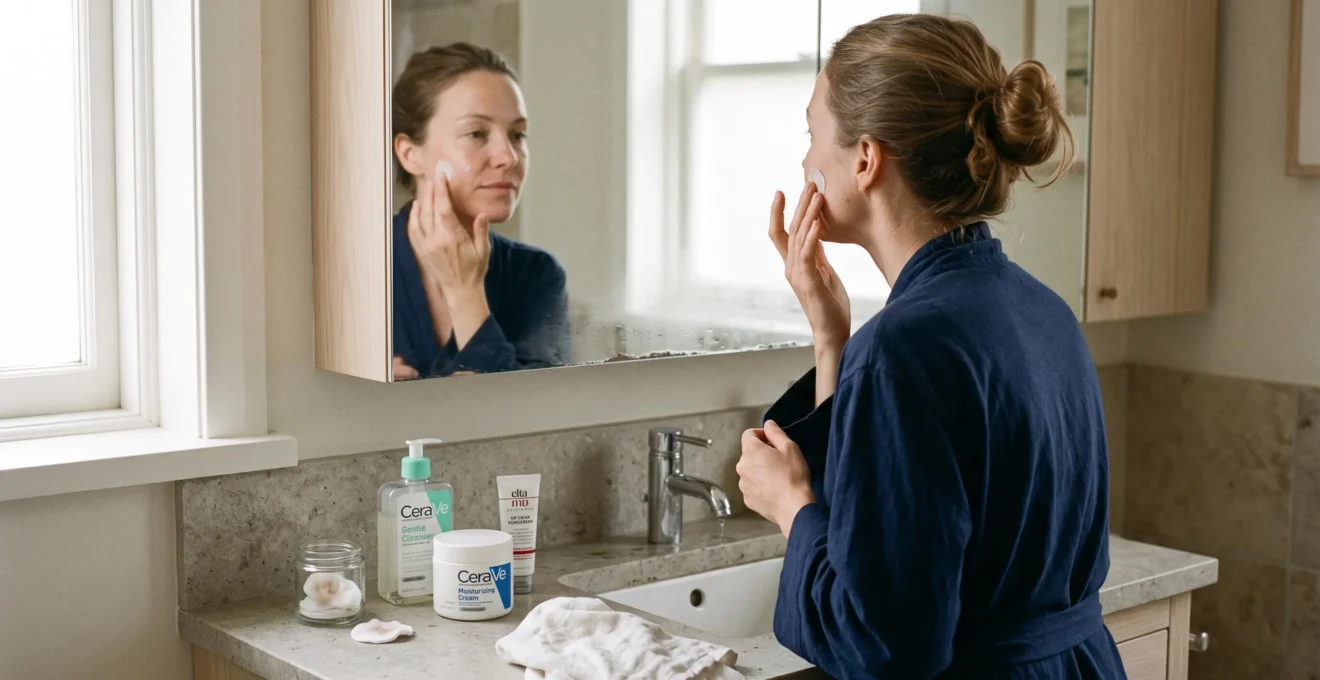
Healthy-looking skin depends on more than the products sitting on a bathroom shelf. Sleep, stress, sun exposure, cleansing habits and the condition of the skin barrier all influence how skin looks and feels. An expensive serum cannot replace consistent sun protection, compensate for an irritating routine or guarantee that breakouts will disappear.
The practical starting point is to make the basics reliable before spending money on additional treatments. Gentle cleansing removes everyday buildup, moisturizer helps maintain skin comfort, and sunscreen reduces exposure to ultraviolet radiation. These steps are useful across many skin types, although persistent acne, eczema, rosacea and other skin conditions may require targeted treatment.
Habits also need to be realistic. A routine that takes little time, uses products already available and fits ordinary mornings and evenings is easier to maintain than a complicated sequence of treatments. Improvements may be gradual, and different concerns respond at different rates.
The aim is not to eliminate every serum. It is to understand which habits deserve priority, which products are genuinely useful and when adding another treatment is more likely to complicate things than help.
The essentials for healthier-looking skin
- Keep the foundation simple: gentle cleansing, suitable moisturizer and broad-spectrum sunscreen.
- Pay attention to stress and irritation instead of automatically adding more active ingredients when skin looks worse.
- Build consistent habits, observe changes over time and seek professional advice when symptoms persist or become severe.
- Why Does Your Skin Look Worse During Stressful Weeks Even With Good Skincare?
- How to Improve Skin Health in 14 Days Without Buying New Products?
- Hydration, Breakouts, or Redness — What Should You Fix First for Healthier-Looking Skin?
- The Daily Habit That Can Keep Your Skin in a Constant “Irritated” Cycle
- When Should You Do a Skin “Recovery Night” to Avoid Burning Out Your Barrier?
- How to Cleanse Your Face in 60 Seconds Without Stripping It?
- How to Apply Enough SPF to Actually Protect Your Face Without Pilling?
- How Do You Make Sun Protection a Daily Habit When You Hate the Feel of SPF ?
Why Does Your Skin Look Worse During Stressful Weeks Even With Good Skincare?
Stress can make skin look and feel worse even when a skincare routine stays exactly the same. Stress-related hormonal changes can increase oil production and aggravate acne, while stress can also worsen eczema and make recovery from flare-ups more difficult. This means that a familiar routine may not be enough to prevent every change in your skin.
The American Academy of Dermatology’s overview of stress-related skin conditions explains these connections and recommends combining appropriate dermatological care with stress-management practices.
Stress does not affect everyone in the same way. Some people notice more breakouts, while others experience worsening dryness, itching or inflammation associated with an existing condition. A difficult week can also disrupt sleep, meals and everyday routines, making it harder to maintain consistent skincare.
Recognizing a pattern is more useful than assuming that every new spot means a product has stopped working. Notice whether symptoms repeatedly coincide with stressful periods, changes in sleep or the introduction of a new formula. These observations can guide decisions, but they cannot reliably diagnose the cause on their own.
A useful response is to keep the routine stable while reducing avoidable irritation. Resist the urge to introduce several exfoliants or acne treatments at once, particularly if the skin is already red or uncomfortable. Prioritize manageable stress-reduction practices, such as taking breaks, gentle physical activity or breathing exercises, alongside appropriate treatment.
The goal is to recognize patterns without blaming yourself for them. Stress management can support skin health, but persistent symptoms still deserve appropriate assessment and treatment.
How to Improve Skin Health in 14 Days Without Buying New Products?
A two-week reset can help you identify whether your current routine is contributing to irritation, without requiring a new purchase. Keep the products that your skin tolerates, simplify unnecessary steps and observe a small number of changes. Fourteen days is a practical observation window, not a scientifically guaranteed timeline for clearer skin or complete barrier recovery.
The American Academy of Dermatology’s skin care on a budget recommendations support a straightforward foundation of cleansing, moisturizing and sun protection. The association also notes that using multiple products can increase costs and cause irritation.
During the first few days, concentrate on consistency. Use a gentle cleanser when needed, apply a moisturizer that your skin tolerates and maintain sun protection. Temporarily pause nonessential exfoliants and recently introduced active treatments if irritation is a concern. Do not automatically discontinue prescribed medication or a clinician-directed treatment; check with the prescriber before changing it.
During the second week, continue the same basic routine and look for patterns. Is the skin less tight after washing? Does redness seem less frequent? Are individual blemishes healing without the appearance of new irritation? These observations are more useful than expecting dramatic before-and-after photographs.
Use this five-step checklist to make the reset measurable.
Your 14-day skin reset checklist
- Days 1–2: List your current cleanser, moisturizer, sunscreen and active treatments. Deliverable: a written inventory of what you already use.
- Days 3–4: Remove nonessential routine steps that may be contributing to irritation, while keeping prescribed treatments unchanged unless your clinician advises otherwise. Deliverable: a simplified morning and evening routine.
- Days 5–7: Follow the routine consistently and record one or two symptoms, such as post-cleansing tightness or redness. Deliverable: a short daily observation log.
- Days 8–11: Continue without introducing new products and note changes in comfort and the healing of individual blemishes. Deliverable: four additional dated observations.
- Days 12–14: Compare the beginning and end of the period, noting both improvements and unresolved symptoms. Deliverable: a brief summary of what changed and what may need professional advice.
A lack of visible change does not mean the experiment has failed. Some concerns need longer, while others require targeted care. The value of the two weeks is a clearer understanding of your routine, not a promise of transformation.
Hydration, Breakouts, or Redness — What Should You Fix First for Healthier-Looking Skin?
When hydration, breakouts and redness occur together, start by addressing obvious irritation and discomfort before intensifying acne treatments. Skin that is already sensitive may tolerate additional active ingredients poorly. Once the routine is comfortable and stable, persistent breakouts can be addressed more deliberately. This is a practical sequencing approach, not a universal treatment rule for every skin condition.
The first step is to distinguish the symptoms as far as possible. Dehydrated skin may feel tight or look temporarily less smooth, while dry skin can be rough, flaky or itchy. These descriptions overlap, and neither appearance nor sensation alone establishes a diagnosis. Redness can reflect irritation, an underlying skin condition or another cause.
If a product causes burning or stinging, or if several products suddenly become uncomfortable, avoid responding by layering on more treatments. Review recent changes, reduce nonessential irritants and use a moisturizer that your skin already tolerates. Moisturizing can be helpful even when the skin is oily.
Breakouts require a little more nuance. Acne and irritation can coexist, so stopping every acne treatment indefinitely is not always appropriate. Instead, avoid escalating treatment while the skin is acutely reactive, and seek advice if it is unclear whether a product is causing the reaction or whether the underlying condition is worsening.
A simple decision framework can help:
- Primarily tight or flaky: Review cleansing intensity and moisturizing consistency.
- Red, stinging or unusually reactive: Reduce unnecessary irritation and reassess recently introduced products.
- Persistent breakouts with otherwise comfortable skin: Consider an appropriate acne treatment rather than adding several treatments simultaneously.
- Persistent flushing, painful cysts or a sudden widespread reaction: Seek professional assessment rather than relying on self-triage.
A calmer routine makes it easier to judge what is helping and what is not. If redness, pain or breakouts persist, professional guidance can help distinguish conditions that look similar but require different approaches.
The Daily Habit That Can Keep Your Skin in a Constant “Irritated” Cycle
Repeatedly cleansing or exfoliating the skin more aggressively than necessary can contribute to a cycle of irritation. Skin feels tight after washing, so another product is added to correct the discomfort; that product may cause further irritation, prompting yet another change. Over time, the routine becomes more complicated without addressing the original problem.
The American Academy of Dermatology recommends gentle cleansing, lukewarm water and avoiding scrubbing. Its Face washing 101 recommendations emphasize that abrasive techniques can irritate facial skin.
One misleading signal is the feeling of being completely stripped clean. Skin does not need to feel squeaky to be clean. Persistent tightness, burning, flaking or discomfort after washing may indicate that the cleanser, frequency, water temperature or technique needs adjusting.
The way out is usually to simplify. Reduce unnecessary exfoliation, avoid harsh scrubbing and use a gentle cleanser suited to your skin. Follow with a moisturizer that you tolerate. If several products have recently been introduced, review them one at a time rather than changing everything repeatedly.
Recovery is not always immediate. Irritation may take weeks to settle, depending on its cause and severity. If symptoms continue despite simplifying the routine, or if prescribed treatments seem to be responsible, seek advice from a qualified professional rather than repeatedly experimenting.
There are situations in which more thorough cleansing is reasonable. Heavy makeup, water-resistant sunscreen and substantial oil or dirt accumulation may require a more deliberate evening routine. The objective is to remove residue effectively without making the skin uncomfortable.
The distinction is between adequate cleansing and aggressive cleansing. The former serves a purpose; the latter adds friction and irritation without necessarily improving the result.
A sustainable routine should leave skin feeling comfortable rather than stripped. When discomfort becomes a recurring feature of skincare, reducing unnecessary steps is a more sensible starting point than increasing the number of treatments.
When Should You Do a Skin “Recovery Night” to Avoid Burning Out Your Barrier?
A skin recovery night is a planned evening when you keep skincare to the essentials: gentle cleansing when needed and a basic moisturizer that your skin tolerates. It excludes optional exfoliants, cosmetic treatments and other nonessential active products for that evening. The purpose is to reduce unnecessary exposure to potential irritants, not to detox the skin or accelerate results.
Consider a recovery night when your usual routine begins to feel different. Warning signs can include unusual tightness, flaking, stinging when applying familiar products or new discomfort following an increase in active treatments. These signals do not prove that the skin barrier is damaged, but they are reasonable prompts to reassess the routine.
Frequency depends on what you use and how your skin responds. Someone with a minimal routine may not need planned breaks at all. Someone using multiple potentially irritating treatments may benefit from reviewing the frequency of those treatments with a qualified professional.
A recovery night should not automatically mean abandoning prescribed medication. Retinoids and other treatments may be recommended for specific conditions, and the right schedule depends on the treatment and the person. If irritation develops while using prescribed medication, ask the prescribing clinician how to adjust it safely.
The practical sequence is straightforward:
- Cleanse gently if cleansing is needed.
- Apply a familiar moisturizer if your skin tolerates it.
- Avoid introducing new cosmetic products that evening.
- Notice whether discomfort settles or continues.
- Review recurring symptoms rather than relying on recovery nights indefinitely.
A recovery night is best understood as prevention and routine management. It does not remove toxins, guarantee barrier repair overnight or make an otherwise irritating routine safe.
The objective is a routine that remains tolerable over time. If symptoms are severe, persist or repeatedly return, professional assessment is more useful than scheduling increasingly frequent nights off.
How to Cleanse Your Face in 60 Seconds Without Stripping It?
You can use a short, deliberate cleansing routine to remove everyday residue without scrubbing, but 60 seconds is not a scientifically established requirement for healthy skin. The important factors are a suitable cleanser, lukewarm water, gentle fingertip movements and thorough rinsing. Spend enough time to clean comfortably rather than treating the clock as a measure of effectiveness.
In the evening, begin by wetting your face with lukewarm water. Apply a gentle, non-abrasive cleanser and massage it lightly over the skin with your fingertips. Pay attention to areas where sunscreen, makeup and oil tend to accumulate, such as around the nose, hairline and jaw, without rubbing aggressively.
Rinse thoroughly and pat the skin dry with a clean, soft towel. If your face feels tight, stings or becomes noticeably uncomfortable afterward, review the cleanser and technique. Hot water, abrasive tools, vigorous rubbing and excessive cleansing can all contribute to irritation.
The morning routine does not always need to duplicate the evening routine. Depending on your skin and overnight oiliness, rinsing with water may be sufficient for some people, while others prefer a gentle cleanser. There is no universal approach that works best for every skin type.
Sunscreen and makeup also affect what is needed at night. If a single gentle cleanse does not adequately remove your products, you may need to adjust the method. A two-step cleanse is an option for some routines, but it should not become an automatic extra step if one cleanse is sufficient.
The key is to distinguish adequate removal from over-cleansing. A face that feels stripped is not evidence that the routine has worked better.
Once cleansing is consistent and comfortable, the next priority is protecting the skin during the day. A suitable sunscreen, applied in a sufficient amount, contributes more to long-term protection than increasingly elaborate cleansing rituals.
How to Apply Enough SPF to Actually Protect Your Face Without Pilling?
To get the intended protection from sunscreen, apply a sufficient amount of broad-spectrum 30 SPF or higher and cover all exposed skin. If the product pills, troubleshoot how it is layered and how it interacts with your existing routine rather than automatically applying less. A comfortable formula that allows consistent, adequate application is more useful than one that repeatedly makes you abandon sun protection.
The American Academy of Dermatology’s sunscreen application instructions recommend broad-spectrum, water-resistant sunscreen with SPF 30 or higher. The guidance specifies at least 1 teaspoon for the face and recommends reapplying every 2 hours outdoors, as well as immediately after swimming or sweating.
The amount needed varies with the area being covered and the product. The familiar two-finger method provides a practical visual reference, but it should not be treated as an exact measurement for every face, sunscreen or application. Remember to cover the neck, ears and other exposed areas as appropriate.
Pilling requires a different kind of troubleshooting. Rather than reducing the dose below what is needed, test your application sequence:
- Allow moisturizer to settle before applying sunscreen.
- Apply sunscreen carefully, avoiding vigorous rubbing.
- If necessary, test whether smaller successive passes make the product easier to spread without reducing the total amount applied.
- Give the sunscreen time to settle before adding makeup.
- Change one variable at a time so you can identify which adjustment helps.
These are practical troubleshooting steps, not a guarantee that every case of pilling has the same cause. If a particular combination continues to pill, consider a different sunscreen texture that works with the rest of your routine.
Sun protection also depends on consistency. Sunscreen should be applied before outdoor exposure, with the American Academy of Dermatology recommending application approximately 15 minutes beforehand. When outdoors, reapply it every two hours and immediately after swimming or sweating. Shade and protective clothing can complement sunscreen rather than replacing adequate application to exposed skin.
Key takeaways
- Choose a sunscreen texture that you can apply comfortably in a sufficient amount, instead of accepting repeated pilling or routinely under-applying.
- Use a repeatable application sequence and test adjustments without sacrificing coverage.
- Make sun protection part of the everyday routine, including on ordinary days when the weather is cloudy.
The best sunscreen is one that suits your skin, fits your routine and gets applied consistently. If the current product makes that difficult, finding a more comfortable formulation is a practical improvement, not a failure of discipline.
How Do You Make Sun Protection a Daily Habit When You Hate the Feel of SPF ?
Making sunscreen a daily habit becomes easier when the product feels acceptable and application fits naturally into an existing routine. If a formula feels greasy, heavy or uncomfortable, repeatedly forcing yourself to use it may not be the most effective long-term strategy. The practical solution is to find an appropriate formulation, make the application step predictable and use other protective measures alongside sunscreen.
Start by identifying what you dislike. Is the product too rich, difficult to spread, irritating around the eyes or prone to leaving a visible cast? Different formulations feel different, so testing a suitable lightweight fluid, gel or emulsion may help. People with sensitive skin should pay attention to irritation and seek professional advice if reactions continue.
Next, attach sunscreen to a routine that already happens every day. For example, keep it beside your moisturizer or near the place where you get ready in the morning. Decide in advance when you will apply it, how much you need and which areas require coverage. Reducing the number of decisions makes the routine easier to repeat.
Do not confuse comfort with protection. A product that feels light is not automatically more protective, and a high SPF rating does not compensate for applying too little. Look for broad-spectrum protection of SPF 30 or higher, and choose a water-resistant formula when appropriate for your activities.
If conventional sunscreen still feels unpleasant, a tinted formulation or a different texture may be worth considering. A hat, protective clothing and shade can reduce exposure during outdoor activities. Makeup containing SPF can contribute to protection, but ordinary cosmetic application should not be assumed to replace a properly applied dedicated sunscreen.
Consistency matters because ultraviolet exposure can occur during everyday activities, including on cloudy days and in winter. The aim is not to find a mythical perfect product but to build a protective habit that works in real life.
Start with one change that removes the main obstacle: a more comfortable sunscreen, a better place to keep it or a clear morning application sequence. Pair that habit with gentle cleansing and suitable moisturizing, then give the routine time to become consistent. If skin problems persist despite these basics, seek appropriate professional advice instead of continually expanding the product collection.
Can lifestyle habits really make a difference to skin health?
Yes. Stress can worsen acne and aggravate certain inflammatory skin conditions, while gentle cleansing, moisturizing and sun protection help support a practical skincare routine. Lifestyle changes complement appropriate treatment; they do not guarantee that acne or other skin conditions will resolve on their own.
How long does it take to see healthier-looking skin?
The timeframe depends on the concern, its severity and the changes made. Two weeks can be a useful period for observing whether a simpler routine improves comfort, but it is not a guarantee of clearer skin or complete recovery. Persistent acne, redness or irritation may need longer-term treatment or professional assessment.
Do you need an expensive serum to maintain healthy skin?
No. Effective skincare does not necessarily require expensive products. A basic routine built around gentle cleansing, a suitable moisturizer and sun protection is a reasonable starting point. Specific serums can be useful for particular concerns, but their price alone does not establish that they are necessary or more effective for your skin.
Should you stop all active ingredients if your skin becomes irritated?
Not automatically. It can be sensible to pause nonessential exfoliants or recently introduced cosmetic treatments when irritation develops. However, prescribed medication and clinician-directed treatments should not be discontinued or changed without appropriate advice. Persistent, severe or widespread reactions warrant professional assessment.
Is sunscreen necessary when it is cloudy or you spend most of the day indoors?
Clouds do not eliminate ultraviolet exposure, and protection remains important when you spend time outdoors during ordinary daily activities. The right approach depends on your exposure and circumstances. When outdoors, use broad-spectrum SPF 30 or higher, cover exposed skin and reapply every two hours or immediately after swimming or sweating.