
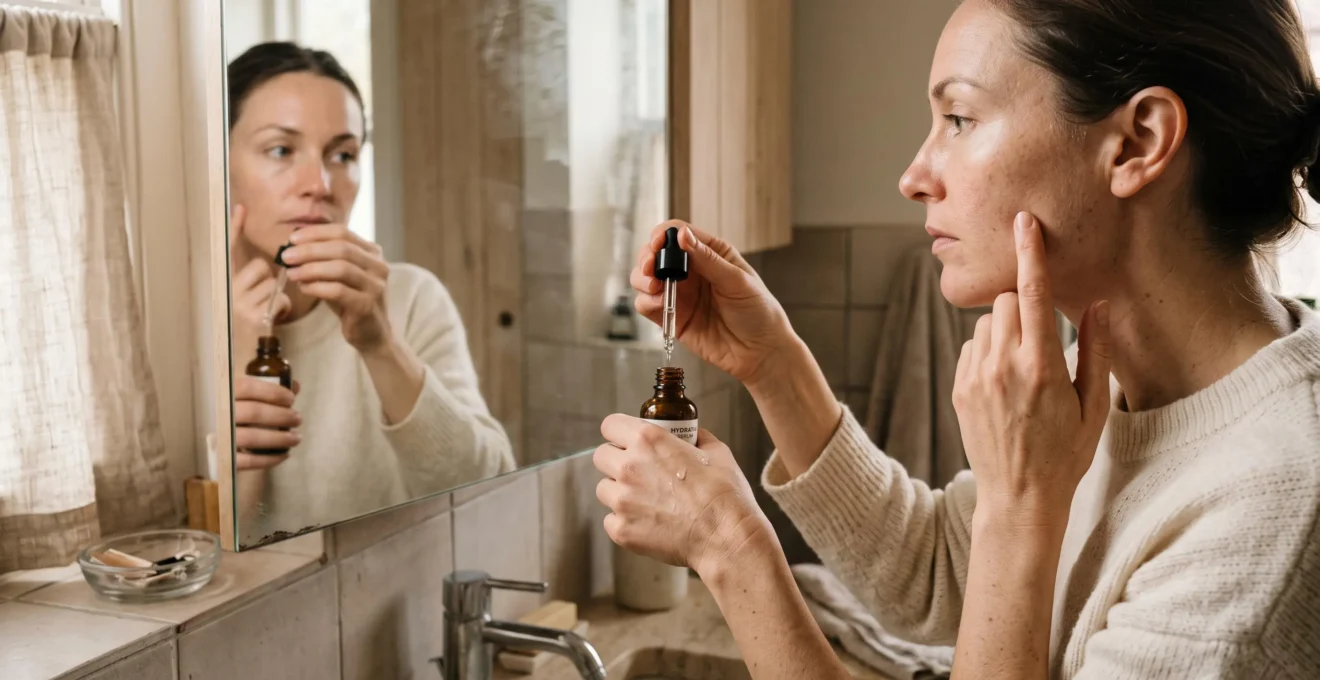
Skin can look reasonably smooth from a distance yet feel uneven when you run your fingertips across your forehead or cheeks. Tiny bumps, dry patches and visible pores can all contribute to that rough texture, but they do not necessarily respond to the same skincare ingredients.
The best texture-focused serum depends on what is causing the roughness. A salicylic acid serum may help when pores are congested. An alpha-hydroxy acid (AHA) may be more appropriate for superficial roughness associated with dead skin cells. A polyhydroxy acid (PHA) can offer a gentler starting point for skin that reacts easily. If dehydration or irritation is the main problem, however, a hydrating serum and a good moisturiser may be more useful than another exfoliant.
The goal is not to exfoliate until skin feels polished. It is to identify the likely cause of unevenness, select an appropriate formulation and introduce it at a pace your skin can tolerate. That approach is especially important if previous exfoliating products have left your skin tight, shiny, flaky or unusually sensitive.
Texture Serums: What Matters Most
- Choose BHA for congestion-prone pores, AHA for superficial roughness and a mild PHA formulation when sensitivity is a concern.
- Begin with one exfoliating product, often once weekly, and increase only if your skin remains comfortable.
- Persistent flaking, burning or tightness calls for barrier support rather than more aggressive exfoliation.
- Why Does Your Skin Still Feel Rough Even When You Exfoliate Regularly?
- How to Start a Texture Serum Twice a Week Without Triggering a Flare-Up?
- AHA, BHA, or PHA: Which Serum Works Best for ‘Bumpy’ Forehead Texture?
- The Serum Combination Mistake That Makes Texture Look Worse, Not Better
- When Should You Apply a Texture Serum: Before Moisturiser or After?
- How to Build an Exfoliation Schedule Starting at Once a Week Without Guessing?
- How to Remove Visible Flakes Without Scrubbing or Burning Your Skin?
- What’s the Safest Way to Deal With Dead Skin Cells If Your Skin Is Sensitive?
Why Does Your Skin Still Feel Rough Even When You Exfoliate Regularly?
Skin can remain rough despite regular exfoliation because uneven texture has several possible causes. Dead skin cells, dehydration, clogged pores and irritation may occur together, and an exfoliant does not address all of them. Sometimes, exfoliating more frequently actually makes roughness worse by irritating the skin barrier and increasing visible flaking.
Healthy skin continuously sheds cells from its outermost layer. Exfoliating products can help loosen cells that remain attached to the surface, but they cannot replace the skin’s need for water, protective lipids and a functioning barrier.
Consider two types of roughness. Skin that feels tight after cleansing, develops fine flakes and stings when moisturiser is applied may be irritated or insufficiently hydrated. Skin with persistent, small, non-inflamed bumps and visible blackheads may be experiencing follicular congestion. These patterns offer clues, not a reliable home diagnosis.
More exfoliation is not always the missing step. Repeatedly applying strong acids or scrubbing an already compromised surface can increase redness, irritation and uneven peeling. The resulting dryness may make fine texture look more noticeable, encouraging another round of exfoliation and continuing the cycle.
The American Academy of Dermatology’s advice on safe exfoliation recommends adapting the method and frequency to skin type, avoiding over-exfoliation and applying moisturiser afterward.
A targeted serum can be useful when the active ingredient matches the problem. Salicylic acid may help address clogged pores, while a hydrating serum containing humectants can improve the feel of dehydrated skin without removing additional surface cells. No single serum corrects every cause of roughness.
If roughness becomes more pronounced after every active treatment, prioritise gentle cleansing and moisturising before introducing another texture-focused product.
How to Start a Texture Serum Twice a Week Without Triggering a Flare-Up?
To introduce a texture serum twice weekly, first establish that your skin tolerates a single application. Test the product on a limited area, follow the manufacturer’s directions and leave several days between initial uses. If redness, burning or uncomfortable dryness develops, do not push through to meet a twice-weekly target.
Twice weekly is a possible starting frequency for some mild formulations, not a universally safe prescription. A stronger glycolic acid treatment may require substantially less frequent use, while a mild PHA product may be easier to tolerate. Product concentration, acidity and your existing routine all affect the result.
Before applying a new serum across the face, perform a preliminary tolerance test. The American Academy of Dermatology’s skin-care product testing instructions recommend testing a small area, such as the underside of the arm or elbow, over seven to ten days. The general instructions describe twice-daily testing, but exfoliating products should not be applied more frequently than their own directions permit.
A negative test cannot guarantee that a product will never irritate facial skin. For particularly reactive skin, a cautious first facial application to a limited area is another reasonable precaution.
Once testing is complete, a gradual introduction might look like this:
- On the first treatment evening, cleanse gently, allow the skin to dry and apply the serum according to its label.
- Follow with a simple moisturiser. For sensitive skin, applying a light moisturiser first may reduce direct exposure, although this buffering method is not validated for every acid formulation.
- Observe your skin over the following 48–72 hours for delayed discomfort or peeling.
- If the skin remains comfortable and the label permits, consider a second application later in the week.
- Keep the frequency unchanged while assessing tolerance rather than adding more applications immediately.
A few new blemishes in usual breakout areas are sometimes described as purging, particularly with ingredients that affect cell turnover. However, purging is not a reliable explanation for every breakout. Itching, widespread redness, burning and painful peeling are warning signs of irritation or another adverse reaction.
During introduction, avoid combining the new exfoliant on the same evening with retinoids, other exfoliating acids, abrasive scrubs or concentrated acidic vitamin C products. This is a precaution against cumulative irritation rather than a claim that every combination is chemically incompatible.
If your skin becomes uncomfortable, stop the irritating product and simplify the routine. A slower schedule is more useful than forcing the skin to adapt to repeated inflammation.
AHA, BHA, or PHA: Which Serum Works Best for ‘Bumpy’ Forehead Texture?
BHA is often the most relevant choice for forehead bumps associated with oily, congested pores. AHA may be better suited to superficial roughness and dullness, while PHA can be an option for sensitive skin seeking mild exfoliation. However, forehead bumps have different causes, so their appearance and accompanying symptoms matter more than choosing an acid by popularity.
AHA, BHA and PHA describe ingredient families with different chemical properties. Their effectiveness and tolerability depend not only on the acid but also on its concentration, formulation, pH and frequency of use.
The following comparison provides a practical starting point for identifying a potentially suitable active.
| Feature | AHA | BHA | PHA |
|---|---|---|---|
| Typical ingredients | Glycolic acid, lactic acid | Salicylic acid | Gluconolactone, lactobionic acid |
| Primary action | Exfoliation of superficial skin cells | Exfoliation with activity relevant to oily, congested follicles | Gentle surface exfoliation with humectant properties |
| Potentially useful for | Dullness and superficial roughness | Blackheads and congestion-related bumps | Mild unevenness in easily irritated skin |
| Main limitation | May irritate dry or sensitive skin | Does not treat every type of bump | May be insufficient for significant congestion |
Salicylic acid is oil-soluble, which makes it particularly relevant to oily follicles and pore congestion. Water-soluble AHAs such as glycolic acid primarily work through surface exfoliation. This distinction helps explain why an AHA may improve overall smoothness without fully addressing blackheads.
PHAs offer another approach. A published review of polyhydroxy acids in photoaged skin describes exfoliating, moisturising and relatively low-irritation properties. These findings support considering PHAs for sensitive skin, but they do not establish that every PHA serum is safer or more effective than every AHA formulation.
To narrow your choice, consider the pattern of your bumps:
- Small bumps with blackheads and noticeable oiliness: a salicylic acid serum may be appropriate.
- Dry-feeling, dull or superficially uneven skin: an appropriately formulated mild AHA may help, provided the barrier is comfortable.
- Fine unevenness with a history of sensitivity: a gentle PHA product may be a more cautious choice.
- Persistent, uniform bumps with itching, inflammation or unusual appearance: seek a professional assessment rather than repeatedly changing acids.
Not every forehead bump is a comedone. Milia, dermatitis, folliculitis and certain keratinisation disorders can resemble ordinary texture problems. Some require treatments that exfoliating cosmetics cannot provide.
Choose one ingredient family based on your most plausible concern, then evaluate it gradually. Once a reasonable product is selected, avoiding incompatible routine habits becomes the next priority.
The Serum Combination Mistake That Makes Texture Look Worse, Not Better
The most common combination mistake is layering several irritating active products without accounting for their total effect on the skin. Strong AHA and BHA treatments, retinoids and additional exfoliating products can collectively increase dryness and irritation. Instead of becoming smoother, skin may look flaky, red or uneven because its barrier is struggling to tolerate the routine.
A product combination does not have to be chemically incompatible to cause problems. Two individually tolerable treatments can become irritating when used together, especially at high concentrations or in an already intensive routine.
Common examples include applying a concentrated glycolic acid serum after an exfoliating toner, combining a retinoid and an acid treatment on the same evening, or adding a low-pH vitamin C product to a routine that already causes stinging.
The effects are often mistaken for insufficient exfoliation. Dry, irritated skin may shed unevenly, making rough patches more apparent. Redness can emphasise surface irregularities, while dehydration can make fine lines and texture look more pronounced.
Rather than introducing another corrective serum, simplify the routine:
- Assign each active product a clear purpose instead of using multiple products for the same texture concern.
- Use only one exfoliating active per treatment evening unless a specifically formulated combination has already proved tolerable.
- Separate exfoliation and retinoid evenings when both are part of your established routine.
- Keep a brief record of products used and changes in comfort or texture over two to three weeks.
Check ingredient lists rather than relying on front-of-pack claims. A toner marketed for radiance may contain glycolic acid; a blemish serum may contain salicylic acid; a resurfacing moisturiser may introduce another exfoliating ingredient.
Multiple acid names do not automatically mean a product is unsafe. Professionally formulated combinations account for ingredient concentrations and overall formulation. The greater concern is independently stacking products without understanding cumulative exposure.
When skin is comfortable again, reintroduce products individually if needed. Knowing the correct application order can also reduce unnecessary complexity.
When Should You Apply a Texture Serum: Before Moisturiser or After?
Most water-based texture serums are applied after cleansing and before moisturiser, following the product’s instructions. This allows the active formula to contact clean skin before a richer cream is added. For sensitive skin, applying moisturiser first may sometimes reduce irritation, although the effect depends on the serum’s formulation and intended use.
The familiar rule of applying products from thinnest to thickest is useful, but it is not absolute. An oil-based treatment behaves differently from a lightweight water-based acid serum, and some formulations specify a particular application method.
For a conventional leave-on exfoliating serum, an uncomplicated evening routine is:
- Cleanse with a gentle, non-abrasive cleanser.
- Pat skin dry, particularly if the acid product instructs use on dry skin.
- Apply the recommended amount of texture serum.
- Follow with a suitable moisturiser.
Applying acids to damp skin can alter how a formulation spreads and may increase discomfort for some users. The safest approach is to follow the label rather than assuming that damp-skin application always improves results.
If you use a moisturiser before your serum as a buffering strategy, understand the trade-off: the underlying cream may alter exposure to the active ingredient. This can make some routines feel gentler but may also change performance. It is not a universal substitute for selecting a lower-strength product.
A mandatory waiting period between serum and moisturiser has not been established. Allowing the serum to settle can make layering easier, but there is insufficient basis for claiming that everyone must wait a fixed number of minutes to prevent neutralisation.
Evening application is a convenient choice for many exfoliating routines, particularly those containing AHAs. The U.S. Food and Drug Administration notes that AHAs can increase sensitivity to ultraviolet radiation and recommends sun protection during their use and for a week afterward. Evening application does not remove the need for daytime protection.
Once the order is clear, how often you repeat the treatment matters more than making small adjustments to the time between layers.
How to Build an Exfoliation Schedule Starting at Once a Week Without Guessing?
Start with one exfoliation evening per week if the product instructions and your skin’s condition allow it. Maintain that frequency while monitoring redness, stinging, dryness and changes in texture. Increase only after several stable weeks, and only when there is a reason to do so. The ideal schedule depends on the formulation and your skin’s response, not a universal weekly target.
Starting once weekly is a conservative planning strategy rather than a clinically established requirement for all acids. A mild formulation and a concentrated resurfacing treatment should not automatically follow the same timetable.
For someone already using a retinoid, exfoliation should be fitted around the existing routine rather than added on top of every treatment night. Rest evenings provide an opportunity to focus on moisturising and monitor whether dryness is accumulating.
As a hypothetical example, someone with an established and well-tolerated retinoid routine might use an exfoliating serum on Monday, their usual retinoid on Thursday and basic moisturising care on the remaining evenings. This is an illustration of separating treatments, not a prescribed schedule or evidence that the combination suits everyone.
Review four indicators at the end of each week: diffuse redness, stinging when moisturiser is applied, visible flaking or unusually tight shine, and whether the skin actually feels smoother. If discomfort appears, reduce the frequency or stop treatment rather than assuming it represents progress.
Your Five-Step Exfoliation Scheduling Checklist
- List every exfoliating ingredient in your current products. Deliverable: a written inventory of acids and other potentially irritating treatments.
- Choose one product to introduce and confirm its label instructions. Deliverable: one selected serum with a documented maximum permitted frequency.
- Reserve one suitable treatment evening. Deliverable: a weekly calendar with a clearly marked exfoliation day.
- Record redness, tightness, stinging and flaking after treatment. Deliverable: a brief skin-response log covering the following days.
- Review the pattern after several stable weeks. Deliverable: a written decision to maintain, reduce or cautiously increase frequency within product directions.
Concentration, pH, formulation, climate, baseline dryness and sensitivity can all influence how frequently exfoliation is tolerated. Two people using products with the same headline ingredient may need different schedules.
Visible flakes are an important signal in that assessment. Their appearance should prompt a review of skin comfort before another exfoliating session.
How to Remove Visible Flakes Without Scrubbing or Burning Your Skin?
Visible flakes are usually best managed by improving hydration and avoiding friction rather than scrubbing them away. A gentle cleanser, a suitable moisturiser and temporary withdrawal of irritating treatments can help when dryness is responsible. If the skin remains inflamed or flaky, adding another exfoliant may aggravate the problem instead of solving it.
Flaking occurs when groups of surface cells detach visibly. It can accompany ordinary dry skin, but it may also result from irritation, dermatitis or other skin conditions. The presence of flakes alone does not prove that dead skin cells need to be removed more aggressively.
For several days, focus on gentle care. Wash with lukewarm water and a non-abrasive cleanser, avoid rubbing the face dry, and apply moisturiser regularly. A bland cream containing humectants and barrier-supporting ingredients may help soften rough patches and reduce uncomfortable dryness.
Do not pick at peeling skin or use exfoliating gloves, gritty scrubs or brushes on tender areas. Mechanical force can worsen irritation, especially when the skin surface is already inflamed.
Once the skin is comfortable, a mild keratolytic formulation containing a PHA, low-strength lactic acid or appropriately formulated urea may be considered for persistent superficial roughness. These are alternatives to evaluate, not treatments that must be applied to actively peeling or burning skin.
Flaking with itching, persistent redness, sharply defined patches or recurrent inflammation deserves additional attention. Conditions such as eczema or seborrhoeic dermatitis may require a different diagnosis and treatment approach.
Seek professional advice if flakes persist despite gentle care, spread, become painful or repeatedly return. A dermatologist can distinguish routine dryness from conditions that are unlikely to respond to cosmetic exfoliation.
For skin that becomes uncomfortable after minor changes in routine, the broader question is whether regular exfoliation is needed at all.
Key Takeaways Before Exfoliating Sensitive Skin
- Persistent roughness does not automatically mean that skin needs stronger or more frequent exfoliation.
- Formula strength, barrier condition and cumulative active exposure matter as much as the ingredient family.
- When sensitivity is prominent, prioritise comfortable, stable skin over rapid surface smoothing.
What’s the Safest Way to Deal With Dead Skin Cells If Your Skin Is Sensitive?
The safest approach for sensitive skin is often to let natural cell turnover occur while maintaining gentle cleansing, moisturising and daily sun protection. Exfoliation is optional, not an essential daily skincare step. If uneven texture remains a concern after the skin is comfortable, a carefully selected mild exfoliant may be introduced gradually and discontinued if irritation develops.
The outer layer of the skin naturally renews itself. A healthy routine does not need to force every visible change through exfoliating ingredients. For reactive skin, improving hydration and reducing unnecessary product exposure can make the surface feel more comfortable without aggressively removing cells.
When exfoliation is appropriate, several options deserve consideration. Enzyme-based formulas and mild PHAs may suit some sensitive users, while low-strength lactic acid can offer surface exfoliation with humectant properties. Salicylic acid may be useful when congestion is the primary concern, but it can still cause dryness and irritation.
There is no reliable universal ranking in which every enzyme product is gentler than every PHA, AHA or BHA product. Formulation and individual tolerance determine the practical risk. Acid concentration, pH, contact time, added soothing ingredients and the condition of the skin all matter.
Physical scrubs are not automatically harmful, but abrasive products can be particularly irritating for sensitive, dry or acne-prone skin. If rubbing produces redness or discomfort, a non-abrasive routine is the more appropriate choice.
Daily sun protection remains important, especially when AHAs are used. Broad-spectrum SPF 30 or higher is a practical baseline for exposed skin, combined with protective clothing and shade where appropriate. The FDA’s AHA guidance specifically highlights the potential for increased ultraviolet sensitivity.
Use one new product at a time, check tolerance on a limited area and stop if burning, swelling or persistent stinging develops. If reactions repeatedly occur with otherwise gentle products, a dermatologist may help identify underlying skin disease or contact allergy.
Choose your next skincare step based on how your skin feels today: maintain gentle care if it is irritated, or consider a single low-intensity active if it is comfortable but persistently uneven. Sustainable improvement is more valuable than a briefly smooth surface followed by another flare-up.
How long should you assess a texture serum before deciding whether it works?
Evaluate comfort from the first application, but allow a consistent, well-tolerated routine time to show whether texture is improving. Results depend on the ingredient, formulation and underlying cause of roughness. There is no universal timeline that guarantees visible improvement. Stop earlier if significant irritation develops.
Can you use a hydrating serum and an exfoliating serum in the same routine?
Often, yes. A simple hydrating serum may complement an exfoliating treatment, particularly when it contains non-exfoliating humectants. Check the ingredient lists of both products, follow their application instructions and avoid introducing several new formulas simultaneously.
Does a higher acid percentage mean a texture serum will work better?
No. A higher advertised concentration does not guarantee a better result. Product pH, formulation, ingredient availability and skin tolerance also influence performance. A stronger product that causes repeated irritation may be less useful than a mild formula used consistently.
Can a serum permanently shrink enlarged pores?
No cosmetic serum can permanently eliminate pores or guarantee a lasting reduction in their anatomical size. A suitable treatment may reduce congestion and improve the appearance of pores, but their visibility is also influenced by factors such as skin structure, oil production and ageing.
Should you stop exfoliating before a facial treatment or cosmetic procedure?
Ask the clinician performing the treatment. The appropriate pause depends on the procedure, the active ingredients involved and your skin’s condition. Do not assume a single preparation interval applies to chemical peels, laser procedures, waxing and other facial treatments.