
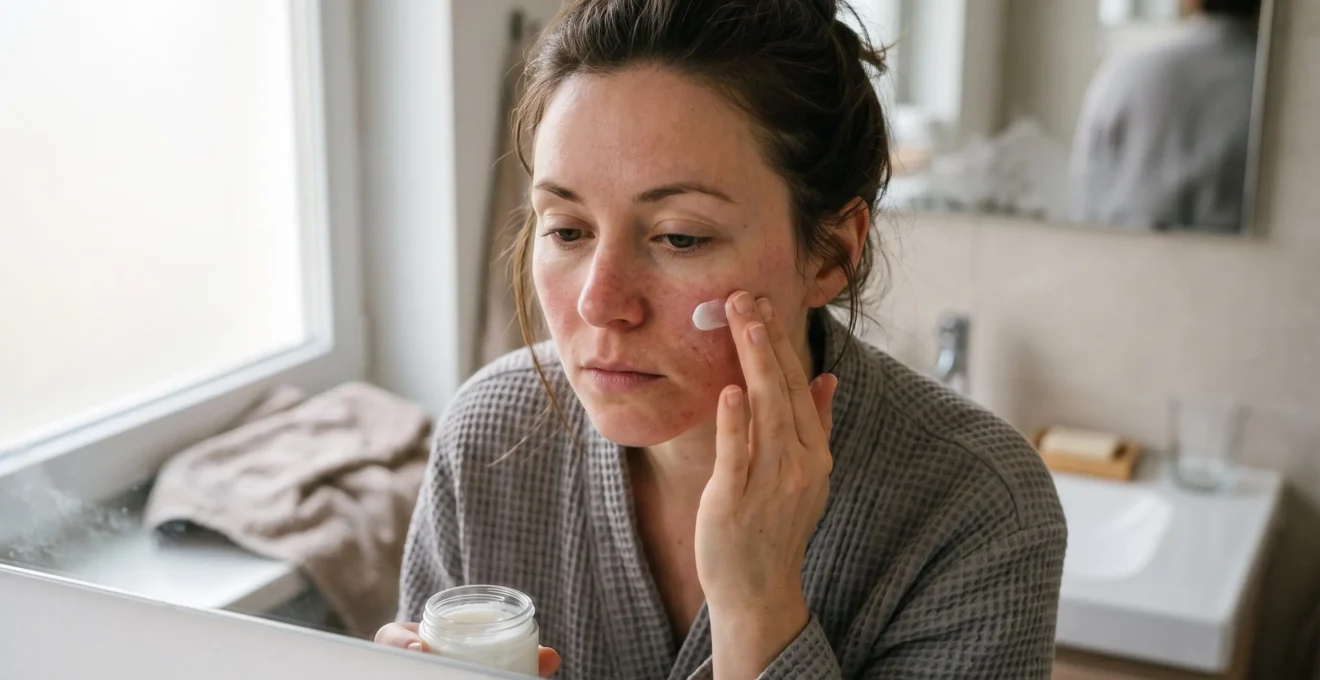
Burning, tightness, flaking, redness, and unexpected breakouts after introducing retinoids or exfoliating acids can indicate that your skincare routine is irritating your skin. The first priority is not to find another active ingredient that promises faster recovery. It is to reduce irritation, restore comfortable hydration, and give the skin time to recover.
Your natural moisture barrier helps limit water loss and protects the skin against environmental irritants. When repeated exposure to irritating products disrupts this protective function, even water or a familiar moisturizer may temporarily sting. Continuing to exfoliate, switching between potent ingredients, or repeatedly testing new products can prolong the problem.
A practical recovery approach starts with a gentle cleanser, a well-tolerated moisturizer, and a temporary pause on nonessential actives. Improvement may begin within days, but complete recovery does not follow a universal seven-day schedule. Persistent or severe symptoms can indicate a condition that needs medical assessment rather than another cosmetic product.
Quick Guide to Skin Barrier Repair
- Pause irritating cosmetic actives, particularly retinoids and exfoliating acids, when burning, persistent redness, or peeling develops.
- Keep your routine simple with gentle cleansing and a moisturizer that supports hydration without unnecessarily irritating acne-prone skin.
- Resume active ingredients gradually only after your skin has settled, and seek professional advice for severe, persistent, or worsening symptoms.
- Why Does Damaged Skin Barrier Cause Both Dryness and Breakouts at the Same Time?
- How to Start a Barrier Repair Routine Using Only 2 Products and 7 Days?
- Stop All Actives or Keep One: What Should You Do When Your Barrier Feels Burned?
- The Barrier-Damage Mistake That Can Turn Mild Irritation Into Weeks of Sensitivity
- When Can You Restart Retinoids After Barrier Damage Without Triggering Another Flare?
- How to Cleanse Your Face in 60 Seconds Without Stripping It?
- How to Choose a Moisturiser in 5 Minutes by Checking 3 Label Clues?
- How Do You Choose an Appropriate Moisturiser If Everything Feels Either Greasy or Dry?
Why Does Damaged Skin Barrier Cause Both Dryness and Breakouts at the Same Time?
Damaged or irritated skin can feel dry and develop breakouts at the same time because water loss, inflammation, and acne are not mutually exclusive. A weakened barrier may make the skin feel tight and reactive, while existing acne or irritation from skincare products creates bumps. These symptoms can overlap, but they do not necessarily share one cause or require the same treatment.
The outermost skin layer helps retain moisture through an organised structure of skin cells and lipids, including ceramides. When irritating products or excessive cleansing disrupt this structure, the skin may lose water more readily. It can then become rough, flaky, tight, or unusually sensitive to products that previously felt comfortable.
Breakouts need a more careful interpretation. Small red bumps that appear soon after introducing a retinoid or exfoliating acid may reflect irritation, but appearance alone cannot reliably distinguish irritation-related inflammation from acne. Blackheads, whiteheads, and recurring acne lesions may indicate underlying acne rather than barrier damage alone. Location, timing, texture, and recent product changes are useful clues, not a definitive diagnostic test.
Dryness may also contribute to an uncomfortable cycle. The American Academy of Dermatology advice on moisturizers for acne explains that excessive dryness can stimulate additional oil production, which may contribute to clogged pores and breakouts. That does not mean every dry face produces excess oil or that barrier damage directly causes acne bacteria to multiply.
For acne-prone skin, removing every moisturizer is therefore not a reliable solution. Choose a lightweight or otherwise comfortable, non-comedogenic formula and monitor whether symptoms improve. Such labeling reduces the likelihood of clogged pores but cannot guarantee that an individual product will suit every person.
The practical objective is to improve hydration without aggravating existing acne. If painful nodules, persistent comedones, spreading redness, or recurrent inflammation continue after irritating products have been removed, seek advice about the underlying skin condition instead of assuming that every blemish is a barrier problem.
How to Start a Barrier Repair Routine Using Only 2 Products and 7 Days?
A simple barrier-repair routine can begin with two products: a gentle cleanser and a well-tolerated moisturizer. For the first week, the goal is to reduce unnecessary irritation and observe whether tightness, redness, and sensitivity improve. Seven days is a practical observation period, not a guaranteed recovery deadline or a substitute for medical treatment when symptoms are severe.
Choose a cleanser formulated to clean without leaving your skin tight or uncomfortable. Mild synthetic-detergent cleansers, often called syndets, can be preferable to traditional alkaline soaps. A moisturizer should help retain water and soften the skin; ingredients such as glycerin and ceramides can be useful options. The exact formula matters more than buying the largest number of products or chasing a particular ingredient concentration.
During days one and two, cleanse gently in the evening and apply moisturizer. In the morning, use lukewarm water alone if that is more comfortable, followed by moisturizer as needed. Avoid introducing new exfoliants, masks, scrubs, or potent serums simply because your skin feels dry.
During days three to five, keep the routine consistent and assess how your skin responds. During days six and seven, review the changes rather than automatically adding another product. If your skin tolerates sunscreen, continue using a suitable broad-spectrum product. If your current sunscreen stings, consider a fragrance-free alternative, including a mineral formula if better tolerated, and use shade and protective clothing while seeking advice if necessary.
Look for three practical signs of improvement: less tightness after cleansing, decreasing redness, and less discomfort when water or moisturizer touches the skin. These observations are useful for deciding what to do next, but they do not prove that the barrier has completely recovered.
Your Seven-Day Barrier Repair Checklist
- Remove nonessential actives from your daily routine. Deliverable: a written list of products temporarily paused.
- Choose one gentle cleanser that does not leave your skin tight. Deliverable: the selected cleanser and its ingredient label.
- Choose one well-tolerated moisturizer with hydrating and barrier-supporting ingredients. Deliverable: the product name and INCI list.
- Record your skin’s response each day without deliberately provoking a reaction. Deliverable: a seven-day log of redness, tightness, peeling, and stinging.
- Review the log and decide whether symptoms are improving, unchanged, or worsening. Deliverable: a documented decision to continue, adjust the routine, or contact a healthcare professional.
If pain, crusting, oozing, marked swelling, or worsening redness develops, do not wait until day seven to seek medical advice. These symptoms may indicate more than uncomplicated cosmetic irritation and can require treatment beyond a simplified skincare routine.
Stop All Actives or Keep One: What Should You Do When Your Barrier Feels Burned?
When your skin burns, becomes persistently red, or starts peeling after using active ingredients, temporarily stopping nonessential irritating products is usually the safer starting point. Retinoids and exfoliating acids deserve particular attention. Whether a milder ingredient can remain depends on symptom severity, the product formulation, and your skin’s response; there is no universally validated three-level classification that determines which actives are safe for everyone.
Use the following practical guide to decide how cautious to be.
| Observed symptoms | Practical response | Next decision |
|---|---|---|
| Occasional mild tightness without persistent redness or pain | Review the frequency and amount of irritating products. Reduce unnecessary steps and monitor closely. | Pause an active if symptoms continue or worsen. |
| Persistent redness, repeated stinging, or visible peeling | Pause nonessential retinoids, exfoliating acids, and other products that appear to aggravate symptoms. | Keep cleansing and moisturizing gentle; seek advice if symptoms persist. |
| Significant pain, painful touch, severe peeling, swelling, or weeping skin | Stop experimenting with cosmetic products and obtain prompt medical assessment. | Do not attempt to manage severe symptoms by switching actives. |
Retinoids, alpha-hydroxy acids (AHAs), and beta-hydroxy acids (BHAs) can irritate skin, particularly when several are used together or too frequently. Replacing retinol with an exfoliating acid is not necessarily a gentler alternative. Both may continue to aggravate an already irritated skin surface.
Azelaic acid or low-concentration niacinamide may be tolerated by some people, but neither is automatically safe during a flare. If a product stings or appears to worsen redness, do not keep applying it to test your tolerance. A ten-minute trial is not a validated method for establishing that an ingredient is safe for a compromised barrier.
Prescribed treatments require additional care. Do not independently change or discontinue a medical treatment for acne, rosacea, or another skin condition without consulting the prescribing clinician. They can advise whether a temporary pause, altered application frequency, or different formulation is appropriate.
Once the skin is comfortable again, products can be reconsidered individually. The priority is to establish a tolerable baseline first, rather than preserving every step of an ambitious routine at the expense of ongoing inflammation.
The Barrier-Damage Mistake That Can Turn Mild Irritation Into Weeks of Sensitivity
One common mistake is repeatedly testing irritated skin to see whether it has recovered. Applying an exfoliant to check for stinging, trying another serum, using a scrub, or introducing a supposedly soothing mask can expose the skin to additional irritants before it has had time to settle. Repeated exposure can sustain irritation, although it does not mean that every mild reaction will inevitably develop into weeks of sensitivity.
DermNet clinical information on irritant contact dermatitis explains that chemical and physical irritants can damage the skin faster than it can repair itself. Irritants may remove surface lipids and natural moisturizing factors, while friction and repeated exposure can contribute to inflammation. Topical retinoids and benzoyl peroxide are among the products that can cause irritant contact dermatitis in some circumstances.
This is why repeatedly changing products is not a reliable recovery strategy. A formula described as calming or natural may still contain fragrance, essential oils, or other ingredients that irritate an individual’s skin. Alcohol-containing facial mists and aggressive cleansing can add unnecessary exposure, too.
A temporary cosmetic reset means removing nonessential steps until symptoms settle. Keep only products that are genuinely needed and comfortably tolerated, rather than introducing several new hydrating serums, masks, and heavy creams at once. Multiple layers do not automatically improve recovery, and a rich product can feel uncomfortable or prove unsuitable for a particular person’s skin.
There is no established universal duration for this simplified routine. Some irritation settles relatively quickly; more persistent irritant contact dermatitis can take longer to improve. If a previously tolerated moisturizer begins to sting, do not assume that the product has suddenly become toxic or that your skin is permanently damaged. The skin may simply be more reactive, or another condition may be present.
Seek professional assessment if sensitivity persists despite avoiding suspected irritants, or if the reaction is severe. Allergic contact dermatitis, rosacea, acne, and infection can resemble aspects of cosmetic irritation but may require different management.
The most useful test of recovery is not whether the skin can tolerate an aggressive ingredient for a few minutes. It is whether everyday cleansing and moisturizing become comfortable again without persistent redness, pain, or worsening symptoms.
When Can You Restart Retinoids After Barrier Damage Without Triggering Another Flare?
You can consider restarting a retinoid when the irritation has settled, your skin is no longer persistently red or peeling, and applying a familiar moisturizer no longer causes unusual stinging. There is no single number of recovery days that works for everyone. The appropriate timing depends on the severity of the initial reaction, the retinoid formulation, and whether it was prescribed for a medical condition.
Before restarting, assess how your skin responds to ordinary care. Look for comfortable cleansing, stable hydration, and the absence of ongoing burning or obvious inflammation. A smooth texture can be reassuring, but appearance alone cannot prove that the skin has fully recovered.
Reintroduction should be gradual. If a clinician agrees that restarting is appropriate, options may include using the product less frequently, applying a smaller amount, or choosing a less irritating formulation. Starting at a low frequency, such as once weekly, may be a cautious option for some cosmetic routines, but it is not a universally validated restart schedule.
Applying moisturizer before a retinoid may improve tolerability for some people. The moisturizer-retinoid-moisturizer sandwich is another commonly used approach, but it is not guaranteed to prevent irritation in every case. Follow the instructions for the specific product, including whether it should be applied to dry skin.
The American Academy of Dermatology acne treatment recommendations explain that dermatologists may improve retinoid tolerance by adjusting the amount, reducing application frequency, or recommending moisturizer before application. Changes to prescribed treatment should be discussed with the treating dermatologist.
Concentration matters as well as frequency. A lower-strength or differently formulated product may be easier to tolerate, but switching to a new retinoid does not eliminate the risk of irritation. Avoid combining the restart with exfoliating acids or other newly introduced actives until your routine is stable.
If burning, renewed redness, or peeling returns after restarting, stop escalating the routine and reassess. Repeated or severe reactions warrant professional advice. Do not dismiss burning as a necessary purging phase: irritation is not proof that a retinoid is working effectively.
For prescribed retinoids, the next step is to confirm a suitable restart plan with the prescriber. For nonprescription products, wait until your skin is settled and change one variable at a time so that any returning irritation is easier to identify.
How to Cleanse Your Face in 60 Seconds Without Stripping It?
When your skin barrier feels compromised, cleanse gently with lukewarm water, a small amount of mild cleanser, and your fingertips. Avoid scrubbing, hot water, abrasive cloths, and repeated washing. Sixty seconds is a practical upper limit for a simple cleansing step, not a scientifically established threshold that guarantees the skin will retain all its protective lipids.
Choose the cleanser according to your skin’s current tolerance. Cream or lotion cleansers can feel comfortable during a flare, but texture alone does not determine gentleness. Formulation, surfactant type, concentration, pH, and rinsability all affect how a product interacts with the skin.
A scientific review, Skin Cleansing without or with Compromise: Soaps and Syndets, describes the skin’s surface pH as generally ranging from 4.0 to 6.0 and explains that traditional alkaline soaps can disturb surface lipids and proteins. Mildly formulated synthetic-detergent cleansers, or syndets, can be preferable to harsh traditional soaps. A cleanser does not need to have a pH of exactly 5.5 to be suitable.
Use a small amount of product, massage it lightly without rubbing, and rinse thoroughly. Pat your face dry rather than dragging a towel across it. If even a gentle cleanser causes substantial discomfort, using water alone temporarily may be more comfortable, particularly in the morning. Persistent stinging should prompt reassessment rather than increasingly elaborate cleansing techniques.
Watch for warning signs that a cleanser is too harsh for your current skin condition:
- A tight, squeaky-clean sensation immediately after rinsing.
- Increasing dryness or discomfort within minutes of washing.
- Redness or burning that repeatedly follows cleansing.
- A strong urge to apply multiple products immediately to relieve tightness.
When testing a potential replacement, introduce it as the only routine change and observe how your skin responds during ordinary use. Do not deliberately leave a product on irritated skin to see how much discomfort it causes.
If you wear makeup or water-resistant sunscreen, you may need a suitable removal step. A gentle makeup remover or cleansing balm can help, followed by a mild cleanser if necessary. However, double cleansing is not mandatory for every product or every person. Avoid adding a second foaming cleanser automatically if the first step already removes what you need to remove.
After cleansing, apply moisturizer while the skin is still slightly damp if this feels comfortable. If washing continues to cause pronounced burning, worsening redness, or persistent pain, seek medical advice instead of assuming that a different cleansing duration will solve the problem.
How to Choose a Moisturiser in 5 Minutes by Checking 3 Label Clues?
Choose a moisturizer by looking for a combination of hydrating and skin-conditioning ingredients, checking for avoidable irritants, and considering whether the formulation suits your skin. A quick label review can narrow your options, although no three clues can guarantee that a product will be tolerated. During a flare, a simple fragrance-free formula is often a more practical starting point than an elaborate product marketed as clean or corrective.
Clue 1: Look for ingredients that support hydration. Glycerin is a humectant that helps attract and retain water in the outer skin layer. Ceramides help support the skin’s lipid barrier, while squalane can provide emollient benefits. A formula combining humectants with suitable emollient ingredients may be more useful than one selected for a single headline ingredient. Ingredient position can provide context, but it does not reveal the exact concentration or effectiveness of every component.
Clue 2: Check for potential irritants. During recovery, consider avoiding added fragrance and essential oils, particularly if your skin is reactive. Denatured alcohol high in the ingredient list may be a reason to inspect the formula more carefully, although its presence alone does not establish that a product is harmful. Avoid moisturizers that also contain exfoliating acids or retinoids while these ingredients are contributing to irritation.
Clue 3: Consider suitability for your skin. Products labelled fragrance-free and non-comedogenic can be useful starting points for sensitive or acne-prone skin. Non-comedogenic does not mean that breakouts are impossible, and sensitive-skin claims do not guarantee that a formula will suit an individual.
Other potentially useful ingredients include panthenol, allantoin, and bisabolol, but ingredient tolerance varies. A moisturizer does not need to contain every soothing ingredient to be effective. A basic pharmacy moisturizer with a straightforward formula may be sufficient.
Use this five-minute shopping process:
- Read the ingredient list and identify a humectant such as glycerin.
- Look for a suitable emollient or barrier-supporting ingredient, such as ceramides or squalane.
- Check for fragrance and essential oils if these are potential triggers for your skin.
- Look for non-comedogenic positioning if you are prone to acne, while remembering that the label is not a guarantee.
- Compare the full formulation and choose one product to try rather than buying several alternatives at once.
After selecting a moisturizer, monitor its performance over ordinary daily use. A brief label review can identify promising candidates, but actual tolerability matters more than marketing language or a long list of fashionable ingredients.
If a new moisturizer causes persistent burning, itching, swelling, or worsening redness, discontinue the suspected cosmetic product and seek advice when symptoms are significant or do not settle. These reactions should not be treated as evidence that the product is repairing the barrier.
Key Takeaways
- Ingredient selection and texture serve different purposes: a suitable formula must support hydration while remaining comfortable on your skin.
- Greasy and dehydrated sensations can coexist, so changing the quantity or texture may be more useful than repeatedly switching products.
- Evaluate the moisturizer during normal daily use before introducing another active ingredient or changing several steps at once.
How Do You Choose an Appropriate Moisturiser If Everything Feels Either Greasy or Dry?
If every moisturizer feels either greasy or insufficiently hydrating, the solution may be to adjust the formula’s texture and the amount applied rather than abandoning moisturizers altogether. Lightweight lotions and gel-creams can suit some people with oily or combination skin, while richer creams may be more comfortable for dry skin. The best option is the one that provides lasting comfort without aggravating irritation or breakouts.
A greasy sensation often reflects a formula that leaves more surface residue than you prefer. Rich emollients and occlusive ingredients can reduce water loss, but some formulations may feel too heavy for everyday use. At the other extreme, a lightweight gel may feel pleasant initially but provide insufficient conditioning for very dry or flaky skin.
Use the following guide as a starting point, not a rigid rule based on skin type alone.
| Skin condition | Texture to consider | Ingredients or application approach |
|---|---|---|
| Oily skin undergoing barrier repair | Light lotion or gel-cream | Consider glycerin and, if tolerated, niacinamide in a simple formulation. |
| Dry, flaky, or tight skin | Richer lotion or cream | Consider ceramides and suitable emollients such as squalane. |
| Combination skin with isolated dry areas | Light lotion across the face, with a richer product on dry patches if needed | Adjust the amount by area rather than coating the entire face with a heavy layer. |
| Skin that stings with many products | A simple, fragrance-free formula that is comfortably tolerated | Prioritize minimizing potential irritants and seek medical advice if reactions persist. |
The amount applied can matter as much as the texture. If your moisturizer leaves an uncomfortable film, try a smaller amount. If your skin feels tight again shortly after application, a more nourishing formulation or a slightly more generous amount may be appropriate. Avoid changing the product and application quantity simultaneously if you want to identify what actually helps.
Allow skincare layers to settle before applying the next product. If moisturizer pills beneath sunscreen or another necessary product, try using less, allowing more time between layers, or simplifying the combination. Pilling does not automatically indicate barrier damage, and it does not prove that a particular ingredient is incompatible with your skin.
Assess the result after approximately 48 hours of normal use, provided the product is comfortable and does not cause an adverse reaction. Notice whether tightness returns during the day, whether the finish feels persistently greasy, and whether new irritation appears. This short observation period helps assess immediate comfort, not long-term acne control or complete barrier recovery.
If the moisturizer is comfortable but your skin still feels dry, consider whether cleansing, environmental exposure, or another active product is contributing to the problem. Adding several serums or replacing the moisturizer every day makes it harder to identify the cause.
The next step is to keep the simplest comfortable routine and monitor the trend rather than pursuing a perfect finish immediately. If burning, marked redness, swelling, or persistent peeling continues despite removing likely irritants, a dermatologist can help determine whether another skin condition needs treatment.
How long does it take to repair a damaged skin barrier?
Recovery time varies according to the severity of irritation, the cause, and the individual’s skin condition. Mild irritation may improve within days after the triggering products are removed, while persistent irritant contact dermatitis can take longer. A seven-day routine is an observation framework, not a guarantee of complete recovery. Seek medical advice if symptoms worsen, persist, or include significant pain, swelling, or oozing.
Should you stop using moisturizer if it stings?
If a moisturizer repeatedly causes burning or worsens redness, do not continue applying it to test your skin. The formula may be unsuitable, or your skin may be unusually reactive. Consider removing the suspected product and seeking advice if symptoms are significant or persistent. A moisturizer that is labelled for sensitive skin is not guaranteed to be tolerated by everyone.
Can you use sunscreen while repairing your skin barrier?
Sun protection remains important during recovery. Continue with a broad-spectrum sunscreen that your skin tolerates, and consider a fragrance-free mineral formula if your current product stings. Hats, shade, and protective clothing can provide additional protection. If every sunscreen causes significant discomfort, ask a healthcare professional for guidance rather than repeatedly testing products on irritated skin.
Can a damaged skin barrier cause acne or small bumps?
Irritation can cause inflammatory bumps, while dryness may contribute to changes in oil production. However, acne, contact dermatitis, rosacea, and other conditions can produce overlapping symptoms. Small bumps following a new active ingredient do not automatically mean that your skin is purging or that the barrier is damaged. Persistent, painful, or worsening breakouts may need a professional assessment.
When should you see a dermatologist for skin barrier damage?
Seek prompt medical advice if you develop substantial pain, marked swelling, crusting, oozing, spreading redness, or severe peeling. Arrange an assessment if persistent irritation does not improve after removing suspected triggers, or if your symptoms repeatedly return when using ordinary skincare products. A clinician can help distinguish irritation from allergic contact dermatitis, acne, rosacea, infection, or another condition requiring specific treatment.