
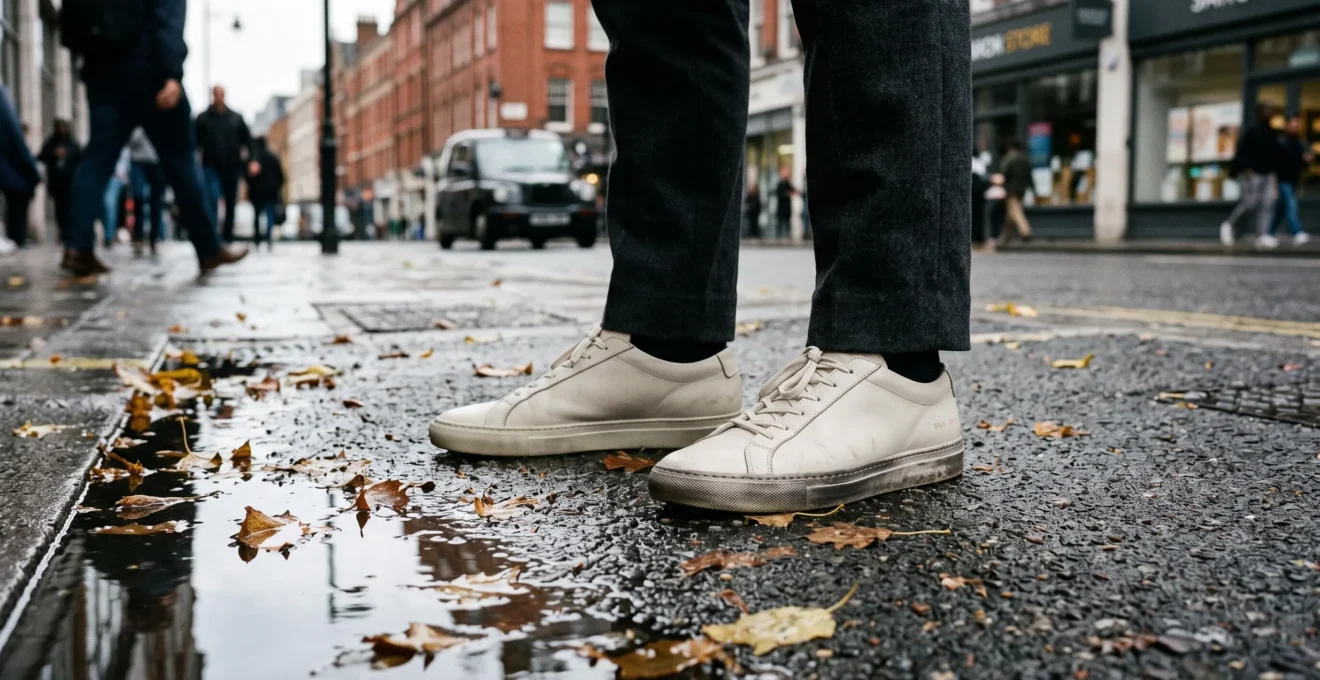
The minimalist sneakers most likely to look sharp after a rainy commute are low-profile leather pairs with a smooth, wipeable upper, restrained stitching, a stable rubber sole and a colour that disguises minor marks. Off-white, stone and light grey are particularly useful starting points. The important distinction is between a sneaker that looks clean when new and one that is easy to restore after walking through wet streets.
Rain introduces a problem that product photography rarely shows. Water marks, pavement grime and dirt collected around the sole can make an otherwise elegant shoe look tired long before its construction actually fails. A minimalist design leaves those imperfections unusually exposed.
The best choice also needs to work with the clothes worn after the commute. A comfortable sneaker that overwhelms tailored trousers is no more useful than a beautiful leather pair that leaves feet overheated. Upper material, lining, sole proportions, fit and maintenance all affect the result.
There is no completely maintenance-free solution. However, choosing a forgiving material and developing a short after-rain routine can make everyday smart-casual dressing considerably easier.
Minimalist sneakers for rainy commutes: the essentials
- Choose wipeable materials: smooth, finished leather is a practical starting point for light rain, while absorbent textiles and delicate suede require more caution.
- Keep the silhouette restrained: a slim sole, simple toe shape and minimal branding help sneakers work with chinos and tailored trousers.
- Maintain them after wet journeys: remove surface moisture and grime, air-dry fully and rotate pairs rather than repeatedly wearing damp shoes.
- Why Do “Clean” Sneakers Start Looking Worn Out So Quickly?
- How to Choose Minimalist Sneakers That Work With Trousers, Not Just Jeans?
- Leather or Knit Sneakers: Which Is Better If Your Feet Run Hot?
- The Minimalist Sneaker Mistake That Makes Smart Casual Look Sloppy
- When Should You Clean Minimalist Sneakers So Stains Don’t Set Permanently?
- How to Choose One Pair of Shoes That Works With 80% of Your Wardrobe?
- How to Test Leather Boots in 5 Minutes So You Don’t Need a Painful Break-In?
- Which Pair of Shoes Gives You the Biggest Style Upgrade for Under £150?
Why Do “Clean” Sneakers Start Looking Worn Out So Quickly?
Minimalist sneakers often look worn before they become structurally worn out because their simple surfaces expose every stain, crease and colour change. Road residue can leave pale marks on leather, absorbent uppers can dry unevenly, and dirt around the midsole weakens the shoe’s clean outline. Repeatedly wearing damp shoes also makes them harder to keep fresh.
Three visible changes are especially common after wet journeys. First, rainwater carries dirt and sometimes dissolved salts onto the upper. When the moisture evaporates, residue may remain near seams or the sole edge. Second, porous knit and textile uppers can absorb dirty water, creating darker patches or uneven drying marks. Third, mud and grime collect around the midsole, making an otherwise slim sneaker appear neglected.
The effect is disproportionately noticeable on minimalist footwear. A technical running shoe may use contrasting overlays, patterned mesh and multiple colours. These details visually interrupt small marks. On a plain off-white leather sneaker, the same mark can become the most noticeable feature.
Not every mark represents permanent damage. Loose dirt, fresh surface residue and some water marks can often be removed with material-appropriate cleaning. By contrast, deeply absorbed staining, altered suede texture, persistent discolouration and yellowed bonding materials may be difficult or impossible to restore completely.
The less visible problem is moisture retained inside the shoe. A sneaker can feel dry on the outside while its lining, footbed or interior seams remain damp. Wearing it again before those components dry encourages persistent odour and exposes the materials to repeated moisture and flexing. It does not mean every damp sneaker will deform permanently, but it can undermine comfort and make maintenance less effective.
This is why the distinction between cleaning and drying matters. According to adidas‘ sneaker-cleaning instructions, loose dirt should be removed gently, uppers should be cleaned with suitable tools, and sneakers should air-dry at room temperature until both the interior and exterior are dry.
For commuters, the useful question is not simply whether the upper resists rain. It is whether the whole shoe can be cleaned and dried without much effort between wears.
Once those risks are clear, the next consideration is visual proportion: even a spotless sneaker can look wrong when its shape clashes with smarter trousers.
How to Choose Minimalist Sneakers That Work With Trousers, Not Just Jeans?
Minimalist sneakers work best with tailored trousers when their shape follows the outfit’s restrained proportions. Look for a relatively low-profile sole, a neat rounded or softly tapered toe, minimal side branding and a collar that sits naturally beneath the trouser hem. The goal is a deliberate transition from fabric to footwear rather than a bulky interruption.
Jeans can accommodate substantial sneaker volume because denim has visual weight and a relatively casual texture. Wool trousers, lightweight chinos and cropped tailoring are less forgiving. A thick, contrasting sole can draw attention away from the trousers and make the outfit look bottom-heavy.
The relationship between hem and shoe is particularly important. When trousers have little or no break, the full upper and collar become visible. A clean ankle line can look intentional, but a high, padded collar or oversized tongue may disrupt it. With slightly longer trousers, the hem should fall smoothly rather than bunching awkwardly over the sneaker.
Use this comparison when narrowing down candidate pairs.
| Feature | Usually works better with tailoring | More difficult to style |
|---|---|---|
| Sole profile | Slim or moderately thick with a clean edge | Very chunky or aggressively sculpted |
| Toe shape | Neat, rounded or subtly tapered | Bulky, exaggerated or heavily reinforced |
| Upper finish | Matte, smooth or lightly textured | Highly glossy or visually busy |
| Branding | Minimal, discreet or tonal | Large contrasting side logos |
| Colour | Off-white, stone, taupe or light grey | High-contrast combinations requiring careful coordination |
| Collar and tongue | Compact and unobtrusive | Oversized padding or a prominent tongue |
Colour also affects how gracefully a pair ages. Brilliant optic white creates a striking contrast with dark trousers but makes everyday grime noticeable. Off-white and light grey can look softer against navy, charcoal and earthy colours. They are not inherently more durable, however; their advantage is mainly visual.
Test sneakers against the trousers actually worn during the week. A pair that looks excellent beside rolled denim in a product photograph may look too athletic beneath pleated wool trousers.
Imagine three regular outfits: charcoal work trousers, beige chinos and dark jeans. If the sneaker looks proportionate with all three, it is a stronger candidate than one that works only with the jeans. Check the appearance from standing height, not just in a close-up product image.
For frequent wet-weather wear, a smooth leather upper with tonal stitching offers a useful combination of formality and relatively straightforward surface cleaning. Suede may be equally attractive with tailoring, but its care requirements deserve more consideration.
Once the silhouette works, material becomes the next decision. It determines how the shoes manage rain, heat and the moisture produced during a long day.
Leather or Knit Sneakers: Which Is Better If Your Feet Run Hot?
Knit sneakers can be more comfortable for hot feet because open textile constructions often allow greater airflow, but they may also admit rain more readily. Finished leather provides a more substantial barrier against light splashes, although it can retain more heat. Neither material is automatically superior: lining, ventilation, water protection and drying behaviour matter as much as the visible upper.
The trade-off becomes clear on a typical commute. A lightweight knit sneaker may feel airy during a warm train journey but leave socks wet after walking through rain. A smooth leather sneaker may be easier to wipe clean when arriving at work, yet become uncomfortable if its lining restricts airflow.
It is important not to confuse water absorption with drying speed. Some synthetic uppers dry relatively quickly, while dense knitted structures, absorbent linings and padded components can retain moisture. Similarly, leather may resist superficial wetting without being waterproof. Once thoroughly saturated, some leather constructions can take considerable time to dry.
REI‘s footwear materials and construction advice explains that upper materials influence breathability, durability, weight and water resistance. Its guidance concerns hiking footwear rather than smart-casual sneakers, so it supports the general material trade-offs rather than a universal leather-versus-knit verdict.
The interior construction deserves close inspection. Two leather sneakers with similar external appearances may use very different linings. One may feature moisture-management materials and ventilation openings; another may have substantial padding and a less permeable inner structure. Even a breathable upper cannot guarantee a comfortable microclimate if the rest of the shoe retains moisture.
Waterproof membranes introduce another compromise. REI’s separate explanation of waterproof footwear notes that barriers may help keep external water out while increasing heat retention and limiting the escape of water that enters through the shoe opening. This principle is worth remembering when evaluating weatherproof sneakers.
Odour management is another consideration. Knit surfaces, internal padding and footbeds can retain perspiration and absorbed contaminants, while smooth finished leather is generally easier to wipe at the surface. However, the interior of a leather shoe can still develop odour if it remains damp.
Use the behaviour of existing footwear as a practical guide:
- If feet become hot but socks remain relatively dry, prioritise ventilation, suitable lining and enough internal space.
- If socks become noticeably damp from perspiration, examine moisture-management linings and removable footbeds rather than judging the upper alone.
- If rain exposure is frequent, favour an upper that resists everyday splashes and can be cleaned without soaking.
- If shoes remain damp the following morning, consider a faster-drying construction or a second pair for rotation.
For a warm-footed commuter who regularly wears tailored clothing, a moderately ventilated, smooth-leather sneaker is often a reasonable compromise. In hotter, drier conditions, a restrained textile sneaker may be more comfortable.
Material selection addresses comfort and weather exposure. Keeping the result smart-casual requires equal attention to the sneaker’s visible condition.
The Minimalist Sneaker Mistake That Makes Smart Casual Look Sloppy
The most common styling mistake is wearing visibly neglected minimalist sneakers with otherwise carefully chosen clothing. Scuffed toes, dirty laces, stained collars and grime around the sole make the outfit appear less deliberate. Because minimalist footwear depends on visual simplicity, its condition plays a larger role in the overall impression than many commuters expect.
Minimalist does not mean maintenance-free. In fact, a plain upper removes the decorative elements that might otherwise disguise wear. When a crisp shirt, well-fitting trousers and clean outerwear are paired with visibly tired sneakers, the contrast can make the footwear look accidental rather than relaxed.
There is a difference between natural ageing and neglect. Gentle leather creasing can give a shoe character, especially when the finish develops an even patina. Deeply embedded dirt, salt residue or damaged edging, however, can make the same shoe appear poorly maintained.
A second mistake occurs at the buying stage: choosing a shoe that is technically minimalist but visually overworked. A shiny upper, exaggerated toe, conspicuous athletic sole or highly contrasting laces can undermine the restrained look. A cleaner smart-casual result usually comes from letting shape and material do the work.
Assess the shoes from standing height before leaving. This approximates how they will appear as part of the complete outfit rather than as an isolated object held close to the face.
Check three areas:
- Toe box: look for noticeable scuffs, dark patches or uneven staining.
- Sole edge: check for road grime, pale residue and discolouration.
- Collar and laces: identify visible dirt, twisting or wear that makes the shoe look untidy.
This inspection need not demand perfectly pristine footwear. A small crease or a little ordinary wear may be acceptable, particularly in relaxed workplaces. The question is whether the shoe still looks intentional beside the rest of the outfit.
A useful personal threshold is straightforward: if a visible mark becomes the first thing noticed about the sneaker, clean it before pairing the shoe with smarter clothing.
The easiest way to preserve that polished appearance is to intervene before grime becomes difficult to remove, rather than relying on occasional intensive cleaning.
When Should You Clean Minimalist Sneakers So Stains Don’t Set Permanently?
Minimalist sneakers should be checked after each wet or muddy commute and cleaned when contamination is present, rather than only on a fixed weekly schedule. Remove surface moisture and fresh residue promptly, then treat remaining stains with a method suited to the material. Shoes should dry fully before being worn again, and aggressive scrubbing of delicate wet uppers should be avoided.
The timing matters because some contaminants become more difficult to remove after drying or penetrating a material. Mud can lodge in textured surfaces, while dissolved salts may leave visible deposits as moisture evaporates. However, no universal deadline guarantees stain removal, and the effect depends on the upper, finish and substance involved.
A practical routine has three levels. After a wet journey, gently wipe smooth finished leather with a suitable soft cloth, paying particular attention to the sole edge. If visible marks remain, perform a targeted clean using the manufacturer’s approved method. Reserve more thorough cleaning for a time when the shoes can dry completely before their next use.
For knit uppers, allow heavy surface mud to dry enough to remove loose particles gently rather than rubbing abrasive grit into wet fibres. Follow material-specific cleaning instructions and avoid soaking components unnecessarily. Suede and delicate leather may require dedicated brushes or care products rather than the techniques used on finished leather.
Drying is not an optional final step. Use room-temperature airflow, avoid direct heat sources and ensure the inside of the shoe is dry before wearing it again. Paper stuffing or a suitable shoe form can help support the shape, provided the manufacturer’s care instructions permit it.
The five-action rainy-commute sneaker care checklist
- Inspect both sneakers on arrival. Identify the toe box, sole edge and upper areas that need attention; the result is a short, visible list of marks to address.
- Remove loose surface moisture and grime. Use a suitable soft cloth on wipeable surfaces; the result is an upper free of obvious wet residue.
- Spot-clean remaining marks appropriately. Match the brush, cloth or cleaning product to the material; the result is a treated stain without unnecessarily wetting the whole shoe.
- Air-dry the pair completely. Place the shoes in a ventilated room away from direct heat; the result is footwear dry inside and out before reuse.
- Prepare for the next wet journey. Inspect the finish and apply a compatible protective treatment when appropriate; the result is a ready-to-wear pair with its condition checked.
Preventive treatment can make maintenance easier, particularly on materials for which the manufacturer recommends water repellency products. Apply only a compatible product to clean, dry shoes, follow its instructions and test inconspicuously where appropriate. A repellent does not make every sneaker waterproof or prevent all staining, and treatments may change the appearance or feel of some materials.
Rotating footwear is often more useful than repeatedly cleaning the same damp pair. A second option allows time for drying, particularly in a climate where wet journeys occur on consecutive days.
Good maintenance supports appearance, but it also changes the value of the original purchase: a shoe that remains presentable through regular use can serve more outfits over time.
How to Choose One Pair of Shoes That Works With 80% of Your Wardrobe?
To choose shoes that work with 80% of your wardrobe, start by identifying the trousers and outfits you actually wear most often. Compare candidate sneakers against those combinations, giving greater weight to frequently repeated outfits. The 80% figure is a personal target, not a proven level of versatility that any particular sneaker can guarantee.
A useful audit begins with three or four common bottom silhouettes. For example, a commuter might regularly wear navy chinos, charcoal wool trousers, dark jeans and beige casual trousers. Those four categories provide a more realistic test than asking whether a pair looks universally stylish.
Frequency matters. If navy chinos are worn three days a week and jeans only at weekends, a shoe that complements the chinos should receive more weight in the decision. Counting every wardrobe item equally can give an inaccurate picture of usefulness.
Colour is the quickest way to narrow the selection. Off-white, light grey, taupe and stone are adaptable starting points for many contemporary wardrobes. They sit between stark white and black, making them relatively easy to combine with both darker tailoring and lighter casual clothes.
These are styling guidelines, not universal rules. Black sneakers can be exceptionally versatile in a predominantly dark wardrobe, while bright white can complement sharply contrasting outfits. The right neutral is the one that suits the wearer’s actual colour palette.
Consider a hypothetical wardrobe with five regularly repeated outfit combinations. A candidate sneaker that looks appropriate with four of them meets an 80% outfit-coverage target in this simplified example. If those outfits are worn at different frequencies, the calculation should instead reflect how often each combination is used.
The compromise is that the most versatile sneaker may not be the ideal choice for any single outfit. A slim leather pair might be dressy enough for office chinos and relaxed enough for jeans without outperforming formal leather shoes or athletic trainers in their respective settings.
Rain changes the calculation further. A suede sneaker that looks excellent with every outfit but requires careful protection during most commutes may be less useful in practice than a smooth-leather pair that complements slightly fewer combinations yet remains easier to maintain.
Count wearable occasions, not theoretical outfit matches. Include weather, walking distance, workplace expectations and the amount of care the shoe needs.
Once a pair passes that test, fit becomes the final major obstacle: even the most versatile shoe is a poor investment if wearing it hurts.
How to Test Leather Boots in 5 Minutes So You Don’t Need a Painful Break-In?
A five-minute footwear test can reveal common comfort problems before buying leather sneakers or boots. Check where the sole flexes, whether the heel feels stable, whether internal seams rub and whether the toe box allows natural movement. Then walk in the shoes using the socks normally worn. Do not rely on painful footwear becoming comfortable after breaking in.
The same principles used to assess leather boots apply to many minimalist leather sneakers. A relatively simple upper does not guarantee a soft fit, and a slim appearance does not reveal how the sole behaves underfoot.
Start with the natural flex point. The shoe should bend appropriately around the ball of the foot during walking, rather than forcing the foot to fight an unusually rigid forefoot. It should also retain enough midfoot stability to feel supportive rather than twisting excessively.
Next, examine the heel counter. A supportive heel structure is useful, but it must not dig into the foot. Press gently around the heel area, feel the internal collar and inspect any seams that may contact the ankle. A seam that already creates a concentrated pressure point deserves attention.
Check the toe box without assuming that a tapered appearance means an acceptable fit. The toes should not feel compressed, and the forefoot should have enough room for natural movement. Cushioning and a removable footbed may improve practicality, but neither compensates for an incorrect shape or size.
The American Podiatric Medical Association‘s footwear-fitting recommendations support checking heel stability, forefoot flexibility and immediate comfort. The referenced guidance is directed at older adults, so it should not be treated as a validated five-minute sneaker-testing procedure for everyone. Its warning against depending on break-in to solve discomfort is nevertheless relevant when evaluating a new pair.
For an efficient in-store assessment, divide the available time between handling the construction and actually walking. A shoe that feels acceptable while seated may reveal heel movement, pressure or uncomfortable flexing after several steps.
Leather will often soften and crease where it repeatedly bends, but this should not be mistaken for a solution to poor fit. Soft, supple leather may require little adjustment. Thicker leather can become more flexible with wear, yet a rigid sole, badly positioned seam or uncomfortable heel structure may remain problematic.
If a pair is purchased online, try it indoors on a clean, suitable surface while keeping it in returnable condition. Short trial sessions can help reveal fit problems. Conditioning should only be considered when appropriate for the particular leather and permitted by the manufacturer’s instructions; it is not a general remedy for uncomfortable new shoes.
Persistent pressure, heel rubbing or painful stiffness should trigger reconsideration of the fit. A return or different model is generally a more sensible response than committing to prolonged discomfort.
A comfortable, appropriately proportioned pair is now a realistic purchase candidate. The remaining question is how much to spend to get the greatest everyday improvement.
What matters before spending your budget
- Assess cost against the outfits and commuting conditions the shoes must handle, rather than judging price or branding in isolation.
- Prioritise an immediately comfortable fit, a clean silhouette and materials that can tolerate the maintenance routine realistically available.
- Budget for ownership as well as purchase: material-appropriate care and enough drying time are part of keeping one versatile pair presentable.
Which Pair of Shoes Gives You the Biggest Style Upgrade for Under £150?
For many smart-casual commuters, the strongest style upgrade under 150 £ is a well-fitting, low-profile sneaker in smooth, matte, light-neutral leather. The improvement comes from proportion, finish and compatibility with everyday trousers rather than a prominent brand name. A clean toe shape, restrained sole and manageable care requirements make the shoe useful beyond its first few wears.
At this budget, it is sensible to begin with construction rather than marketing. Inspect the upper finish, stitching, sole attachment and internal comfort. A shoe does not need elaborate detailing to look refined; in fact, conspicuous features can make it harder to pair with smarter clothing.
Consider the allocation of spending in practical terms. Upper material and sole construction deserve attention because they strongly influence appearance, water behaviour and durability. Fit is equally non-negotiable. Laces and removable insoles may be easier to change later, although they cannot correct a fundamentally unsuitable shoe.
The £80–£150 range can be used as a shopping filter, not as proof that every model within it offers equivalent quality. Retail prices fluctuate across countries, stockists and promotions, and a higher price does not automatically establish better rain resistance or comfort.
There are two useful buying strategies. The first is to choose one versatile pair that covers office days, social occasions and casual weekends. The second is to separate wet-weather commuting from smart-casual styling, using a more weather-resistant pair for difficult journeys and keeping another pair clean for indoor use.
For people exposed mainly to light rain, a smooth-leather minimalist sneaker may provide an effective single-pair compromise. For commuters walking long distances through persistent rain or standing water, a dedicated weather-protective option may be more realistic. Conventional leather sneakers are not substitutes for waterproof footwear in severe conditions.
Before paying, inspect the candidate from several angles. Look at the toe profile with the trousers normally worn, check for bulky sidewalls, assess whether the sole colour clashes with the upper and confirm that the shoe remains comfortable when walking.
The best purchase is the pair that continues to earn its place in the wardrobe. That means surviving ordinary use aesthetically as well as remaining comfortable.
Ownership habits determine whether the initial upgrade lasts. Keep a suitable cleaning cloth available, use compatible protective care when appropriate, allow complete drying after wet journeys and rotate footwear when weather makes repeated damp wear unavoidable.
Choose the pair that passes the trouser-proportion test, feels comfortable immediately and suits the weather actually encountered. Then make its care routine part of the purchase decision. A well-chosen pair under £150 can remain a useful smart-casual staple, provided its upkeep matches the demands placed on it.
Are minimalist leather sneakers waterproof?
Not necessarily. Finished leather can resist light rain and splashes, but water may still enter through seams, stitching, the tongue or the collar. Waterproof performance depends on the complete construction and any specifically designed protective features. For sustained heavy rain, choose footwear with suitable water protection rather than assuming ordinary leather is waterproof.
Can off-white sneakers look professional in a smart-casual workplace?
Yes, where the workplace dress code permits sneakers. A restrained off-white leather pair with minimal branding, a slim sole and a neat toe shape can complement navy chinos, charcoal trousers and other relaxed tailoring. The overall fit and condition of the shoes matter more than the colour alone.
Should wet sneakers be dried with a hairdryer or radiator?
Room-temperature air drying is generally the safer approach. Direct heat can be unsuitable for leather, adhesives and other shoe components. Remove surface dirt, support the shape if appropriate and leave the pair in a ventilated space until the lining, footbed and exterior are completely dry.
Is it better to own one expensive sneaker or two cheaper pairs?
It depends on weather exposure and how frequently the shoes are worn. One well-fitting, versatile pair may suit occasional wet commutes and a moderate walking routine. Two suitable pairs become more practical when regular rain makes full drying between wears difficult. The better option is the one that provides appropriate comfort, weather protection and usable rotation within the available budget.