
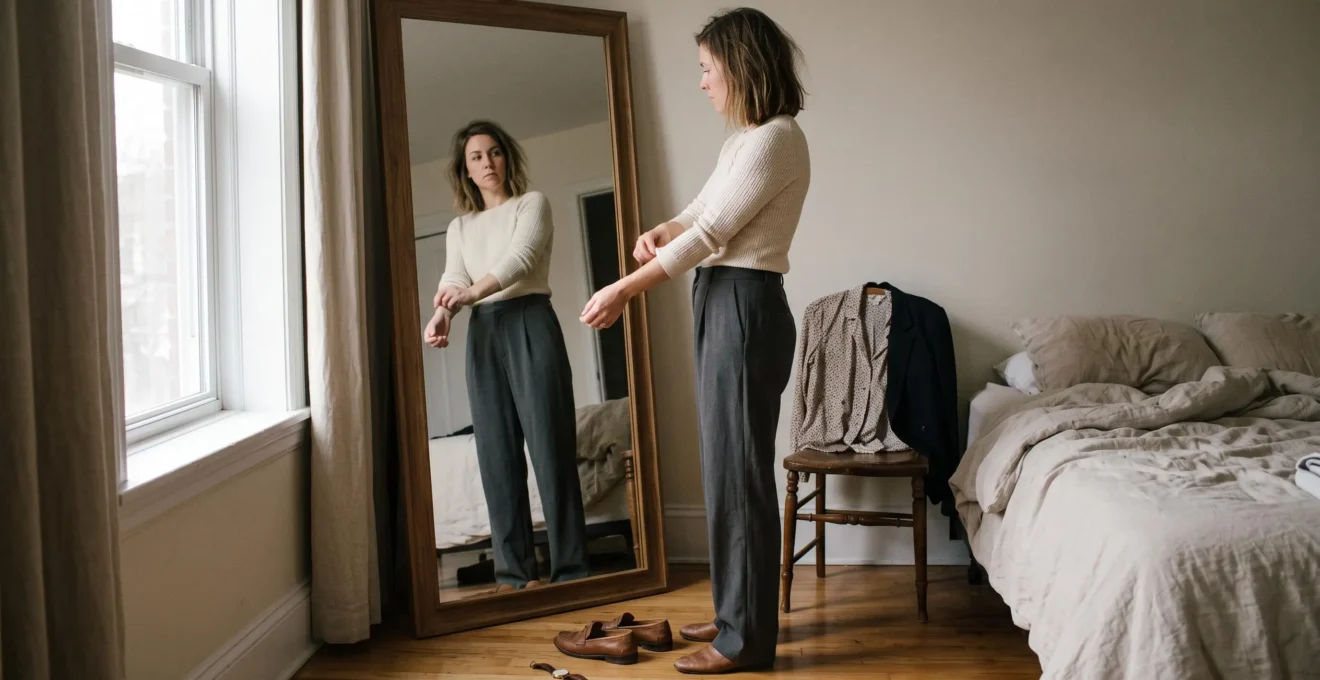
A memorable outfit does not require a designer label, a dramatic colour combination or a wardrobe full of statement pieces. It requires a few deliberate decisions that work together. When time is limited, the most useful priorities are proportion, fabric contrast and restraint: establish a clear silhouette, introduce visual interest through texture, then finish with one detail that feels distinctly yours.
The difference between an outfit that looks fine and one that people remember often lies in its overall shape rather than the number of individual pieces. A well-cut pair of trousers, a simple knit and clean shoes can create a stronger impression than several expensive items competing for attention. The result depends on how the pieces relate to one another and whether they suit the setting.
Clothing design principles identified by Utah State University Extension include proportion, balance, emphasis, rhythm and harmony. These provide a practical framework for combining clothes already in your wardrobe, although visual harmony remains subjective. The goal is not to follow a universal formula for attractiveness. It is to develop a reliable way to look considered without making getting dressed another demanding task.
With a prepared outfit formula and a short final check, ten minutes can be enough to create a look that works for a professional day, an informal meeting or an evening plan.
The 10-Minute Formula for a Memorable Outfit
- Choose a clear silhouette before deciding on colours or accessories.
- Use contrasting fabric textures to create interest without relying on trends.
- Repeat one recognisable detail and remove anything that competes with it.
- Why Do Your Outfits Look Forgettable Even When the Clothes Are Expensive?
- How to Build a Memorable Outfit in 7 Minutes Using Only Basics?
- Statement Piece or Clean Minimal Fit: Which Gets More Compliments at a Work Event?
- The One Styling Mistake That Makes a Memorable Look Feel Costume-Like
- A Simple Signature Outfit Formula You Can Reuse 30+ Times Without Boredom
- How to Dress for Authority in a Smart-Casual Office Without Wearing a Suit?
- How to Make an Outfit Look Intentional by Repeating 1 Detail 3 Times?
- How Do You Dress to Make a Deliberate Impression Without Looking Like You’re Trying?
Why Do Your Outfits Look Forgettable Even When the Clothes Are Expensive?
Outfits can look forgettable despite expensive clothing because price does not automatically create a coherent silhouette. Individual pieces may be attractive and well made, yet their proportions, textures and visual emphasis may not work together. A memorable look begins when the complete outfit reads as one deliberate shape rather than a collection of separate purchases.
Consider the difference between a beautifully made jacket that ends at an awkward point on your trousers and one that creates a clean relationship with the waistline. Both may be expensive, but the second is more likely to look intentional because the proportions support one another. The same principle applies to the balance between a relaxed top and a fitted bottom, or a structured jacket and fluid trousers.
Utah State University Extension’s clothing and textile design principles identify proportion as the relationship between the size and spatial arrangement of garment components. The guidance also discusses balance, emphasis, rhythm and harmony. These principles help explain how separate items can form a unified ensemble, but they do not prove that proportion makes an outfit more memorable than price.
Try the silhouette squint test. Stand in front of a full-length mirror and slightly narrow your eyes until small details become less prominent. Look at the outline: is there a clear relationship between your shoulders, waist, legs and hem lengths? Or does your attention jump between disconnected garments? This is a practical styling heuristic, not a validated scientific test, but it helps you assess the overall shape before getting distracted by accessories.
Another common problem is buying pieces in isolation. A striking coat, excellent shoes and several quality basics may all be good purchases, but if each requires a different silhouette, palette or styling approach, getting dressed becomes a fresh puzzle every morning. Build around an anchor piece instead: a jacket, trouser shape or knit that consistently creates a flattering, recognisable outline.
Visible luxury branding is not a guaranteed shortcut to a favourable impression, either. In a 2017 PLOS ONE study, Joël Berger reported that luxury labels affected some perceptions of wealth but did not consistently improve social interactions across five experiments. The research examined visible labels in specific Swiss settings, not the price or proportions of complete outfits, so it should not be used to claim that expensive clothing never matters.
The practical conclusion is simpler: before buying another premium item, examine the relationships between the pieces you already own. A single well-considered proportion can do more for the coherence of an outfit than adding several more neutral garments.
Once the shape is clear, you can make faster decisions about fabric and finishing details. That is the foundation for a repeatable morning routine rather than another round of wardrobe experimentation.
How to Build a Memorable Outfit in 7 Minutes Using Only Basics?
You can build a memorable outfit in seven minutes by choosing the silhouette first, contrasting fabric textures second and adding one finishing detail last. This order limits indecision and keeps the focus on the elements that make simple clothes look considered. It is a practical time-management method, not a scientifically established guarantee of outfit quality.
Minute 1: establish the silhouette. Choose one dominant relationship: a fitted top with relaxed trousers, or a looser top with a more defined lower half. Avoid making every garment oversized or every piece equally close-fitting unless that is a deliberate shape you already know works for you. Check where the top ends relative to the waistband and whether the trouser length works with your shoes.
Minutes 2–4: choose texture and structure. Basics become more visually interesting when their fabrics behave differently. A matte, substantial knit can balance a smoother shirt; structured cotton can work alongside fluid wool-blend trousers. A little sheen against a matte surface adds contrast without requiring a bright colour or a trend-led item. Consider weight and drape as well as colour: two garments in similar shades can still create a clear visual relationship through texture.
Minutes 5–6: use a finishing detail. Select one element that completes the outfit: a watch, a belt, a structured bag or a simple pair of earrings. It should reinforce the overall direction rather than introduce an entirely new one. If the shoes already make the outfit feel polished, there may be no reason to add a statement accessory.
Minute 7: subtract. Look at the complete outfit and remove anything that seems to be competing with the silhouette. If you are unsure about a third accessory, leave it off. If the shoes draw more attention than the rest of the outfit, consider a quieter pair. Under time pressure, subtraction is often more useful than inventing another styling decision.
The strongest shortcut is to prepare two or three default outfit templates in advance. Choose combinations from your existing wardrobe that fit well, suit your routine and work across several occasions. For example, one template might pair relaxed tailored trousers with a fitted knit and leather shoes; another might use a structured shirt, straight-leg trousers and a simple watch.
To identify these templates, look for garments you repeatedly wear together without needing to adjust them throughout the day. Photograph the combinations, note the shoe pairing and record which outer layer works. The aim is to turn the morning decision into selecting a proven combination, not creating a new outfit from scratch.
Your Seven-Minute Outfit Checklist
- Choose a fitted or relaxed silhouette and write down the combination that works.
- Select two garments with visibly different textures or fabric behaviour.
- Add one finishing detail, such as a watch, belt or structured bag.
- Remove one accessory or garment that competes with the overall shape.
- Photograph the finished outfit and save it as a reusable wardrobe template.
After several mornings, your photographs will begin to reveal which combinations consistently feel right. Those repeatable outfits are more useful than a collection of one-off looks because they give you a dependable starting point for work and social plans.
Statement Piece or Clean Minimal Fit: Which Gets More Compliments at a Work Event?
Neither a statement piece nor a clean minimalist outfit universally earns more compliments at a work event. A statement item can attract immediate attention, while a restrained outfit can communicate consistency and polish. The better choice depends on the event’s dress expectations, the visibility of your role and whether you will encounter the same people repeatedly.
A statement piece could be a distinctive jacket, a sculptural shoe or a strongly coloured bag. It provides a clear focal point and can make an otherwise simple outfit feel personal. Its limitation is that it can dominate the impression. At a presentation, a networking event or a meeting where the substance of your contribution matters, an unusually attention-grabbing detail may compete with what people should be focusing on.
A clean minimalist outfit uses fit, proportion, texture and a controlled palette to create interest without relying on a conspicuous item. Its advantage is versatility: the same overall style can work across repeated professional encounters. Its risk is the opposite. At a celebratory event or a creative gathering, an overly restrained look can seem disconnected from the occasion.
| Decision factor | Statement piece | Clean minimal fit |
|---|---|---|
| Audience frequency | Useful for making a distinct first impression | Useful for building a consistent visual identity over repeated encounters |
| Role visibility | Keep the statement controlled when attention needs to stay on a presentation or discussion | Useful when you want your overall appearance to feel polished without dominating the room |
| Event dress norm | Works when individual expression fits the occasion | Works when restraint and understated polish match the setting |
Workplace clothing research offers a reason to make this decision contextually rather than treating one style as universally superior. A 2024 integrative review by Yingyi Chang and Jose M. Cortina, indexed in the PubMed abstract of the workplace clothing research review, examines how clothing characteristics can shape perceptions of warmth and competence. The authors also emphasise that such perceptions vary across individuals, situations, cultures and time. The review does not establish which outfit earns more compliments at a professional event.
For a middle path, keep the outfit’s structure simple and choose one elevated texture or distinctive accessory. A sharply cut jacket in an interesting fabric can provide character without requiring a loud print, dramatic silhouette and statement shoes at the same time. Equally, a minimalist outfit can feel event-appropriate through better fabric, polished footwear or one carefully chosen accent.
Compliments are an imperfect measure of success. People may comment on novelty because it is easy to notice, not because the entire outfit is coherent. A more useful signal is whether people consistently recognise your appearance as polished and characteristic of you, without one particular item having to do all the work.
Once you know which impression you want to create, the next task is controlling the number of competing visual decisions. That is what separates a distinctive outfit from one that looks like a costume.
The One Styling Mistake That Makes a Memorable Look Feel Costume-Like
The most common styling mistake that makes a memorable look feel costume-like is stacking several attention-grabbing decisions without giving the outfit a visual hierarchy. An oversized silhouette, a bold print, statement shoes and conspicuous accessories can each work individually. Together, they may compete for attention rather than create a coherent personal style.
A useful editorial rule is to choose one deliberate deviation from convention and keep the remaining elements controlled. If the trousers have dramatic volume, balance them with a simpler top. If the jacket carries a striking print, let the shoes and accessories support it rather than compete with it. The aim is not to limit every outfit to one interesting item; it is to make sure the interesting elements have a clear relationship.
Clothing design principles provide a framework for this approach. Emphasis directs attention towards a prominent feature, while balance and harmony concern the relationship between the parts of an ensemble. Utah State University Extension explains these principles in its educational guidance on clothing and textiles. They are useful design concepts, not proof that every memorable outfit must contain exactly one focal point.
Try the one-question test: does the outfit communicate your personal style, or does it immediately resemble a recognisable fashion costume? If the strongest impression is a particular trend, decade or streetwear reference, consider reducing one of the elements that makes that reference so obvious. Keep the shape you like and simplify the surrounding details.
Fabric also affects how a dramatic shape reads. A generously cut jacket in a fabric with enough body can look deliberate because the shoulders and hem hold their form. The same shape in a material that collapses or clings unpredictably may appear less controlled. When your budget is limited, assess the fabric’s weight, drape and finish before spending more on decorative details.
Context matters. A bold silhouette that feels appropriate at a creative event may look out of place in a conservative office. Instead of abandoning the idea completely, preserve its shape and replace the loudest element with a quieter equivalent. A dramatic jacket can work with a plain top and restrained shoes; a patterned shirt can be balanced by clean trousers and understated accessories.
This approach also makes dressing easier. Rather than asking whether each item is fashionable, ask whether it contributes to the intended shape, texture or focal point. An outfit becomes easier to edit when every piece has a clear purpose.
With that balance established, you can turn an effective outfit into a repeatable signature. The key is to make the recognisable part structural enough to survive changes in season, colour and trend.
A Simple Signature Outfit Formula You Can Reuse 30+ Times Without Boredom
A signature outfit formula becomes reusable when its structure stays consistent while a few details change. Keep a recognisable silhouette and one recurring element, such as a particular shoe shape, jewellery style or hem length. Then rotate fabric weight, colour depth and one accessory to create variety without losing the visual identity that makes the outfit feel like yours.
Think of the formula as a fixed skeleton with variable slots. For example, the skeleton might be relaxed tailored trousers, a fitted top and a defined waistline. The recurring detail could be a slim watch or a particular style of leather shoe. Variable slots could include a fine-gauge knit, a heavier winter knit, a crisp shirt or a different outer layer.
This approach aligns with the design principle of rhythm. Utah State University Extension describes rhythm as a visual effect that can be created by repeating patterns, lines, shapes, colours or textures. Repetition can help an outfit feel connected, although the source does not establish that a signature formula makes a person more memorable or that a specific number of combinations is optimal.
Keep the fixed element structural where possible. A silhouette, a consistent relationship between top and bottom, or a preferred shoe shape is less dependent on a particular season than a trend-led item. A signature built around one seasonal jacket may need rebuilding when that piece no longer suits the weather or your wardrobe. A signature built around proportion can accommodate different fabrics and layers.
To make the idea of 30 or more variations concrete, start with three suitable tops, three lower-half options and two finishing choices. If each top works with each lower-half option and either finishing choice, the wardrobe offers up to 18 combinations. Add a second appropriate footwear option and the potential reaches 36, assuming the combinations are genuinely compatible. This is a hypothetical wardrobe-planning calculation, not a claim that every combination will work or feel different enough to wear.
Seasonal changes create another source of variation. A lighter knit and breathable trousers can carry the same proportions in warmer weather, while a heavier knit, wool trousers and a suitable outer layer can adapt the formula for colder conditions. The outline remains familiar even as the materials change.
There is a difference between consistency and repetition fatigue. If you start skipping the supposedly signature detail, or the fixed silhouette no longer feels comfortable, the formula may need refreshing. Change one variable at a time rather than discarding the entire approach. A new fabric, a different colour depth or a revised shoe shape may be enough to make the combination feel current to you again.
Once your formula is dependable, it can also serve as the foundation for professional dressing. A consistent silhouette makes it easier to adjust formality without losing the personal style that distinguishes your appearance.
How to Dress for Authority in a Smart-Casual Office Without Wearing a Suit?
You can dress for authority in a smart-casual office without wearing a suit by prioritising precise fit, considered fabrics and a controlled overall appearance. A well-fitting shirt, structured knit or tailored trouser can create a polished impression when the pieces work together. The right combination depends on the workplace’s expectations; no single outfit guarantees that others will perceive you as more senior or competent.
Start with the structure. Look for shoulders that sit where they should, trousers that fall cleanly and a waistline that creates a deliberate relationship between the upper and lower halves. A defined shoulder or waist can give the outfit a clear outline without requiring a formal jacket. Fit should allow you to sit, walk and work comfortably rather than making the clothes feel restrictive.
Next, examine the materials. Wool, quality cotton, leather and other well-finished fabrics can help an outfit feel considered. This does not mean every item must be expensive. The important practical checks are whether the fabric holds its shape appropriately, whether seams and hems look neat, and whether the garment behaves well throughout the day.
A restrained palette is a useful shortcut. Two or three compatible colours can make separate pieces feel coordinated, particularly when you are working with basics. However, a three-colour maximum is a styling guideline, not a scientifically established rule. A larger palette can work when the colours and patterns have a clear relationship.
Workplace dress is also interpreted through local norms. The 2024 integrative review by Chang and Cortina examines the relationship between clothing characteristics and perceptions of warmth and competence, while acknowledging that these perceptions vary by person, situation, culture and time. It does not establish that a tailored knit outranks a suit or that a specific dress formula creates professional authority.
To calibrate your outfit, observe how the people whose professional presentation you respect dress during ordinary working days. Note their level of formality, footwear, garment structure and use of accessories. Aim to look appropriately polished within that environment rather than automatically dressing more formally than everyone else. A creative studio, a client-facing office and a conservative professional setting may have very different expectations.
One common mistake is treating smart-casual as a simple garment substitution: replacing jeans with chinos while leaving the rest of the outfit unchanged. That may alter the category of clothing without changing the overall impression. Consider the top’s fabric, the finish of the shoes, the fit of the trousers and whether the complete silhouette looks deliberate.
Closed footwear and polished materials can be useful choices in a more formal smart-casual environment, but they are not universal requirements. Check the actual dress code and the practical demands of your role before applying a rigid checklist.
The most effective professional outfit is one you can wear naturally throughout the working day. Once the overall structure is right, a repeated detail can make it feel individual without making it less appropriate for the room.
How to Make an Outfit Look Intentional by Repeating 1 Detail 3 Times?
Repeating one detail across three different parts of an outfit can make the combination feel visually connected. The detail might be a colour, material or shape that appears at the head, torso and feet. Three repetitions are a practical styling heuristic rather than a scientifically validated threshold, but the technique can help a simple outfit look more coordinated without adding more statement pieces.
The principle is visual rhythm. When an element recurs, the eye can recognise a relationship between otherwise separate items. Utah State University Extension identifies repetition of pattern, line, shape, colour or texture as one way to create rhythm in clothing design. Its guidance supports the underlying design concept, not a rule that exactly three repetitions always produce the best result.
There are several ways to use the technique. A colour echo might connect a scarf tone, a small bag detail and shoe stitching. A material echo could link a leather bag, leather trim on a jacket and leather shoes. A shape echo might connect a rounded collar, a rounded bag and rounded-toe footwear.
The location of the repetitions matters as much as the element itself. Spreading them across the body creates a visual path from top to bottom, whereas placing all three details around the neck or waist can make the coordination feel concentrated. You do not need three identical accessories: subtle differences in scale and material can preserve the relationship without making the match too literal.
For example, a neutral outfit with a cream knit, charcoal trousers and tan shoes could incorporate a tan leather watch strap and a small tan detail on a bag. The repeated tone ties the accessories together while the rest of the outfit remains restrained. This is an illustrative styling example, not a tested formula for increasing compliments or recognition.
Use repetition with restraint. One appearance may go unnoticed, while two matching details can sometimes look overly coordinated; a third can establish a clearer rhythm. But more repetitions are not automatically better, and three conspicuous elements can feel excessive if they compete with the outfit’s main shape.
Check whether the repeated detail remains recognisable when the outfit is viewed as a whole. The elements should have enough in common to establish a relationship, but they do not need to be identical in size or finish. A small colour accent can balance a larger material detail, for example, without creating a uniform or costume-like effect.
When the repeated detail supports a silhouette you already wear comfortably, the result is easier to make your own. The final step is learning how to preserve that coherence without making the outfit appear overly engineered.
Key Takeaways
- Keep the overall silhouette coherent before introducing extra details.
- Use one repeated element to create continuity rather than relying on several statement pieces.
- Make the final outfit feel familiar and comfortable enough to wear naturally.
How Do You Dress to Make a Deliberate Impression Without Looking Like You’re Trying?
To make a deliberate impression without looking as though you have tried too hard, combine a precise outfit with one or two relaxed details. A clean silhouette, well-chosen fabrics and considered proportions provide the foundation; pushed-up sleeves, an open top button or a less rigid finish can soften the result. The aim is controlled ease, not visible effortlessness at any cost.
Start with an outfit you already know works. Familiarity makes it easier to assess whether the fit, proportions and materials feel right, without the distraction of wearing an entirely new combination. A trusted formula also lets you focus on small adjustments instead of spending the morning deciding whether every element belongs together.
Then introduce a modest contrast between polish and informality. A tailored trouser can work with a relaxed knit. A structured jacket can feel less formal when worn over a simple top. Sleeves can be pushed up when practical, or the top button can be left open if the setting permits. These details should look natural with the garment rather than appear as staged signs of casualness.
The distinction between deliberate and overworked styling is often the number of competing statements. When every garment has an unusual shape, every accessory attracts attention and every colour has been carefully matched, the outfit can feel overly constructed. A useful final edit is to remove the least essential element and check whether the overall shape becomes clearer.
Comfort matters, too. An outfit that restricts movement, needs constant adjustment or makes you self-conscious can interfere with the ease you want to convey. Check that you can sit, walk and move naturally. If you have to keep correcting a sleeve or pulling at a hem, choose a more practical combination or adjust the fit before relying on styling tricks.
Workplace clothing research also cautions against treating appearance as a universal code. The review by Chang and Cortina discusses how clothing-related perceptions vary across individuals, situations, cultures and time. Looking polished may influence an observer’s impression, but it does not establish actual competence, and the same styling choice may be interpreted differently in different environments.
To avoid looking boring when you simplify, preserve one element that has personal meaning or visual character. That might be a particular trouser cut, an interesting knit texture, a distinctive shoe shape or a familiar accessory. You do not need several focal points to make an outfit individual; you need a coherent foundation and a detail that feels genuinely yours.
Before your next busy morning, choose a reliable outfit formula, prepare the shoes and finishing detail, and give yourself a final moment to check the whole silhouette. The objective is not to make every outfit an event. It is to develop a recognisable way of dressing that feels appropriate, comfortable and distinctly personal.
Can a simple outfit really be memorable?
Yes. A simple outfit can feel distinctive when its silhouette, fabric textures and finishing details work together. You do not need bright colours or prominent logos. A consistent trouser shape, a well-fitting knit and a recognisable accessory can create a coherent personal style. The effect remains subjective and depends on the setting and the observer.
What should you prioritise when you have only ten minutes to get dressed?
Choose the silhouette first, then compare fabric texture and structure, and finish with one useful accessory. Leave colour experimentation and unnecessary additions until another time. Preparing two or three reliable outfit combinations in advance makes a short morning routine a process of selection rather than improvisation.
Do expensive clothes make you look more stylish?
Not automatically. Price alone does not ensure that garments fit well together or create a balanced silhouette. Research on visible luxury labels has found that branding can affect some perceptions of wealth without consistently improving social interactions. Fit, fabric behaviour, coordination and suitability for the occasion are useful factors to assess alongside price.
How can you develop a signature style without wearing the same outfit every day?
Keep one structural element consistent, such as your preferred silhouette or shoe shape, and rotate tops, fabrics, colours and accessories. Save photographs of combinations that work so you can identify patterns in your wardrobe. Change one variable at a time when the formula starts to feel repetitive, rather than replacing your entire approach.
Is repeating the same colour or accessory three times a styling rule?
No. Repeating a colour, material or shape across three parts of an outfit is a practical styling technique, not a scientifically established rule. Clothing design principles recognise repetition as one way to create visual rhythm, but the appropriate number of repetitions depends on their prominence, spacing and relationship to the rest of the outfit.