
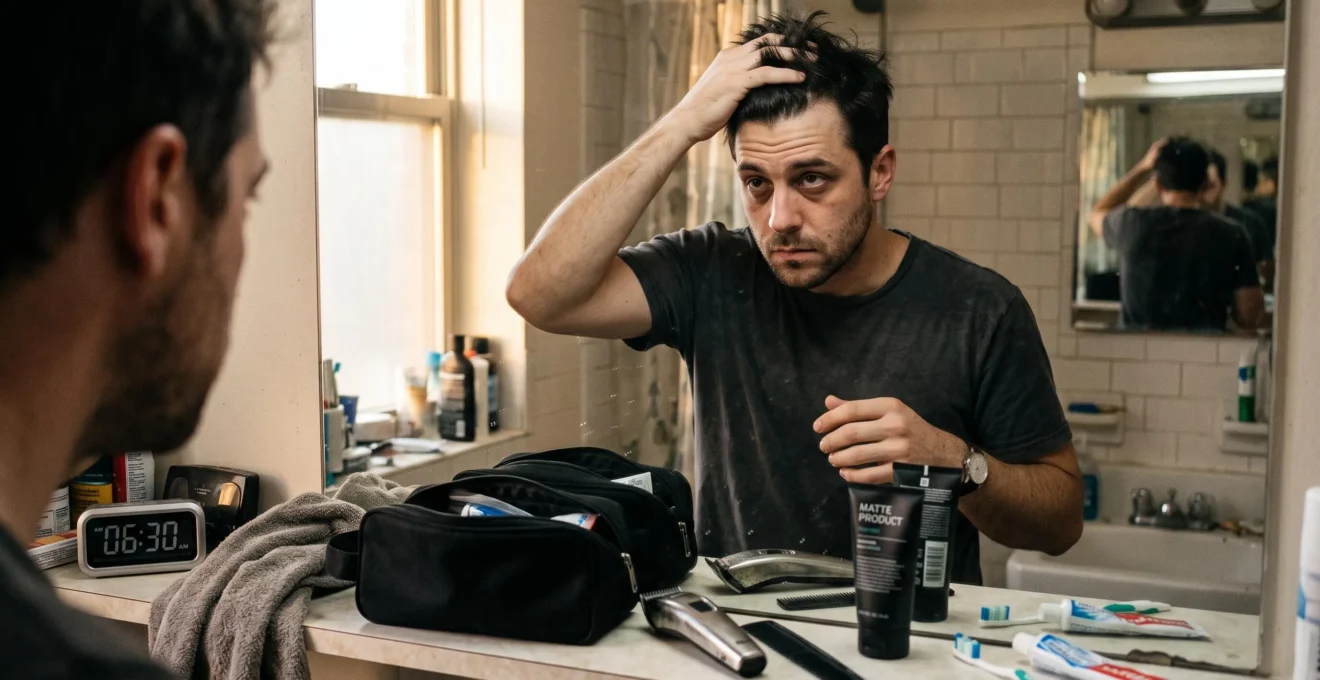
Five hours of sleep can leave you short on energy, patience, and time for personal care. The solution is not to add more products or force yourself through an elaborate morning routine. It is to build a grooming system that keeps the most visible details under control, even when motivation is low.
A reliable system has two layers: a short daily routine that covers hygiene and presentation, and a weekly reset that prevents small maintenance tasks from accumulating. Hair shape, facial hair edges, clean clothes, fresh breath, and appropriate skin care usually deserve attention before optional styling extras. The exact priorities depend on your haircut, beard, skin, work environment, and personal style.
The important distinction is between looking less tired and trying to conceal genuine exhaustion. Grooming can help you look deliberate and put together, but it cannot replace sleep or reliably erase its visible effects. The goal is to maintain a consistent appearance without spending more energy than the morning allows.
The low-effort grooming system
- Keep a six-minute minimum routine for hygiene, skin care, and visible grooming details.
- Prioritize whichever feature is most out of shape: hair, beard, or skin.
- Use a weekly 15-minute reset to prevent maintenance from turning into a time-consuming correction job.
- Why Does Your Look Feel “Off” Even When Your Outfit Is Good?
- How to Finish a Grooming Routine in 6 Minutes Without Skipping the Important Steps?
- Hair, Skin, or Beard: What Should You Fix First for the Biggest Upgrade?
- The Grooming Mistake That Makes You Smell “Too Much” in Close Conversations
- When Should You Do a 15-Minute Weekly Grooming Reset So You Never Look Scruffy?
- How to Style Hair in 8 Minutes Using the Right Product Order?
- How to Maintain a Beard At Home With 2 Guards and 10 Minutes a Week?
- How Do You Style Your Hair So It Still Looks Good After a Windy Commute?
Why Does Your Look Feel “Off” Even When Your Outfit Is Good?
Your look can feel inconsistent because clothing and grooming communicate different things. A well-fitted outfit signals that you made an effort, while overgrown hair, uneven beard edges, or visibly neglected skin can suggest that the details were left to chance. The answer is not necessarily a better wardrobe; it may be a more reliable maintenance routine.
Start with a three-point face-frame check. Look at your hairline and overall hairstyle, the jaw and beard line if you have facial hair, and the skin around your eyes. These areas provide a practical way to identify visible grooming issues without inspecting every detail of your appearance.
Fatigue and skipped maintenance need different responses. Experimental research on facial signs of sleep deprivation found that observers perceived changes in the eyes and skin, among other features, under particular laboratory conditions. The study used photographs of 10 individuals and assessments by 40 observers; it does not establish that everyone who sleeps five hours will look tired in the same way. The experimental study on facial signs of sleep deprivation is useful context, not a diagnostic test.
If your eyes look tired, keep your morning simple: wash your face gently, use your usual moisturizer, and allow enough time to get ready without rushing. If the real problem is a hairstyle that has lost its shape or a beard with uneven edges, correct the maintenance issue instead of adding another skin product.
**Use this rule:** distinguish between a feature that needs care and a feature that simply reflects how you feel. Trying to fix both with more grooming wastes time and can irritate your skin.
Once you know what is actually making your appearance feel inconsistent, you can build a short routine around the tasks that matter rather than trying to do everything every morning.
How to Finish a Grooming Routine in 6 Minutes Without Skipping the Important Steps?
A six-minute grooming routine works when it protects hygiene first, addresses the most visible details second, and removes optional tasks from rushed mornings. The objective is not to complete every possible grooming step in six minutes. It is to preserve a consistent minimum standard when energy and time are limited.
Divide your routine into three categories:
- Daily non-negotiables: clean your face with a gentle cleanser or rinse as appropriate, apply deodorant or antiperspirant, and brush your teeth. Follow your usual dental-care recommendations and personal hygiene needs.
- Visibility-critical tasks: restore your hairstyle, check beard edges if applicable, and remove obvious lint or marks from your clothing.
- Deferrable tasks: detailed beard reshaping, elaborate styling, optional grooming treatments, and other maintenance that can wait for your weekly reset.
Sequence tasks so that one does not unnecessarily delay another. For example, apply moisturizer while your hair is partially drying, then style your hair while the moisturizer settles naturally. Do not impose a rigid waiting period unsupported by your product instructions, and do not rush a necessary skin-care step simply to meet a timer.
A basic skin-care routine does not require a crowded bathroom shelf. The American Academy of Dermatology’s skin-care advice on a budget prioritizes cleansing, moisturizing, and protection from the sun. Its guidance recommends broad-spectrum SPF 30 SPF or higher, with products selected for your skin’s needs.
The exact six-minute allocation is a practical planning target, not a medically validated duration. A workable starting schedule is two minutes for oral care and deodorant, two minutes for face care, and two minutes for hair and a final appearance check. Adjust the sequence to fit your actual routine and the time your products require.
Keep a fuller version for normal mornings, when you can trim facial hair, spend longer on styling, or complete additional skin care. On low-sleep days, use the minimum version without treating it as a failure.
A short routine is valuable because it is repeatable. When the minimum standard is clear, a difficult morning no longer requires an all-or-nothing decision about grooming.
Hair, Skin, or Beard: What Should You Fix First for the Biggest Upgrade?
Fix the feature that is most visibly out of shape, not the feature that offers the most interesting new product to try. Hair and beard edges are useful first checks because their shape can change the overall appearance quickly. Skin care is equally important for long-term comfort and health, but many improvements develop gradually rather than appearing after one morning.
Use this decision grid to allocate limited grooming time:
| Current situation | First priority | Practical action |
|---|---|---|
| Hair has grown beyond its intended shape | Hair | Restore the usual silhouette and identify whether a haircut is due. |
| Beard or stubble edges look uneven | Beard | Clean up the neckline and obvious stray hairs without shortening everything. |
| Hair and beard are maintained, but skin feels dry or irritated | Skin | Review cleansing and moisturizing, and simplify products if needed. |
| All three are maintained | Consistency | Check hygiene, clothing, nails, and whether essential products need replacing. |
This ranking is a practical decision aid, not a universal rule about attractiveness. Hair texture, facial hair density, skin conditions, cultural expectations, and personal style affect what makes the biggest difference. Someone with a shaved head, for example, does not need a hair-styling routine to look polished.
Choose one element to maintain properly before expanding your system. If the haircut has lost its shape, repeatedly changing facial cleansers will not solve that particular problem. If the hair and beard already look deliberate, adding unnecessary trimming can create new work rather than improving the result.
For skin, consistency generally makes more sense than accumulating products. Gentle cleansing, suitable moisturizing, and sun protection are a practical baseline. For hair, use methods suited to its texture and avoid excessive heat. For facial hair, preserve a shape that works with your natural growth rather than drawing artificial lines that require constant correction.
Once that priority is under control, shift from correction to maintenance. The next challenge is keeping your overall grooming consistent without allowing fragrance or hygiene products to become another source of problems.
The Grooming Mistake That Makes You Smell “Too Much” in Close Conversations
The most common practical mistake is treating fragrance as a substitute for hygiene or repeatedly applying it because you can no longer smell it yourself. A scent that seems faint to you may remain noticeable to colleagues or people sitting nearby. The goal is controlled application, clean clothing, and appropriate personal hygiene, not maximum fragrance projection.
Start by separating odor prevention from fragrance. Wash regularly, dry your skin thoroughly, and use a deodorant or antiperspirant that suits your needs. Change and wash clothing regularly, especially items that collect sweat around the collar, underarms, or other contact points. A fragrance cannot reliably solve odor trapped in an unwashed shirt or jacket.
The UK National Health Service‘s guidance on body odour and clothing hygiene recommends regular washing, appropriate use of deodorants or antiperspirants, and changing and washing clothes. This guidance concerns body odor and hygiene; it does not establish a scientifically measured ideal distance for detecting perfume.
For fragrance, begin with the quantity recommended by the manufacturer and avoid automatic reapplication throughout the day. If you stop noticing the scent, that alone does not prove that it has disappeared. Keep your application conservative in offices, public transport, meeting rooms, and other environments where people share close space.
Pay attention to textiles as well as skin. A hat, coat, scarf, or shirt worn repeatedly can retain odors. Cleaning these items when appropriate may do more to improve freshness than adding another layer of fragrance. If body odor changes unexpectedly or persists despite reasonable hygiene, seek medical advice rather than continually masking it.
**A useful practical standard:** your fragrance should not dominate a close conversation. If you are unsure, ask someone you trust for feedback after several hours of normal wear, and review the amount you apply rather than relying solely on your own sense of smell.
When hygiene is dependable, you can spend less time compensating for problems and more time maintaining the details that keep your appearance consistent throughout the week.
When Should You Do a 15-Minute Weekly Grooming Reset So You Never Look Scruffy?
Schedule a 15–minute grooming reset when you can complete it without rushing, ideally after a shower or before a relatively quiet day. The best time is the one that survives your working week, not necessarily Sunday evening or another fixed calendar slot. Its purpose is to handle small maintenance jobs before they become obvious enough to require a longer correction.
Use the reset to check beard edges, stray hairs, nails, product supplies, and the general condition of your grooming tools. If you have a haircut or shaving schedule, review whether the next appointment or maintenance session needs to be arranged. Not every task needs to be completed every week; the aim is to identify what is actually due.
A 60-second scruff audit makes the reset more efficient. Check your hair silhouette, beard or stubble perimeter, nails, and the products you rely on every day. Then consider what is coming up: an important presentation, a client meeting, a social event, or several days of travel may justify prioritizing one task over another.
Growth rates and maintenance needs vary. A person with fast-growing stubble may need more frequent edge work than someone with a short, carefully maintained beard. Nails may require attention on a different schedule from hair. Use visible condition and personal comfort to determine the frequency instead of assuming that every grooming task belongs on a weekly checklist.
Skipping one reset is not a disaster. The risk is allowing several missed sessions to turn routine maintenance into a larger correction job: an overgrown beard may take longer to reshape, products may run out unexpectedly, and a haircut may become more urgent. A short protected appointment with yourself helps prevent that accumulation.
Keep your kit accessible and replace essentials before they run out. A trimmer with a charged battery, a clean comb, nail clippers, and the skin-care products you actually use are more useful than a large collection of neglected tools.
Your 15-minute grooming reset checklist
- Inspect your hair shape and note whether a haircut or simple styling adjustment is due; leave a one-line reminder if needed.
- Check your beard or stubble perimeter and identify the specific edges that need maintenance; record the guard length that normally works for you.
- Inspect your nails and trim or file them if needed; finish with visibly clean hands and nails.
- Review your essential skin-care, hygiene, and styling products; write down any item that needs replacing.
- Check your calendar for the coming week’s important commitments and select one grooming priority to complete before the most demanding day.
With weekly maintenance under control, daily grooming becomes easier because the basic shape is already there. That foundation makes a quick hair-styling routine much more reliable, even when the morning starts badly.
How to Style Hair in 8 Minutes Using the Right Product Order?
An eight-minute hair routine is most effective when it starts with the right preparation, uses a small amount of suitable product, and follows the natural shape of your hair. Product order depends on the formulas involved, so there is no universal sequence that works for every head of hair. The practical objective is to avoid buildup, unnecessary manipulation, and styling that collapses as soon as you leave home.
Begin by towel-drying your hair gently. For many hair types, hair is more vulnerable to breakage when wet, so avoid aggressive rubbing and unnecessary pulling. The American Academy of Dermatology advice on styling hair without damage recommends allowing hair to partially air-dry before styling or combing, while also cautioning against excessive heat and some long-lasting-hold styling practices.
For products designed to layer, a sensible starting approach is to apply a compatible lightweight preparer before a heavier cream or clay. A finishing product is optional, not mandatory. Follow the instructions for each formula: some products are intended for damp hair, others for dry hair, and not every combination works well together.
Use this eight-minute framework as a flexible target:
- Minute 1: remove excess water gently and check your natural parting, texture, and growth direction.
- Minutes 2–3: allow partial air-drying or use a suitable dryer setting, keeping heat exposure controlled.
- Minutes 4–5: distribute a small amount of your main styling product evenly, adjusting the quantity to your hair length and density.
- Minutes 6–7: shape the hair with your fingers or a suitable comb. Add another product only if the result genuinely needs it.
- Minute 8: check the silhouette from the front and sides, remove visible residue from your hands, and stop.
Start with a small quantity and add more only when necessary. A pea-sized amount can be a useful trial for some creams, but it is not a universal dose for every product or hairstyle. If hair becomes greasy, stiff, or difficult to restyle, reduce the amount or simplify the combination before buying something new.
On low-sleep mornings, aim for a shape that works with your natural texture instead of trying to manufacture perfect volume. A simpler style may require less product and less correction during the day. If heat styling is necessary, use a suitable technique for your hair type and avoid excessive temperature or repeated passes.
Hair that is easy to shape in the bathroom is only half the job. A reliable style should also survive ordinary movement and weather, which means choosing a finish you can restore instead of trying to make it immovable.
How to Maintain a Beard At Home With 2 Guards and 10 Minutes a Week?
A two-guard beard system can simplify home maintenance by separating overall length from shorter perimeter work. One guard maintains the bulk of the beard; the second handles areas that need a closer finish. The right lengths depend on your beard density, face shape, and preferred style, so the method is a starting framework rather than a universal trimming specification.
Begin with a clean, dry beard unless your trimmer’s instructions specify otherwise. Select the longer guard first and work methodically with the direction of growth in mind. Check the result in good lighting before switching to a shorter setting. Removing too much length cannot be reversed during the same session, so conservative trimming is usually the safer choice.
For the neckline, use your natural beard growth and facial anatomy as a guide. A point roughly two fingers above the Adam’s apple can serve as a starting reference for some beard styles, but it is not a fixed anatomical rule. Check the line from the front and both sides before removing hair, and avoid cutting so high that the beard appears disconnected from the jaw.
For the cheek line, follow the natural boundary of your growth rather than drawing an unnecessarily hard line across sparse areas. Remove obvious stray hairs, then reassess the shape before making further changes. The objective is a clean outline that looks intentional, not a perfectly symmetrical design that requires constant upkeep.
Use a 10-minute weekly session for the perimeter, overall length, and a final symmetry check. If only two minutes are available on a difficult morning, focus on visible neck scruff and obvious stray hairs rather than attempting a full reshaping. Leave more substantial trimming for a day when you can concentrate.
Choose a guard combination you can repeat and record the lengths that work for you. This removes guesswork from future sessions. Clean the trimmer according to its instructions, maintain the blades as recommended, and do not use damaged or unsuitable equipment against irritated skin.
A maintained beard reduces the amount of daily correction needed. The same principle applies to hair: styles that recover easily from movement and compression are more useful than elaborate finishes that need to be rebuilt after every commute.
Key takeaways
- Choose a hairstyle that remains acceptable when wind or a hood changes its shape.
- Keep a small, practical reset kit and restore the silhouette rather than adding layers of product.
- When a helmet or hood compresses your hair, adapt the timing or style instead of fighting the same problem every morning.
How Do You Style Your Hair So It Still Looks Good After a Windy Commute?
Style your hair for recovery, not for perfect hold. Wind can flatten volume, separate strands, and disturb a carefully arranged shape, especially when the style depends on product alone. A practical commute hairstyle should still look acceptable after movement and should be easy to restore with your fingers or a small comb in under a minute.
Start with the way your hair naturally behaves. If it falls forward, choose a style that can be redirected without a complete restyle. If it has natural texture, work with that texture rather than forcing every strand into a precise position. A matte finish and moderate hold may suit some styles, but the best product depends on hair type, length, weather, and the shape you are trying to maintain.
The aim is not to eliminate movement. It is to choose a style whose appearance degrades gracefully. An overly rigid finish can become difficult to correct once wind separates the hair, while a simpler shape may need only a few finger movements. Test your hairstyle on an ordinary commute before relying on it for an important meeting.
Keep a compact comb or brush that suits your hair and, if needed, a travel-size version of your usual styling product. Before entering the office or meeting someone, take a moment in a restroom or another appropriate place to check the front, sides, and overall silhouette. Avoid adding product automatically: first determine whether the problem is misplaced hair, excess volume, or compression.
Use a 30-second recovery sequence:
- Identify the direction in which the hair has shifted.
- Use your fingers or a comb to restore the main shape.
- Reintroduce texture or volume gently instead of flattening every strand.
- Add a small amount of product only if the hair genuinely needs extra hold.
Helmets and hoods require a different strategy because they compress hair mechanically. If you cycle or walk in conditions that force you to cover your head, prioritize appropriate head protection and accept that the style may need attention afterward. For short hair, styling after arrival may be easier; for longer hair, a texture-friendly or deliberately secured style may be more practical. Do not compromise necessary helmet fit or safety to preserve a hairstyle.
Product choice also matters, but more hold is not automatically better. Excess product can weigh hair down, make restyling harder, or leave residue. Begin with the smallest amount that works for your hair and avoid repeated heavy applications throughout the day.
The broader principle is simple: personal grooming should support your real schedule, not create another demanding task. Establish a minimum routine, maintain the details that matter, and choose products and styles that tolerate ordinary disruptions. On mornings after too little sleep, keep the routine manageable and prioritize rest whenever possible rather than expecting grooming to compensate for chronic sleep loss.
Can a grooming routine make you look less tired after five hours of sleep?
A consistent routine can improve the appearance of maintained hair, facial hair, skin, and overall hygiene, but it cannot replace sleep. Facial signs associated with sleep deprivation have been observed in experimental research, although individual responses vary and the findings do not mean that every person sleeping five hours will look visibly exhausted. Keep grooming simple and prioritize adequate sleep whenever possible.
What is the minimum grooming routine for a busy professional?
Start with oral hygiene, appropriate face cleansing, deodorant or antiperspirant, and a quick check of your hair, facial hair, and clothing. Add moisturizer and suitable sun protection according to your skin-care needs. The exact sequence and duration depend on your habits, products, and appearance; six minutes is a practical target, not a universal requirement.
How often should you trim your beard at home?
Use visible growth and your preferred beard shape to determine the frequency. A weekly check can help identify stray hairs, uneven edges, or excess length, but not every beard needs a full trim every week. A two-guard approach can simplify maintenance, provided you start with the longer guard, check the result carefully, and avoid removing too much length.
Should you apply hair product to wet or dry hair?
It depends on the product and the hairstyle. Some formulas are designed for damp hair, while others work best on dry hair. For many hair types, gentle handling and partial air-drying before styling can help limit damage. Follow the product instructions, avoid excessive heat, and use a small amount before deciding whether more is needed.
How can you prevent fragrance from becoming overwhelming at work?
Begin with the manufacturer’s recommended amount, avoid reapplying simply because you can no longer smell the fragrance, and consider the close-contact nature of your workplace. Maintain clean skin and clothing, and use deodorant or antiperspirant where appropriate. Fragrance should complement hygiene rather than conceal persistent body odor.