
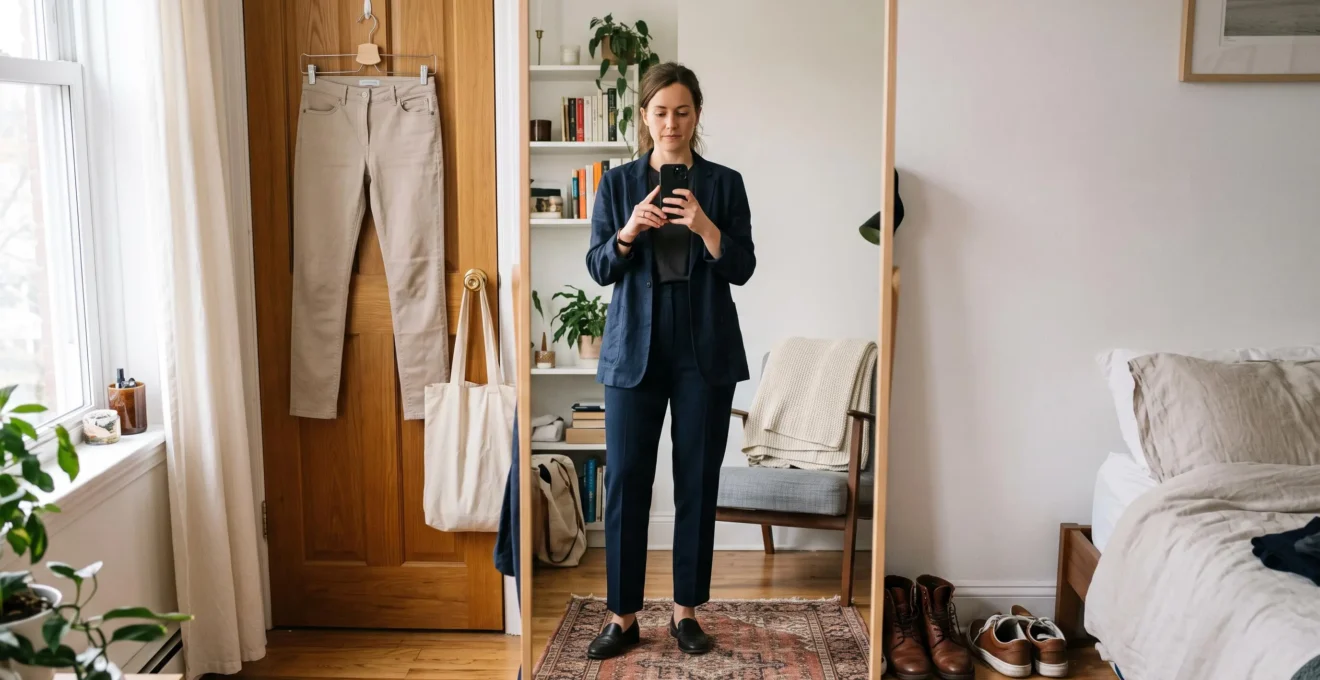
The difference between an outfit that looks right and one that feels slightly off often comes down to silhouette rather than colour, price or individual pieces. A trouser leg may be too wide for a particular jacket, a hem may interrupt the line created by the shoes, or several oversized garments may compete for visual attention. None of these problems necessarily means the clothes are unsuitable for your body.
A useful starting point is to assess the outline of the complete outfit, from shoulders to shoes, before judging its details. The goal is not to fit a prescribed body type or disguise particular features. It is to understand how garment shape, volume, length and footwear interact, then choose combinations that reflect your preferences and the occasion.
A consistent silhouette makes shopping more deliberate, too. Once you recognise which lines work for your everyday outfits, you can identify compatible basics, avoid purchases that never quite come together and build a wardrobe with fewer unnecessary pieces. The following methods turn that visual judgement into a practical process, without treating any single proportion as universally ideal.
The silhouette-first approach
- Judge the complete outline of your outfit before focusing on colour, fabric details or price.
- Use consistent full-length photos and a side view to assess proportions, volume and how shoes connect to hems.
- Choose one clear visual anchor, balance fitted and relaxed elements according to context, and test combinations in motion.
- Why Does the Right Silhouette Make Even Cheap Clothes Look Better?
- How to Find Your Best Silhouette Using 3 Full-Length Photos at Home?
- Slim or Relaxed: Which Silhouette Looks Better for Smart Casual at 6 pm?
- The Silhouette Mistake That Can Make You Shorter in Photos
- When Should You Choose the Silhouette Anchor: Trousers, Jacket, or Dress?
- The ‘Wrong Basic’ Mistake That Makes Each Outfit Look Slightly Off
- One Signature Silhouette or Two: Which Makes Items More Interchangeable?
- How Do You Know If an Item Is Truly Interchangeable in Your Wardrobe?
Why Does the Right Silhouette Make Even Cheap Clothes Look Better?
The right silhouette can make an inexpensive outfit look more polished because the overall outline is often easier to read than individual fabric details from a distance. When proportions, garment lengths and volumes work together, the outfit appears deliberate. When they conflict, even expensive materials and attractive buttons may not resolve the visual imbalance. This is a principle of design, not a guarantee that a particular price point will look more luxurious.
The essential distinction is between **line** and detail. Line describes the outer contour created by clothing: the slope of a shoulder, the width of a trouser leg, the position of a hem or the continuity of a dress. Detail includes buttons, prints, stitching, surface finishes and other smaller features. Both matter, but they do different jobs. Details add interest; the line establishes the overall shape.
The academic chapter Chapter 9 of Communicating Fashion: Trend Research and Forecasting explains silhouette as the outline formed by the edges of shapes and emphasises the importance of considering the complete appearance, including clothing, shoes and accessories. That whole-outfit perspective is more useful than judging each item in isolation.
Consider a simple outfit of straight-leg trousers, a plain top and clean shoes. If the trouser length meets the footwear naturally and the top finishes at a deliberate point, the combination may look cohesive without expensive embellishment. Conversely, a premium jacket with a shoulder line that conflicts with the rest of the outfit can create a less convincing result.
There is also a practical consequence for shopping. When an outfit feels wrong, it is easy to conclude that your body is the problem or that you need better-quality clothes. Sometimes the actual issue is a mismatch between garment shapes. Recognising that distinction helps you evaluate the clothing rather than treating your proportions as something that must be corrected.
A quick test is to step back approximately three metres, or take a full-length photo from a consistent position. Look first at the outline, not the individual pieces. Can you understand the outfit’s shape immediately? Does the visual emphasis feel intentional? These are useful observations, although aesthetic harmony remains subjective rather than a universal rule.
The key principle is straightforward: a coherent silhouette can help modestly priced clothes look considered, but it cannot guarantee fabric quality, good construction or a perfect fit. The next step is learning to identify which lines work for you in everyday clothing.
How to Find Your Best Silhouette Using 3 Full-Length Photos at Home?
Three full-length photos can help you compare silhouettes more consistently: one front view in fitted basics, one side view in the same outfit, and one view in an outfit you wear regularly. Together, they show how clothing distributes volume, where visual lines fall and how your usual styling choices work in practice. This is a practical self-assessment method, not a scientifically validated body-typing test or a way to discover one objectively perfect silhouette.
Start by setting up your phone so that your entire body and footwear remain visible. Use the same camera position and distance for comparable photos, with the phone securely supported. Wear fitted basics that allow the garment outline to remain visible, rather than compressing or reshaping your body. Stand naturally, with your arms relaxed and your weight distributed comfortably.
Read the photos for relationships rather than labels. In the front view, observe the shoulder line, where the waist appears in the garment and how the clothing falls over the hips. In the side view, notice the distribution of volume around the bust, abdomen, seat and legs. In the everyday outfit, assess the combined effect of your preferred layers, hems and shoes.
A mirror can encourage small adjustments that change the result: pulling down a top, shifting your hips or straightening your shoulders. A photograph preserves one particular moment and makes it easier to compare outfits later. Neither method reveals an absolute truth about your appearance, but a neutral photo can provide a useful baseline.
The side view deserves special attention. An outfit that looks balanced from the front may feel different when a jacket projects away from the torso or a long top changes the relationship between upper and lower volumes. Ignoring this view can lead to buying clothes based on only part of the silhouette.
Use these five actions to turn your observations into a repeatable wardrobe reference.
Your five-step silhouette assessment
- Take a front-facing photo in fitted basics and save it as your front-view reference.
- Take a side-facing photo in the same clothes and save it as your volume reference.
- Photograph your most-worn complete outfit, including the shoes, as your real-life reference.
- Mark the apparent shoulder line, waist position, hip break and first point that attracts your eye on each image.
- Write down two or three garment combinations that appear balanced, along with the hems and shoe styles that support them.
These observations help identify preferences, not body categories. Clothing design principles such as proportion, visual balance and emphasis provide a useful framework, as explained in Utah State University‘s clothing and textile design principles. The source also recognises that judgements of harmony depend on the observer’s subjective opinion.
Your best silhouette is the combination you feel comfortable wearing and prefer seeing on yourself across real situations. With that baseline established, the next decision is how to balance fitted and relaxed pieces for a specific occasion.
Slim or Relaxed: Which Silhouette Looks Better for Smart Casual at 6 pm?
For smart casual at 6 pm, neither a slim nor a relaxed silhouette is automatically better. The more useful choice depends on the outfit’s volume balance, the formality of the setting, how long you will wear it and whether it remains comfortable when sitting and moving. A fitted piece paired with a relaxed one is a practical starting point, not a universal fashion rule; all-slim or all-relaxed outfits can also work when their lines are deliberate.
A slim element can establish definition, while a relaxed element creates space and movement. Straight or slim trousers with a softly structured jacket, for example, may offer a clear lower-body line without making the entire outfit close-fitting. Alternatively, relaxed trousers with a more defined top can distribute volume differently while preserving an identifiable outline.
The decision becomes more complicated after a workday. An outfit worn from the office into dinner needs to remain presentable when seated, walking and standing under different lighting. Relaxed fabrics may fold or gather around the waist and knees, while slimmer cuts can pull or crease where movement creates tension. These effects depend on the actual garment, fabric and fit.
| Decision factor | Slimmer silhouette | More relaxed silhouette |
|—|—|—|
| Existing proportions | Can define the garment outline where you want greater clarity | Can create space where you prefer less definition |
| Smart-casual formality | Works when the fit and finish suit the occasion | Works when volume and fabric still look intentional |
| Extended wear | Check for pulling and restricted movement | Check for excess fabric and changes in drape |
| Footwear | Examine whether the hem meets the shoe cleanly | Check that the trouser width and shoe volume feel compatible |
| All-over styling | Several fitted pieces may create a continuous, close outline | Several loose pieces need a clear shoulder, waist or hem reference |
A fully relaxed outfit is easier to read when at least one point is defined: perhaps a shoulder seam, a visible waistline or a clean hem. Without any clear reference point, multiple loose layers may compete or blur into one large volume. That effect is a styling possibility, not an inherent flaw in relaxed clothing.
The photo test is useful, but the movement test is essential. Sit down in the outfit, stand up and walk a few steps. Check whether the top rides up, the waistband shifts, the jacket bunches or the trouser hem catches on the shoes. These practical observations matter more than how the outfit looks in a perfectly still pose.
For a reliable smart-casual outfit, start with one defined line, then adjust the surrounding volume until the whole combination feels intentional in motion as well as in a photo. If photographs still make the outfit appear unexpectedly short, camera perspective is another variable worth checking.
The Silhouette Mistake That Can Make You Shorter in Photos
A silhouette can appear shorter in a photograph when several strong horizontal lines interrupt its vertical flow, particularly around the lower leg or hip. A mid-calf hem, a contrasting belt and a cropped outer layer can each create a separate visual division. These combinations do not make everyone look shorter, however, and the camera’s position, distance and perspective can influence how the same outfit appears in an image.
The first step is to identify where the eye stops. A high-contrast belt can draw attention to the waist; a cropped jacket can establish another line across the hips; a mid-calf hem can create a further division above the shoes. When several such points compete, the outfit may appear segmented rather than continuous.
That effect is not inherently undesirable. Strong horizontal divisions can be part of a deliberate outfit, and a short hem or cropped jacket may be exactly what you prefer. The question is whether the divisions support the look you want or distract from the overall line.
If you want a more continuous appearance, try a few adjustments:
– Match the tone of trousers and shoes when you want the lower-body line to feel less interrupted.
– Experiment with where a jacket or top ends, rather than assuming that one fixed length suits everyone.
– Reduce unnecessary colour contrast between adjacent garments if it draws attention to a division you would rather soften.
– Try a long, relatively uninterrupted colour column as an alternative to several strongly contrasting layers.
Photography can amplify or reduce these effects. Research on The perceptual basis of common photographic practice examines how focal length, camera distance and viewing conditions influence perceived perspective. It does not test clothing combinations directly, but it supports an important caution: differences in photographs cannot always be attributed to the garment.
For a fair comparison, use the same camera position, distance and framing when photographing different outfits. A chest-height camera position can be a useful starting experiment, but it is not a universally correct setting for every phone or body. Compare the results rather than assuming that a particular camera height will always produce the most accurate proportions.
The most effective correction may be a different hem, a less contrasting layer or simply a more consistent photo setup. Once the overall line is clear, choosing which garment should lead that line makes the remaining styling decisions easier.
When Should You Choose the Silhouette Anchor: Trousers, Jacket, or Dress?
Choose the silhouette anchor by identifying the garment that most clearly determines the shape of the complete outfit. Trousers can anchor a look when the leg line and shoe connection matter most; a jacket can establish the shoulder and upper-body structure; a dress can provide one continuous line from top to hem. The best choice depends on the garment you want to emphasise, the occasion and how the other pieces support it.
An anchor is a practical styling concept: one principal garment establishes the outfit’s visual direction, while the remaining pieces reinforce rather than compete with it. It is an application of design ideas such as visual emphasis and coordination, not a formally validated rule that every outfit must follow.
Start by identifying your preferred visual reference. If a jacket gives the outfit its structure, let its shoulder line and length guide the choice of trousers and top. If trousers are the main feature, consider how their rise, width and hem relate to the footwear. If a dress already creates the line you want, shoes and accessories can support it without introducing unnecessary divisions.
Shoes are particularly important because the anchor needs to connect to them. Trousers create a visible junction at the hem, so the length and shoe shape need to work together. A dress can maintain a more continuous line, although the shoe still influences the overall impression. A jacket establishes structure higher on the body, so its relationship to the shoes is more indirect and must be considered through the intervening garments.
Two garments may compete when both introduce strong volume, contrasting proportions or prominent structural lines. That does not mean they cannot be worn together. It means the combination may need another organising element, such as a clearer hem, a quieter colour relationship or a more defined waist.
A required blazer, uniform piece or dress-code garment may not be your preferred anchor. You can still work with it by reducing competing visual emphasis elsewhere. For example, choose a simpler top or trousers with a line that supports the jacket, rather than adding another strongly structured piece that creates a second focal point.
Fashion history offers a useful reminder that silhouette preferences are not fixed. The Museum at FIT‘s exhibition The Body: Fashion and Physique documents how garment construction and cultural ideals have shaped the proportions considered fashionable across different periods. A successful anchor should therefore reflect your own preferences and context rather than an assumed universal ideal.
Once the anchor is clear, wardrobe decisions become more consistent: the same trouser shape can guide several tops, or one jacket can work with a small group of compatible bottoms. The next step is checking whether the basics intended to support these combinations are actually doing their job.
The ‘Wrong Basic’ Mistake That Makes Each Outfit Look Slightly Off
A wrong basic is not necessarily a badly made garment. It is a staple bought because it seems neutral or versatile, but whose shape repeatedly conflicts with the rest of your wardrobe. A generic T-shirt may finish at an awkward point under your preferred jacket, a shirt may have a shoulder line that clashes with your layers, or trousers may introduce a volume that never works with your usual shoes. The result is a series of outfits that look almost right but rarely feel complete.
Basics have an outsized influence because they appear in many combinations. A statement piece may be worn occasionally, but a frequently used T-shirt, shirt or pair of trousers can determine the shape of dozens of outfits. If its line is incompatible with the rest of your clothes, adding more accessories or trend-led pieces may not resolve the underlying mismatch.
Look for a conflict at a transition point. The hem of a top may sit just above the place where your preferred trousers create their strongest line. A shoulder seam may introduce excess width beneath a structured jacket. A waistband may meet a tucked-in top in a way that changes the balance of the outfit. Each issue can seem minor in isolation, yet repeated pairings make the pattern easier to recognise.
The most useful audit begins with your three most-worn basics. Compare each with the silhouettes identified in your photos and ask whether it supports at least two combinations you genuinely like. This is a practical decision rule, not an established scientific threshold.
A basic that works with two or more preferred silhouettes is worth keeping in active rotation. One that consistently disrupts the line may be worth replacing, tailoring or styling differently. Test the alternatives before shopping: changing the way a garment is tucked, layering it under a different jacket or pairing it with another trouser hem may be enough to make it useful.
When a replacement is needed, choose it according to your anchor strategy. If your wardrobe relies on relaxed jackets and straight-leg trousers, look for basics whose lengths and volumes support those pieces. If your preferred line is more fitted, prioritise compatible cuts rather than buying a neutral item simply because its colour appears easy to match.
Replacing one incompatible staple can improve several existing combinations without requiring an entirely new wardrobe. The next decision is whether those combinations share one signature silhouette or belong to two distinct groups.
One Signature Silhouette or Two: Which Makes Items More Interchangeable?
One signature silhouette usually makes a wardrobe easier to mix and match because more garments follow the same logic of shape, length and volume. Two signatures can provide greater variety, but they work best when each group forms a coherent set of outfits. The practical question is whether items from both groups can be combined successfully or whether each silhouette depends on its own particular proportions and footwear.
A signature is more than a preferred trouser cut or a favourite jacket. It describes the recurring relationship between upper-body volume, lower-body volume, garment lengths and shoes. For example, one signature might combine relaxed upper layers, straighter trousers and understated footwear. Another might rely on more defined tops, wider trousers and shoes with a different visual weight. These are illustrative combinations, not rules tied to a particular body shape.
A single signature has an obvious advantage: fewer compatibility decisions. When most items share a similar line, it becomes easier to replace a worn-out staple or combine familiar pieces in new ways. The trade-off is visual uniformity. If every outfit has the same outline, variety must come from fabric texture, colour, accessories or subtle changes in proportion.
Two signatures allow more variation, but they can also create two separate mini-wardrobes. This is not necessarily a problem. Someone who wears relaxed everyday clothes and more structured work outfits may benefit from distinct groups. The important point is to understand the boundaries between them before buying additional items.
Use a simple sorting test. Place your clothes into two groups according to the silhouettes you wear most often. Try combining items across groups, including the shoes you would normally wear with them. If many cross-group pairings work naturally, the wardrobe may effectively have one signature with several variations. If most cross-pairings fail because of volume, hem length or shoe compatibility, the two groups may function better as separate outfit systems.
Footwear belongs in this definition. A trouser shape that works beautifully with slim shoes may create a different effect with bulky trainers or substantial boots. Defining a signature as **silhouette plus shoe category** makes the system more useful than classifying garments by shape alone.
A second silhouette is worthwhile when it serves a real need for variety or a different context, not simply because the wardrobe feels incomplete. Once the groups are clear, each potential purchase can be evaluated against the outfits it will actually support.
Key takeaways
- Define interchangeability through complete outfits, not through neutral colour or a garment’s supposed versatility.
- Check whether the item’s shape supports an existing silhouette and anchor without requiring additional purchases.
- Judge practical value by whether the item gets worn comfortably in real situations, not merely whether it passes a visual test.
How Do You Know If an Item Is Truly Interchangeable in Your Wardrobe?
An item is genuinely interchangeable when it works in at least three existing outfits without requiring additional purchases or changes to your usual routine. This is a practical wardrobe rule rather than a scientifically validated threshold. Its purpose is to replace the vague promise that something “goes with everything” with a test based on complete, wearable combinations.
Colour compatibility alone is not enough. A beige top might match many trousers and skirts, yet its length or volume may conflict with the jackets you wear most often. Similarly, a pair of trousers may work with several colours but require a specific shoe shape or top length to look balanced. Silhouette compatibility is therefore the first check, followed by the relationship to the anchor garment and existing footwear.
Use three checks before deciding to keep an item.
First, the **silhouette check**: does its shape fit your signature, or one of the two groups you have deliberately established? Consider shoulder width, garment length, volume and the relationship between upper and lower pieces.
Second, the **anchor check**: does the item support the outfit’s main garment, or does it introduce a competing line? A top that repeatedly disrupts the jacket you rely on may be less useful than one with a simpler, more compatible outline.
Third, the **shoe check**: can the item connect naturally to footwear you already own? For trousers, pay attention to the hem and shoe shape. For dresses and skirts, examine the combined line created by the hem, legwear if applicable, and footwear.
Then assemble three complete outfits using only clothes you already have. Photograph them or record the combinations in a wardrobe note. If the item needs a new jacket, a special pair of shoes or repeated adjustments to feel wearable, it has not yet demonstrated the versatility you expected.
There is one more important test: actual use. An item may pass all three visual checks but remain unworn because the fabric feels uncomfortable, the fit restricts movement or you do not feel like yourself in it. Track whether you reach for the item during a reasonable period of normal wear. If it remains unused, reconsider the styling, assess the comfort and fit, or consider returning it if that option is still available.
This process helps separate theoretical versatility from practical value. The most useful garment is not necessarily the one that matches the largest number of colours. It is the one that integrates naturally into outfits you genuinely want to wear.
Start with one garment you are unsure about and build three complete outfits around it. If each combination feels comfortable, supports a clear silhouette and works with shoes you already own, you have a stronger basis for keeping it than a general claim of versatility. Over time, this approach makes shopping more selective and everyday dressing more consistent.
Should your shoes match your trousers?
No. Matching the tones of shoes and trousers is one way to create a more continuous visual line, but contrast can also be deliberate and effective. The best choice depends on the trouser hem, shoe shape, overall volume and the look you want to create. Evaluate the complete outfit rather than treating matching colours as a requirement.
Can oversized clothes flatter different body proportions?
Yes. Oversized garments can create a deliberate silhouette when their volume, length and structure work together. Try defining one reference point, such as the shoulder line, waist or hem, if several loose pieces seem to compete. Comfort and personal preference matter as much as the visual effect.
How can you tell whether a garment needs tailoring?
Compare the garment’s intended line with how it sits on your body and interacts with the rest of your outfit. If a hem repeatedly disrupts the trouser-to-shoe connection, or a shoulder or waist line consistently conflicts with your preferred combinations, tailoring may help. First check whether a different styling approach solves the issue, and consider the garment’s construction before deciding whether alterations are worthwhile.
Do full-length outfit photos always show an accurate silhouette?
No. Camera distance, focal length, position and viewing conditions can change how proportions appear. Use comparable photographs to identify differences between outfits, but avoid treating one image as a definitive assessment of your body. Combine the photo test with a mirror check, natural movement and an assessment of comfort.
How many signature silhouettes should a wardrobe have?
One is a useful starting point if your priority is easy mixing and matching. Two can be practical when you regularly dress for distinct settings or prefer genuinely different shapes. Test whether garments from each group work across both groups, including with your existing shoes. The number matters less than whether the resulting outfits are comfortable, coherent and regularly worn.